Rosehip Oil vs Almond Oil: Which Bottle Fits You?
Rosehip oil and almond oil often turn up in the same "best face oils" lists, which makes them sound like rivals. They are better understood as two different kinds of bottle: one pressed from the seeds of a wild rose, rich in polyunsaturated fats, and one pressed from sweet almond kernels, rich in oleic acid. Knowing that difference helps you buy, store and use each one well.
Two fatty-acid profiles
A review of plant oils applied to skin gives rosehip seed oil's most abundant fatty acid as linoleic acid, at about 36% to 55%, followed by alpha-linolenic acid at roughly 17% to 27% and oleic acid at roughly 15% to 22%. Sweet almond oil flips the picture. In a study of eight California almond cultivars, oleic acid ran from about 58% to 74% and linoleic acid from about 19% to 35%. Those are general figures for each plant. They are not a profile of our oil, which is cold-pressed, unrefined and sold neat.
Put simply, rosehip leans on linoleic and linolenic acids, which have two or three double bonds each, while almond leans on oleic acid, which has one. That matters because double bonds are where oxygen attacks. A review of vegetable oil oxidation tabulates relative oxidation rates at 100 degrees C of 10 for oleic acid, 100 for linoleic acid and 150 for linolenic acid.
The practical consequence: freshness
Reasoning from those figures, a rosehip oil is the more fragile of the two, and almond oil is the more forgiving. You do not have to be an expert to act on that:
- Buy a small bottle of rosehip oil, and write the opening date on it.
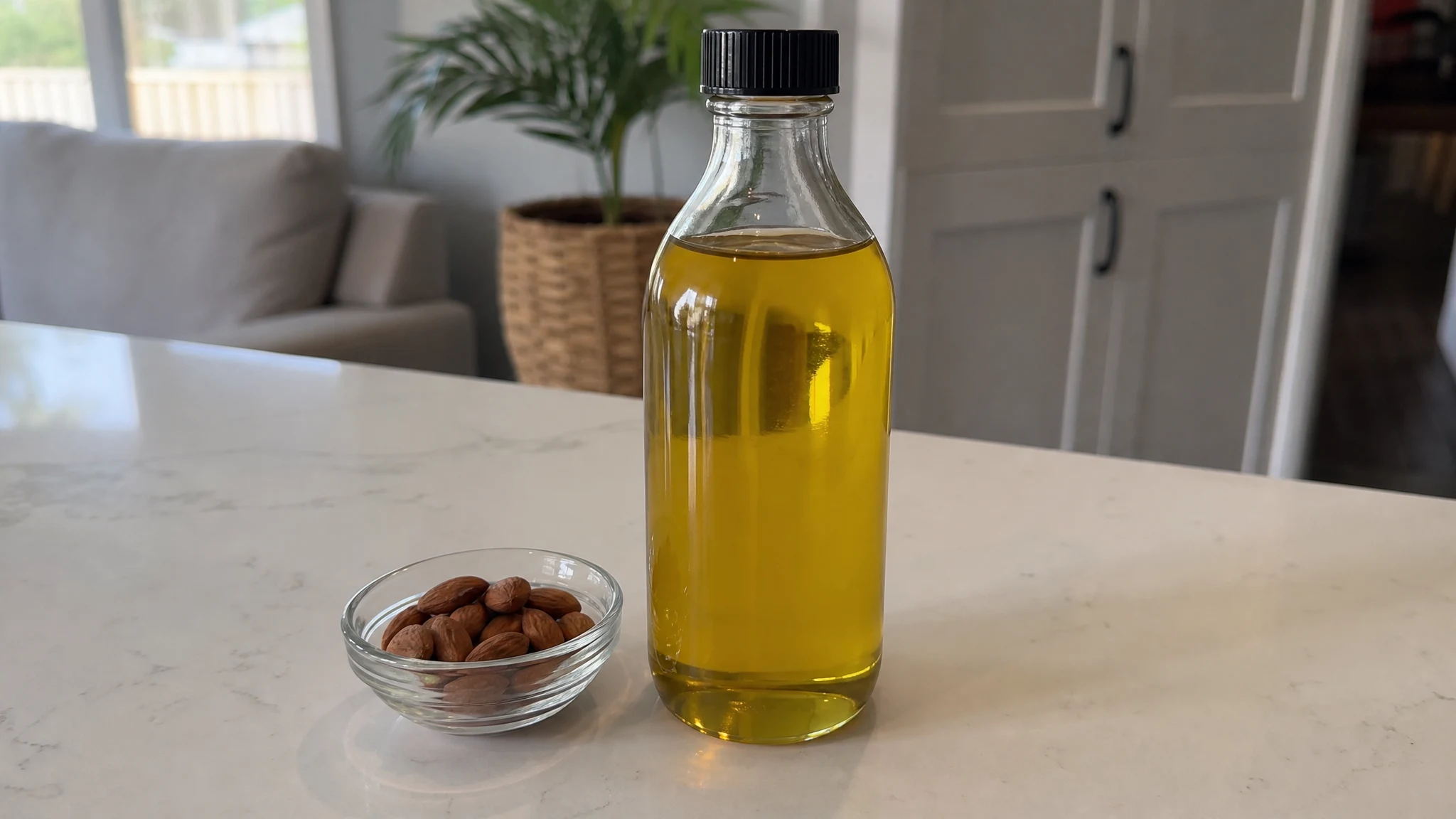
- Keep both oils cool, dark and tightly closed. For ours, we count on about a year from pressing under those conditions, and the bottle carries a pressing date, a bottling date and a lot number in amber glass.
- Smell before you use. An oil that smells different from the first day should come off your skin and out of your routine.
Our storage guide covers the routines in more detail.
Opening both bottles
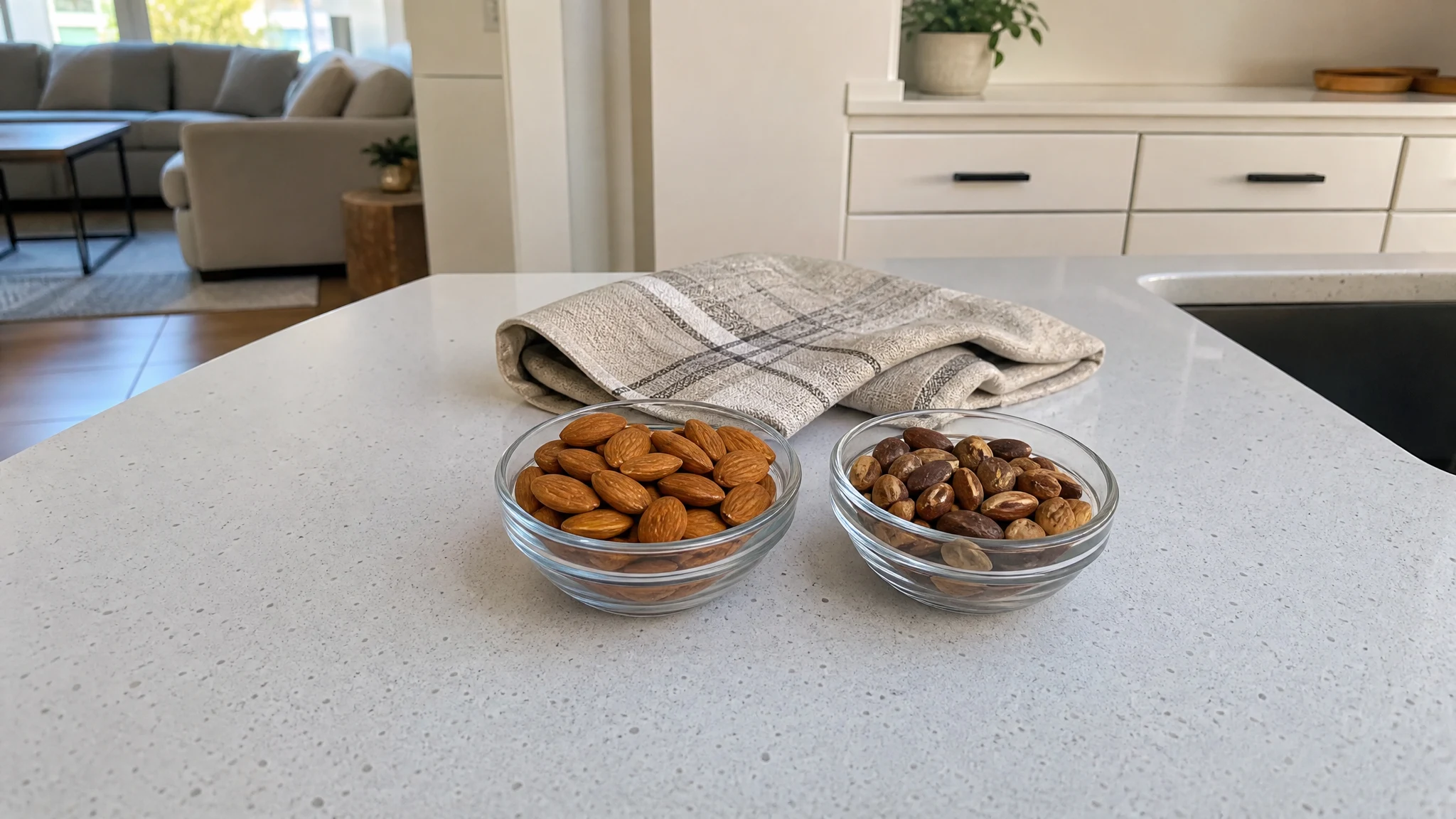
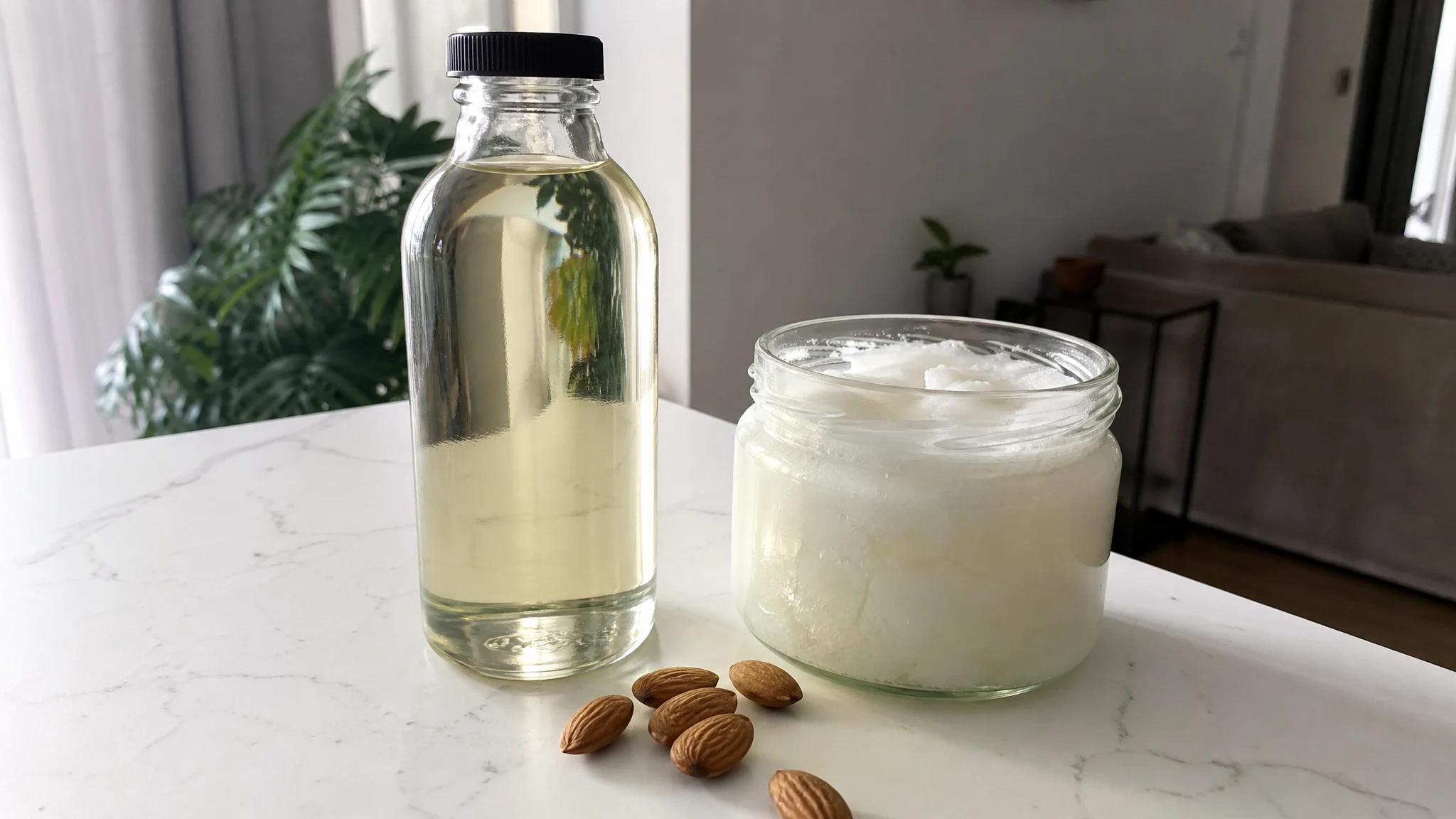
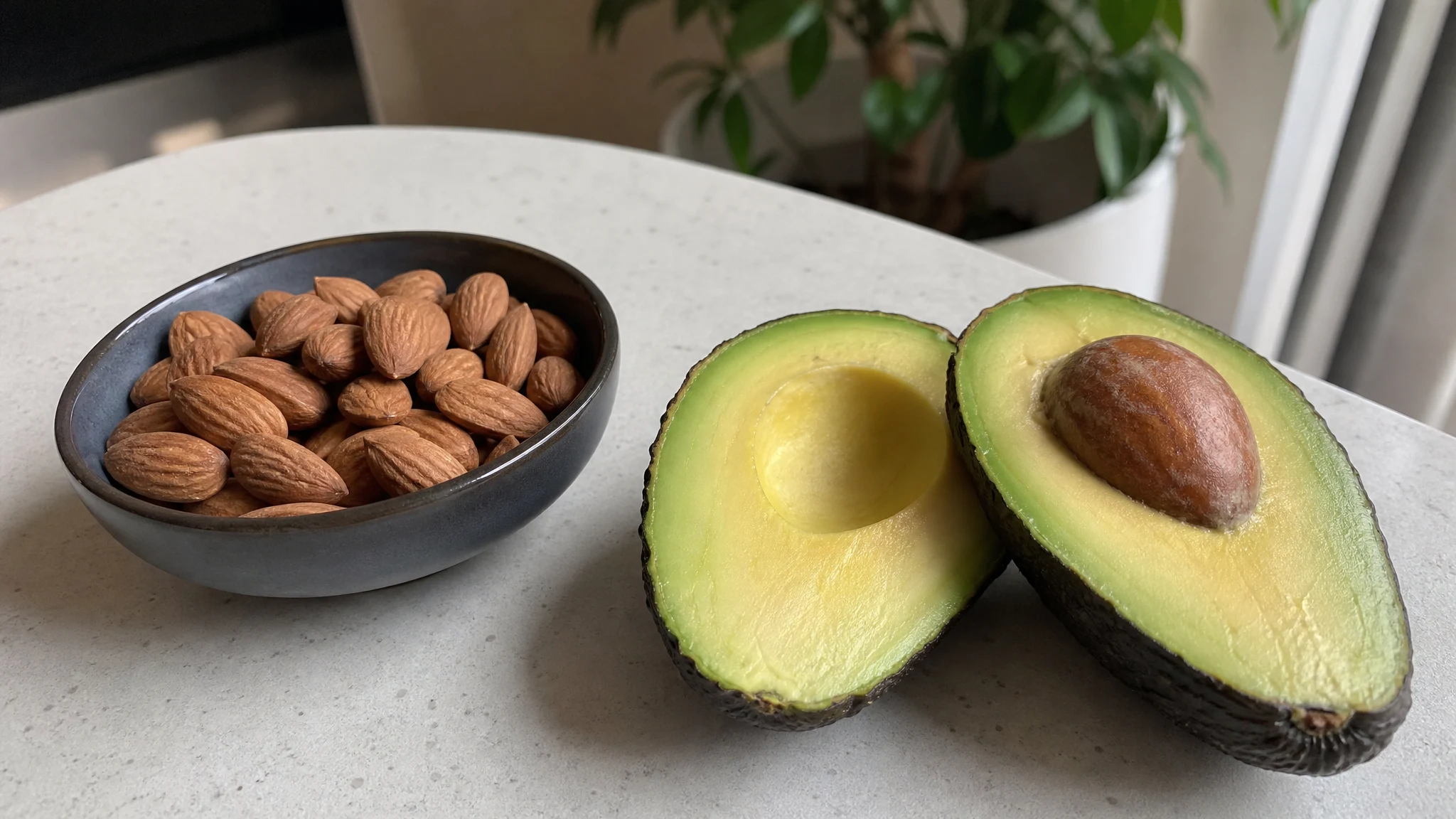
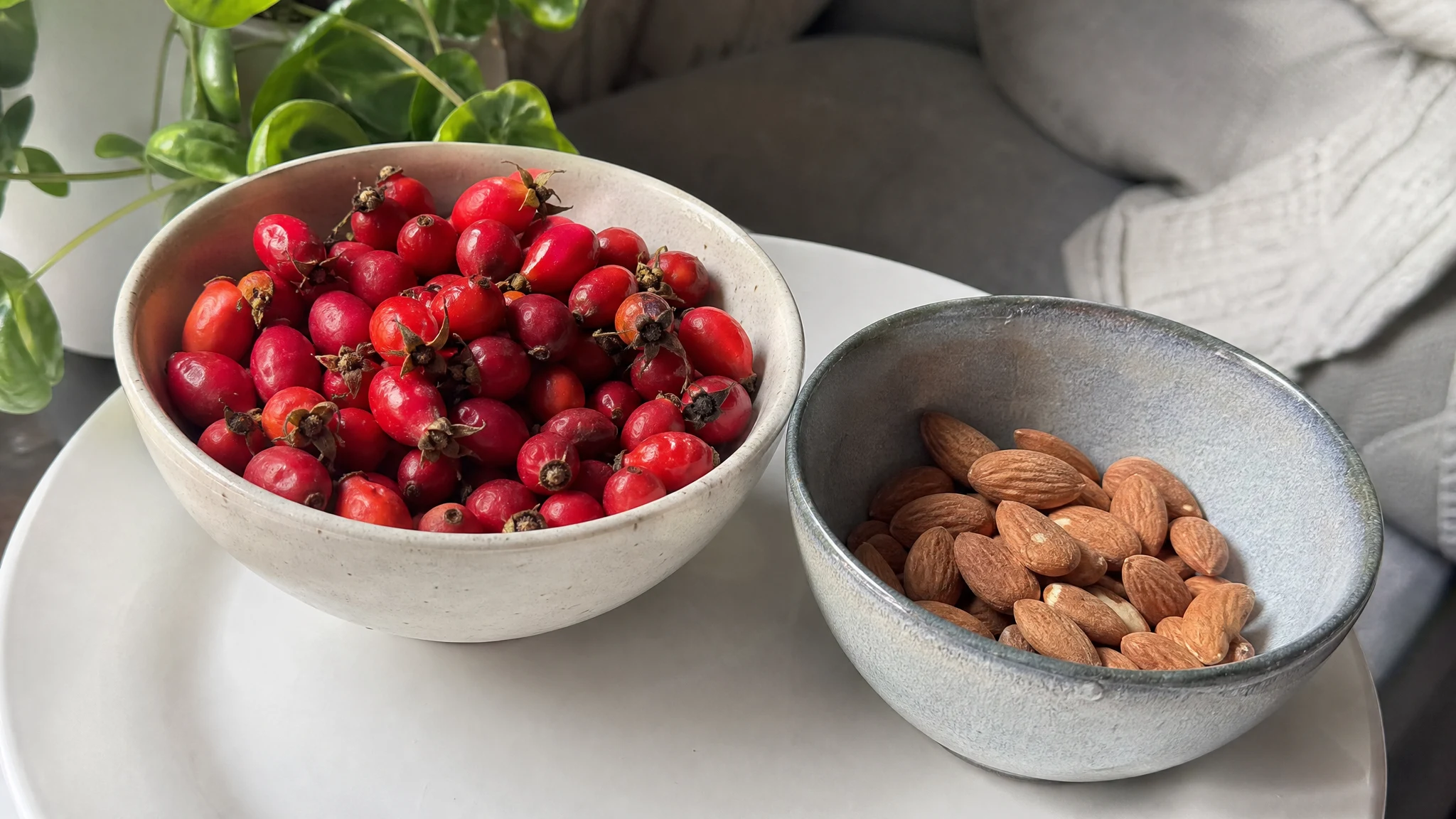
The easiest way to understand the two is to open them side by side. Almond oil is light in colour and soft in scent, a gentle sweetness with a hint of nut. Rosehip oil usually looks deeper and smells more like itself, often a bit earthy. Rub a drop of each between your fingers and notice how quickly it spreads and how it feels a minute later. That small, slightly silly ritual tells you more about what you will enjoy than any list of features.
What dermatologists emphasize
When the American Academy of Dermatology explains how to choose a moisturizer, it talks about product types, creams and ointments for dry skin, gels for oily skin, and fragrance-free formulas, not about named plant oils. Neither rosehip nor almond is singled out. It is a useful reminder that a face oil is an extra, a comfortable finishing step, not a replacement for the basics of moisturizing, and not something to buy because a label promised a transformation.
On the almond side, the most direct evidence we can point to is a small pilot in which 32 people with dry skin used almond oil, coconut oil, jojoba oil or white petrolatum twice daily for two weeks. All four raised skin hydration, with no significant differences between them. That tells you almond oil behaves like a moisturizer; it does not promise more, and it did not include rosehip. We make no promise of a skin outcome for either oil.
How the two feel and fit
Our almond oil has a soft, subtly nutty, lightly sweet scent, absorbs quickly and leaves a non-greasy finish, which makes it a comfortable all-rounder for the face, body and massage, and a carrier that lets essential oils speak without masking them. Rosehip has a character of its own; the best way to find out whether you like it is a sample or a small bottle.
If you are acne-prone, remember that an oil on the face is a personal call, and a dermatologist can advise on your skin. Our acne FAQ explains what we can say about almond oil, and the face routine piece covers technique.
Small habits that make either oil last
Whichever you choose, a few habits are worth building. Keep a pen near the bottle and write the date you opened it on the label. Put the cap back right away, every time, because the less air that gets in, the longer the oil keeps its original scent. Wipe the neck of the bottle with a clean tissue after pouring, so no old oil sits there and ages. Those are boring little steps, and they are the reason a bottle you love stays lovable.
It is also fine to own both. Many people keep a quick, easy oil for the body and a small special bottle for the evening routine, and we think that is a perfectly sensible way to shop.
Allergy comes first
Almond is a tree nut. Our oil is unrefined, so trace almond protein is present, and anyone with a tree nut allergy should not use it. For rosehip, ask an allergist if you have concerns. For either oil, patch test a small area, wait a day, and keep oils away from the eyes. Our nut allergy guide has the fuller picture.
Choosing between them
If you want a long-lasting, versatile, easy-to-handle oil, almond is the practical one, and you can compare it with jojoba and marula as well. If rosehip appeals for its own character, buy it small, store it carefully and enjoy it within a few months.
Either way, the nicest bottle is the one you finish while it still smells the way it did on the first day.

Sweet Almond Oil
Sweet Almond Oil from our own shop, in sizes from 0.5 oz to bulk.
From $9.99
Shop Now →Sources & Further Reading
- Anti-Inflammatory and Skin Barrier Repair Effects of Topical Application of Some Plant Oils, International Journal of Molecular Sciences, 2017.
- Fatty acid composition of California grown almonds, Journal of Food Science, 2008.
- Vegetable oil oxidation: Mechanisms, impacts on quality, and approaches to enhance shelf life, Food Chemistry X, 2025.
- How to pick the right moisturizer for your skin, American Academy of Dermatology.
- Multi-Center Randomized Clinical Study of The Effects of Natural Oils on Xerosis and Skin Barrier Properties, SKIN The Journal of Cutaneous Medicine.