Almond Oil and Tree Nut Allergy: Who Should Skip It
If you have a tree nut allergy, our almond oil is not for you. It is cold-pressed and unrefined, which means trace almond protein is present, and we ask anyone with a tree nut allergy not to use it. The rest of this page explains where that line comes from, what is and is not known about nut oils on skin, and what to do if you are unsure.
What the evidence says about nut oils on skin
Less than the internet implies, in both directions. In an "Ask the Expert" answer for the American Academy of Allergy, Asthma and Immunology, allergist Jacqueline Pongracic wrote that the literature on topical nut oils in food-allergic patients is sparse, and that the reactions reported involved wheat, egg, oat, milk and peanut rather than tree nuts. She also explained that refined oils, which go through chemical or high-heat processing, generally lack allergenic protein, while unrefined, cold-pressed oils may retain it. Her advice was to ask the manufacturer whether a nut oil is refined, before use or after a reaction.
Two things follow. First, a thin literature means nobody can promise a cold-pressed almond oil is harmless to you, though it has not been shown harmful either. Second, ours is exactly the unrefined kind that answer describes, so for anyone with a known tree nut allergy we treat the question as closed rather than gamble on a gap in the evidence.
"I am only allergic to some nuts"
Please do not clear yourself. A 2022 Danish study followed 40 children and young adults aged 2 to 23 with tree nut allergy. Thirty-four had confirmed allergy to at least two tree nuts. Only six were confirmed allergic to almond, the least common of the nuts studied, yet all six were also allergic to hazelnut and walnut. The group is small and Northern European, so these are patterns, not rates you can apply to yourself.
The practical lesson is that "I only react to cashew" is not a reliable basis for deciding almond is fine. Which nuts you tolerate is something an allergist works out with you, sometimes with testing. Until then, our rule applies to any tree nut allergy, not just a documented almond one.
Refined versus cold-pressed
By the AAAAI answer, refining generally removes the protein that cold pressing may leave. We sell only a cold-pressed, unrefined oil, so we cannot speak for how another product was made, and the word "refined" on a label is not a measured protein level. Our refined versus unrefined guide covers what else changes between the two.
It is easy to borrow rules from elsewhere, so a caution. The FDA's tree nut list is a food-labeling list: its FAQ page says only the nuts in Table 1 of the current guidance count as major food allergens, and it does not address cosmetic oils. Our oil is a cosmetic, not a food, and the list is no clearance either way.
Sweet or bitter, it is still almond
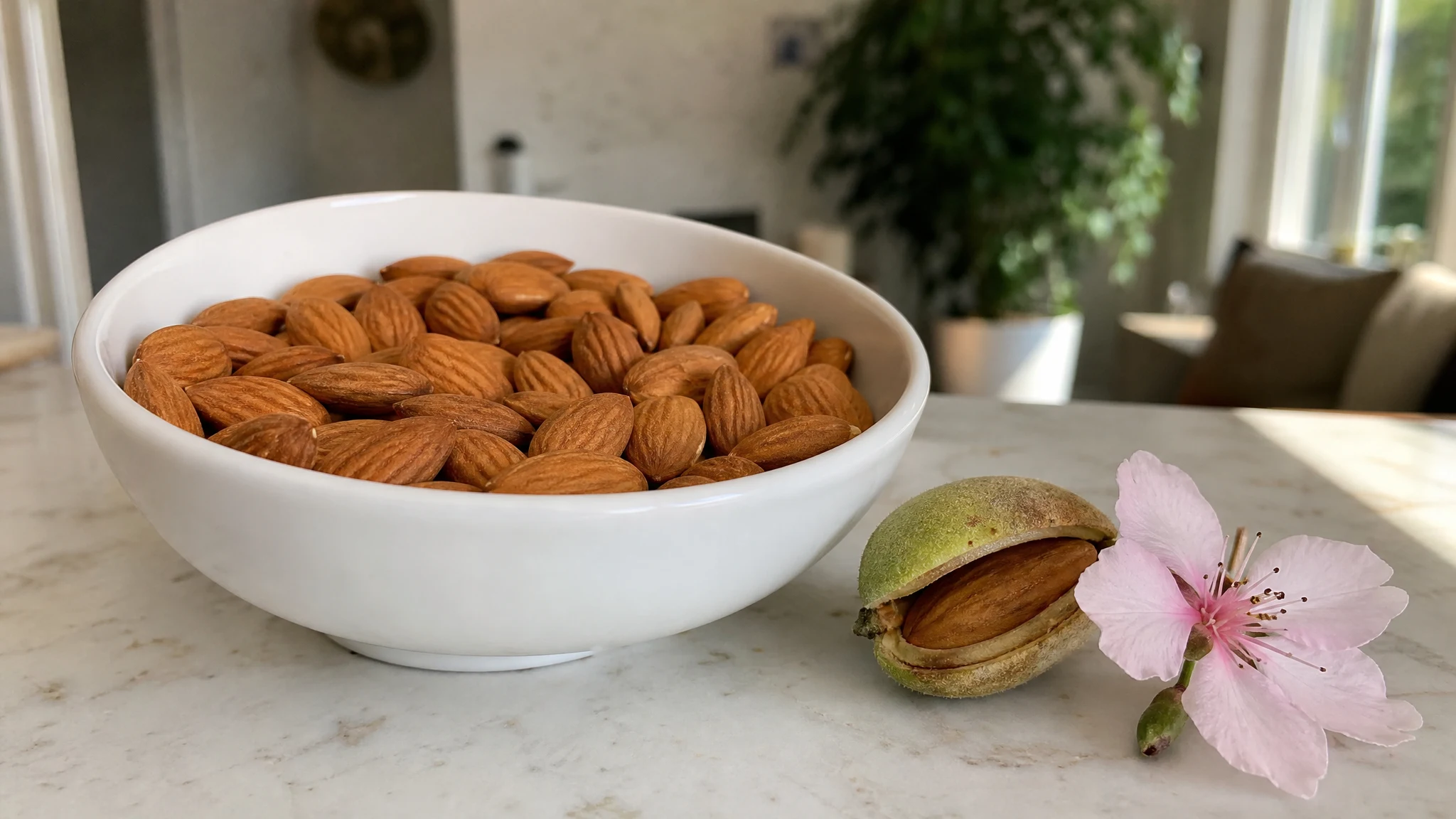
For allergy purposes, reasoning from the botany, both come from almond kernels, so neither is a safe choice for someone avoiding almond. We sell only sweet almond oil, and our sweet versus bitter guide goes through the other differences.
Patch testing is not an allergy test
Our guidance for everyone else is to patch test a small area and wait a day, and that instruction is for people with no known nut allergy. Putting an allergen on skin is itself an exposure, so for someone who might be allergic the test carries the risk. Allergy questions belong with an allergist. If you have no nut allergy and want the steps, see how to patch test almond oil.
If skin reacts
Stop using the oil and contact a professional: an allergist, a dermatologist, or a pharmacist for a mild skin reaction. For breathing difficulty, swelling of the face or throat, or feeling faint, follow the emergency plan your allergist gave you and call emergency services. We are not the right source for those instructions, and we make no medical claims.
Babies and irritated skin
The best-known study here concerns peanut oil, not almond. In the UK ALSPAC cohort, Lack and colleagues found that peanut allergy was significantly related to the use of skin preparations containing peanut oil (an odds ratio of 6.8, with a wide 95% confidence interval of 1.4 to 32.9), and they proposed that sensitization may occur when peanut oil is applied to inflamed skin. That is an association from interview data about a different nut, and it does not show almond oil does the same. It is why a pediatrician should hear about any nut oil going onto a baby's irritated skin. We take this up in baby massage, and the pregnancy side is in almond oil during pregnancy.
What to ask any brand
Ask whether the oil is cold-pressed or refined, and ask for the lot's paperwork in writing. For our own oil, the Certificate of Analysis we publish for one batch lists density, refractive index and optical rotation, and it says nothing about protein or allergens, so it cannot answer an allergy question. If you want to know more about a lot, you can write to us through the contact page, though for anyone with a tree nut allergy our answer on whether to use the oil stays the same.
When you share what you make
If you make balms, scrubs or body oils with almond oil for friends or family, tell them. Write the ingredient on the label, say it out loud when you hand it over, and keep it away from a household member with a tree nut allergy. It is a small courtesy that matters a great deal to the person on the receiving end.
The short version holds after all the detail: with a tree nut allergy, this oil is not for you, and the gaps in the research are reasons for caution, not loopholes. If there is any doubt about your own allergy status, settle it with an allergist before any almond oil touches your skin.

Sweet Almond Oil
Sweet Almond Oil from our own shop, in sizes from 0.5 oz to bulk.
From $9.99
Shop Now →Sources & Further Reading
- AAAAI. Food allergy: nut oils in topical products. aaaai.org
- Juel-Berg N et al. Patterns of Clinical Reactivity in a Danish Cohort of Tree Nut Allergic Children, Adolescents, and Young Adults. Front Allergy, 2022. PMC9361471
- FDA. Frequently Asked Questions: Food Allergen Labeling Guidance for Industry. fda.gov
- Lack G et al. Factors associated with the development of peanut allergy in childhood. N Engl J Med, 2003. PMID 12637607