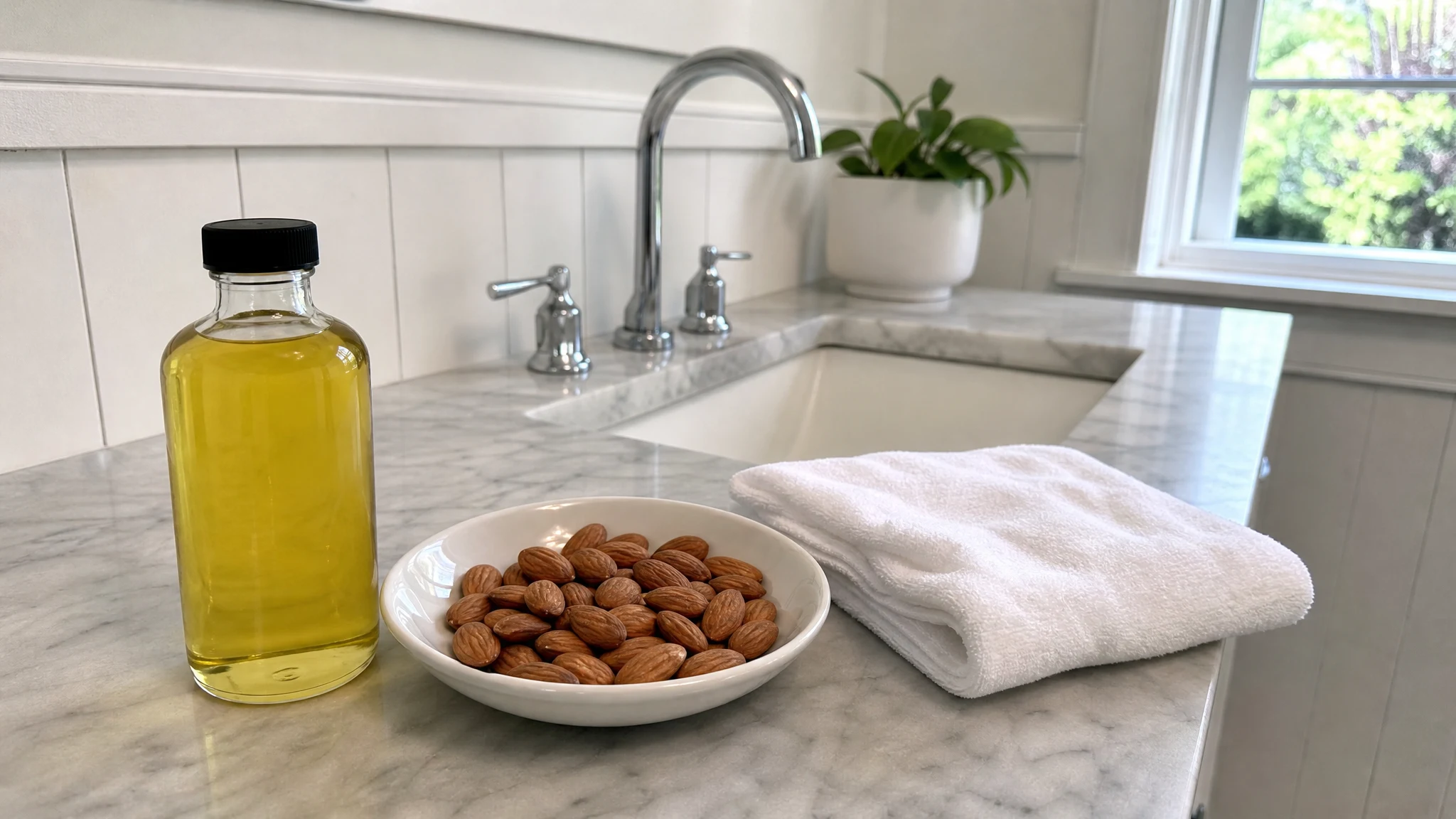
Almond Oil for Breakout-Prone Skin: Our Straight Answer
If your face breaks out, the label on a bottle of facial oil can feel like a dare. Here is our straight answer on almond oil: dermatology guidance for breakout-prone skin leans toward "oil-free," so we would not nominate almond oil for your face, and we would happily point it toward the rest of you.
We run a small business built around one oil, so you might expect us to say yes to every skin type. We would rather you trust us because we told you where our oil does not fit.
What dermatologists actually say
The American Academy of Dermatology has two pieces of advice worth knowing. When choosing a moisturizer for acne-prone skin, it suggests looking on the container for "oil-free," "non-comedogenic" or "won't clog pores." And in its guidance on managing oily skin, it says not to use oil-based cleansers, because they can irritate. Almond oil is plainly an oil, and it is not sold as a non-comedogenic product, so it does not match either piece of advice. We would rather tell you that than dance around it.
The same guidance is encouraging in another way: keep moisturizing. Skin that is treated for breakouts often gets dry, and a suitable oil-free moisturizer helps. If your skin seems to get worse with a product, the AAD suggests asking a board-certified dermatologist, and we agree.
Why "will it clog pores?" has no tidy answer
You have probably seen charts that score oils from 0 to 5 for pore-clogging. They are everywhere. Here is the interesting part: in a 2006 study, researchers patched finished products onto six volunteers three times a week for four weeks and concluded that products containing comedogenic ingredients are not necessarily comedogenic. That is a small study, so we would not read it as a green light. We read it as a reason to be skeptical of any chart that makes a single oil sound like a verdict on your skin. Formulas, amounts and individual skin all change the outcome.
So the practical lesson is not "almond oil is fine" or "almond oil is banned." It is that you are the experiment, and a careful one is better than a confident chart.
Reading labels with a skeptical eye
Labels are your friend here. Words like "oil-free," "non-comedogenic" and "won't clog pores" are what the dermatology guidance points to, so look for them on moisturizers and sunscreens meant for your face. A plant oil in the ingredient list is simply not what that advice is looking for. If you would like a second pair of eyes on a list, a pharmacist can help.
Where almond oil is a natural fit
This is the part we enjoy. Almond oil is light, fast-absorbing and has a faint nutty sweetness, which suits places where nobody is worried about breakouts:
- Hands and cuticles. A drop warmed between the fingers, worked into the nail edges.
- Elbows, knees and heels. Skin that likes a little extra softness.
- Massage and body care. Its soft glide is why we offer it as a massage base. Our massage post shows how it behaves.
It also makes a decent base for blending with essential oils; our dilution guide has the ratios.
Little rituals for the rest of you
Our favorite way to use almond oil is a small, unhurried one. After washing your hands, warm a drop between your fingertips and rub it around each nail and cuticle. Do the same for rough elbows before you pull on a sweater. The aroma is faint and sweet, the oil is light, and a drop really is enough.
If you still want to try it on your face
Some people do. If you are one of them, treat it as a careful trial rather than a routine. Patch test first: the AAD describes a quarter-sized spot on the inner arm or elbow crease, twice a day for 7 to 10 days, and no redness, itching or swelling before you carry on. Then try a very small amount in one area, not everywhere, and stop if you see changes you do not like. Keep it clear of your eyes. Most important, do not use it at all if you have a tree nut allergy; our oil is cold-pressed and unrefined, so trace almond protein is present.
How to run a fair trial
- Choose one small area, such as a patch along the jaw, so you can see what changes.
- Introduce only one new product at a time. If you change cleanser, moisturizer and oil in the same week, you will never know which did what.
- Keep notes: a line on your phone each evening about how the skin looks and feels.
- Stop, and ask a dermatologist, if the skin looks worse.
For a fuller look at what an oil can do on the face, see almond oil on the face, and if you are curious about oil cleansing, which the AAD cautions against for oily skin, our oil cleansing post lays out the evidence on both sides.
Almond oil is a cosmetic oil for external use, and we make no claims about acne or any other skin condition. Skin that keeps breaking out deserves a dermatologist's eye, and that is the advice we would give a friend.

Sweet Almond Oil
Sweet Almond Oil from our own shop, in sizes from 0.5 oz to bulk.
From $9.99
Shop Now →Sources & Further Reading
- American Academy of Dermatology, Moisturizer: Why you may need it if you have acne
- American Academy of Dermatology, How to control oily skin
- Draelos ZD, DiNardo JC. A re-evaluation of the comedogenicity concept. J Am Acad Dermatol, 2006
- American Academy of Dermatology, How to test skin care products