Almond Oil for Rosacea-Prone Skin: Ask First
"Natural" is a lovely word on a bottle, but it is not a statement about how your skin will react, and that matters more than usual when your face flushes easily. If you live with rosacea, a plain oil is not automatically a gentle choice, and it is not automatically a bad one either. It is a decision to make with the person who knows your skin.
What dermatologists actually say about skin care and rosacea
The American Academy of Dermatology describes rosacea as a condition that mostly affects the face, with flushing, lasting redness, bumps and sometimes visible blood vessels, and it lists stinging or burning after skin care products among the signs. Its advice is practical: have a board-certified dermatologist confirm what you have, choose products labelled fragrance-free (not just "unscented"), and skip astringents and toners. Its list of ingredients to avoid includes alcohol, camphor, fragrance, menthol and sodium lauryl sulfate. Plain carrier oils are not on that list, and they are not recommended on it either. Neither the AAD tips nor the National Rosacea Society say anything for or against them.
The National Rosacea Society's survey of 1,066 patients adds a useful picture. About four in ten said certain skin care products had made their rosacea worse, and the ingredients people named most were alcohol, witch hazel and fragrance, with peppermint and eucalyptus oils on the list too. The Society's own advice is to use as few products as you can, because every product you add is another chance for a reaction. That is why we would keep any oil plain on a rosacea-prone face. If you are used to blending essential oils into almond oil, this is one situation where we would leave them out; our blending guide covers dilution for everyone else.
Why people think about oils at all
The idea behind a moisturizer for rosacea is the skin barrier. A review by Dr. Flavia Addor in Anais Brasileiros de Dermatologia notes that several studies find extra water loss through rosacea-prone skin, which she reads as a weakened barrier, and that gentle, irritant-free moisturizers may help. She is also candid that studies measuring barrier function in rosacea are very scarce and that the moisturizer argument leans on reasoning more than on clinical trials. So the logic is sensible, and the proof is thin.
For a specific oil it is thinner still. We are not aware of a trial of almond oil in people with rosacea. The closest oil studies are on healthy skin, and they show that oils behave very differently from one another. In a four-week forearm study of 19 adults, olive oil lowered barrier integrity and caused mild redness, while sunflower seed oil preserved the barrier and improved hydration. Almond oil was not in that study, but its lesson travels: "natural oil" is not one thing, and one oil's behavior says little about another's. We would rather tell you that plainly than let a pleasant reputation do the talking.
If you and your dermatologist decide to try it
- Start with one product. Adding an oil on top of a prescription routine and a new moisturizer makes any reaction impossible to trace.
- Test away from the central face. The Rosacea Society suggests a spot such as the neck or jawline. The AAD's method is longer: a quarter-sized area on the inner arm, twice a day for 7 to 10 days, stopping at any redness, itching or swelling. For reactive skin, the longer test is the more careful one. Our own guidance is to patch test a small area and wait a day, and our patch-test guide walks through both.
- Remember the scent. Nothing is added to our oil, but it has its own soft, nutty, lightly sweet almond aroma, so we would not call it fragrance-free.
- Keep it away from the eyes. Rosacea can affect the eyes, and eye symptoms belong with a doctor.
The firm line is tree nut allergy. Our oil is cold-pressed and unrefined, so trace almond protein is present, and anyone with a tree nut allergy should not use it. The nut allergy article explains why.
Keep a simple skin diary
If you and your dermatologist decide to try anything new, a diary makes the picture clear. Jot down the product, the date, and how your skin looked an hour and a day later. Take a photo in the same light each time. Note weather and anything else that changes, too. When a reaction does show up, stop the new product, wash gently with plain water and write down what happened so you can show your dermatologist. One change at a time makes the diary worth keeping.
What an oil is not
An oil is a cosmetic layer, so it is not a stand-in for sun care: the AAD's tips call for a broad-spectrum, water-resistant sunscreen of SPF 30 or higher on exposed skin. It is not a rosacea plan, either. Redness with bumps can be rosacea or acne, and the two are managed differently, which is another reason to get a diagnosis first. If acne is your question, our acne FAQ covers it, and our sensitive skin article looks at reactive skin more broadly.
Our sweet almond oil is an external cosmetic carrier, and we make no medical claims for it. For a face that flushes, a short routine, a fragrance-free approach and a dermatologist's input will take you further than any bottle of oil, ours included.
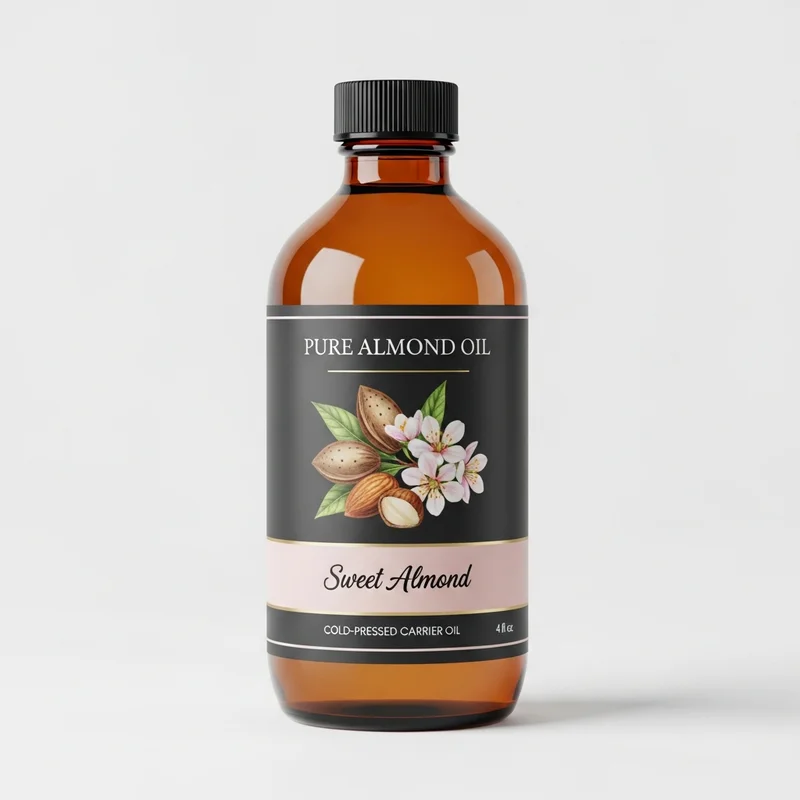
Sweet Almond Oil
Sweet Almond Oil from our own shop, in sizes from 0.5 oz to bulk.
From $9.99
Shop Now →Sources & Further Reading
- American Academy of Dermatology. Rosacea: Overview. aad.org
- American Academy of Dermatology. 7 rosacea skin care tips dermatologists recommend. aad.org
- American Academy of Dermatology. How to test skin care products. aad.org
- National Rosacea Society. Rosacea Skin Care & Cosmetics. rosacea.org
- Addor FA, 2016. Skin barrier in rosacea. An Bras Dermatol 91(1):59-63. PMC4782648
- Danby SG et al., 2013. Effect of olive and sunflower seed oil on the adult skin barrier: implications for neonatal skin care. Pediatr Dermatol. PubMed 22995032