Essential Oil Dilution in Almond Oil: Weigh, Don't Count
Ask ten people how to blend essential oil into a carrier and you will get ten different drop counts. We would hand you a kitchen scale instead. Drops are never quite the same twice, and the right strength for a face oil is not the right strength for a bath oil, so the real question is what the blend is for.
Start with the job, then pick the percentage
The Tisserand Institute sorts dilution by purpose, and we find that the clearest way to think about it. Its published ranges run from 0.2% to 1% for sensitive or impaired skin, 0.5% to 1.2% for facial products, 1% to 3% for body oils and lotions, and 2% to 4% for bath products. The higher bands are for specific short-term uses well beyond a scented body oil, and those are conversations for a pharmacist or dermatologist, not a bottle you mix at the kitchen counter.
Notice the pattern: the more delicate the skin, the lower the number. Our habit is to begin at the bottom of the range for the use, because you can always add scent next time, and a gentler blend is easier to enjoy. The same page warns that a mix of 1 part in 4, which is 25%, is "much too concentrated for almost any safe use," a good reminder that more is not better here.
Why weighing wins
Tisserand's page puts it plainly: conversions that use drops are "always approximate," because no two drops are the same. Weight does not wobble. The sweet almond oil we sell measured a relative density of 0.918 at 20 C on the batch on our Certificate of Analysis, so 1 ml weighs about 0.918 g, and a 1 oz (29.57 ml) bottle holds roughly 27 g. That is arithmetic from one batch, so treat it as a close estimate for any other.
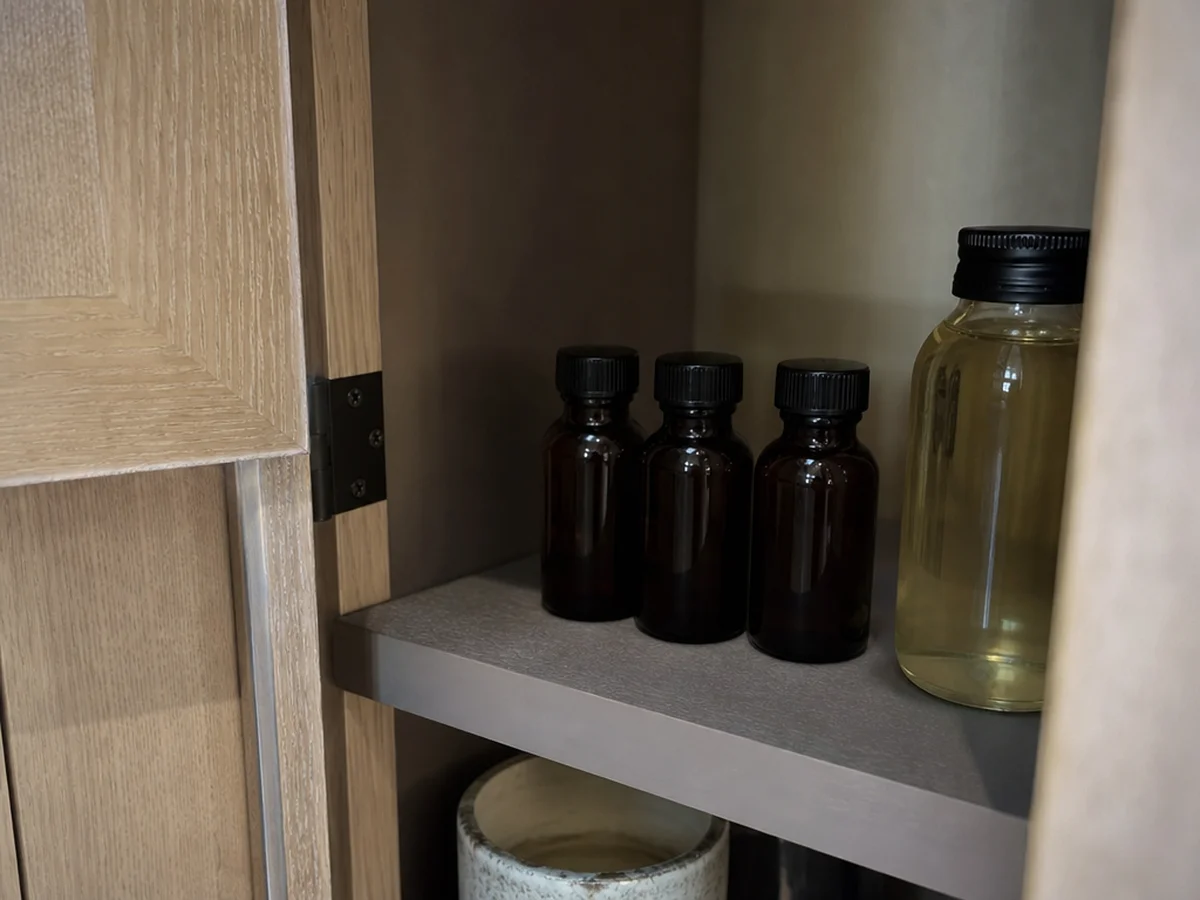
One percent of 27 g is under 0.3 g, too small for most kitchen scales to read well. Make 100 g at a time instead:
| Strength by weight | Essential oil | Almond oil | Almond oil as volume |
|---|---|---|---|
| 0.5% | 0.5 g | 99.5 g | about 108 ml |
| 1% | 1 g | 99 g | about 108 ml |
| 2% | 2 g | 98 g | about 107 ml |
| 3% | 3 g | 97 g | about 106 ml |
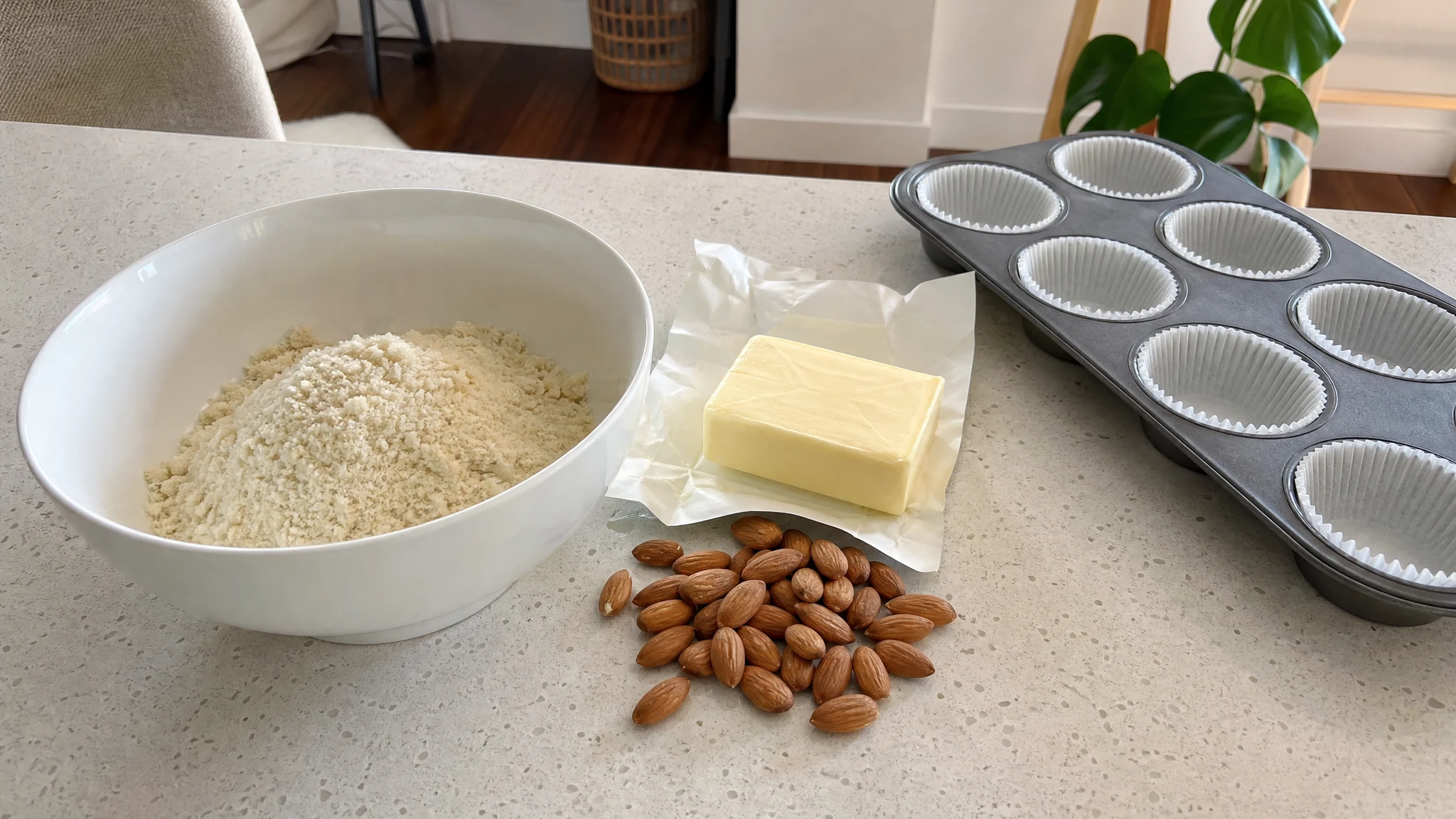
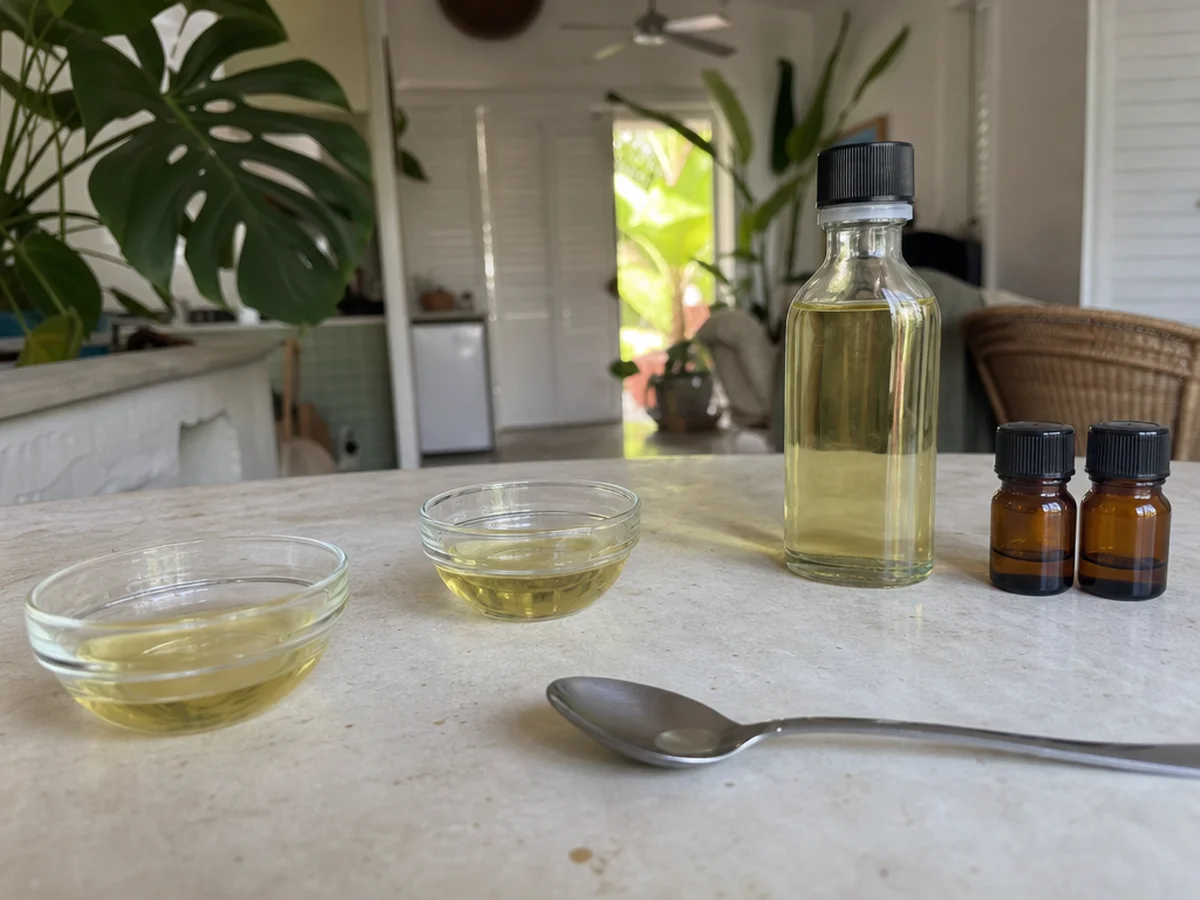
To scale down, just multiply: 50 g of blend at 1% is 0.5 g of essential oil and 49.5 g of almond oil. Weigh into a clean, dry glass bottle, cap it, and turn it end over end for a minute. Essential oils mix into a carrier oil but not into water, so keep the blend water-free.
A note on citrus
Citrus oils deserve one extra check. The Tisserand Institute explains that bergamot oil is limited to 0.4% in a final product meant for skin that may meet the sun, under an IFRA guideline, and that skin treated with a phototoxic amount should stay out of UV for at least 12 hours. It also notes that distilled citrus oils contain very much less of the compounds responsible than pressed ones. So a bright 1% bergamot body oil is above that limit, while a distilled citrus oil is a different conversation. Read the label for how the oil was made before you choose a percentage.
Small habits that make blending easy
Set up before you start: a clean, dry bottle, a label, a pen and your scale. Place the bottle on the scale and zero it, pour in the almond oil first, then add the essential oil last and slowly, so you never overshoot the number. If you do overshoot, do not try to scoop it out. Top up with more almond oil and work out the new percentage, or start a fresh bottle.
Roll the bottle between your palms, then open it and take a gentle sniff from a few centimeters away. The aroma should sit comfortably alongside the nutty sweetness of the almond, not shout over it.
Who the table does not cover
A dilution percentage is written for healthy adults using a product on their own skin. Children, pregnancy, breastfeeding, medicines and pets sit outside it. A 2007 report in the New England Journal of Medicine described three young boys who developed breast tissue growth while using products containing lavender and tea tree oils, which resolved when the products were stopped. Three cases cannot tell us how common that is, but they are a good reason not to borrow an adult table for a child. Your pediatrician, OB/GYN or midwife is the right person to ask.
The carrier makes a lovely partner
We describe our sweet almond oil as soft, subtly nutty and lightly sweet, a base note that lets an essential oil's aroma come through. It blends well with lavender, rose, geranium, chamomile, sandalwood and ylang ylang. We sell the almond oil on its own, so you will find the essential oils at a supplier that prints the botanical name and a lot number.
Almond is a tree nut, and ours is cold-pressed and unrefined, so trace almond protein is present. If you have a tree nut allergy, do not use it, alone or in a blend. Everyone else should patch test the finished blend on a small area and wait a day; our patch testing guide shows how, and our nut allergy article explains the reasoning. If you are weighing other bases, almond oil as a carrier and mixing almond oil with other oils cover that side of the bottle.
One more practical point: oil-soaked cloth can be a fire risk. An insurer's guidance for massage businesses advises washing oily linens at 104 F or hotter and drying them below 125 F. It does not name almond oil, but it is sensible for any scented oil blend. Date your bottle, keep it capped and cool, and enjoy the first batch.
Sweet Almond Oil
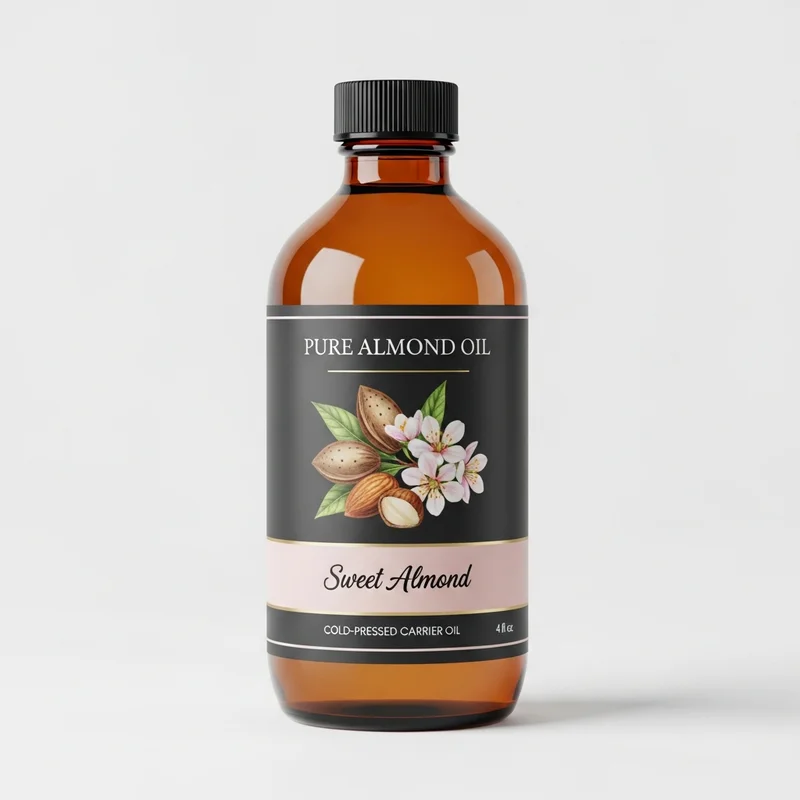
Sweet Almond Oil from our own shop, in sizes from 0.5 oz to bulk.
From $9.99
Shop Now →Sources & Further Reading
- Tisserand Institute, Dilution for essential oils
- Tisserand Institute, Phototoxicity: essential oils, sun and safety
- Henley DV, Lipson N, Korach KS, Bloch CA, 2007. Prepubertal gynecomastia linked to lavender and tea tree oils. N Engl J Med.
- Great American Insurance Group, Avoid Fires from Massage Oils