Premium kernels in. Nothing refined out.

Where It Comes From

Premium California kernels, pressed below forty degrees and bottled without refining anything out of them. Including an honest answer about the water.

Premium Kernels, Never Off-Grade
40°C Cold-Press Ceiling
30-35% Less Water Per Pound
Pressed Date on Every Bottle

What's Actually in Most Almond Oil

Almond oil is one of the easiest oils in the world to buy by the tonne and put your own label on, and the great majority of brands do precisely that.

Commodity almond oil is pressed from whatever kernels were cheapest that season. In practice that means broken, chipped or off-grade nuts that could not be sold whole, from no particular variety and no particular block. Then it is refined until it has no color and no smell, because unrefined oil from stock like that would tell on itself.

Buying finished oil by the drum also means taking a supplier's word on the kernel grade, on the press temperature, and on whether anything else went into the tank.

We buy kernels and press them ourselves. Premium kernels, from orchards in California's Central Valley and Kern County, pressed below forty degrees and bottled unrefined.

The oil is faintly golden rather than water-clear, and it smells like almonds. Both of those are things refining removes.

Central Valley and Kern County

California grows most of the world's almonds, and we are not going to pretend to be somewhere more romantic. What matters is which orchards, on whose water, and how they are run.

Where our almonds are grown CALIFORNIA Central Valley Kern County

Central Valley

The heart of the crop, and the reason almond quality here is a matter of block selection rather than geography.

Kern County

Southern San Joaquin blocks, chosen for the orchards themselves rather than for the acreage around them.

District Water

Predominantly surface water through an irrigation district holding senior contract rights, with groundwater as a supplement rather than a foundation.

That last one is a sourcing decision, not an accident. Roughly a third of Central Valley almond acreage is effectively groundwater-only, and that is precisely the acreage now being pulled out.

Our growers sit in a subbasin with an approved groundwater plan and an allocation they operate inside, rather than one under state probation.

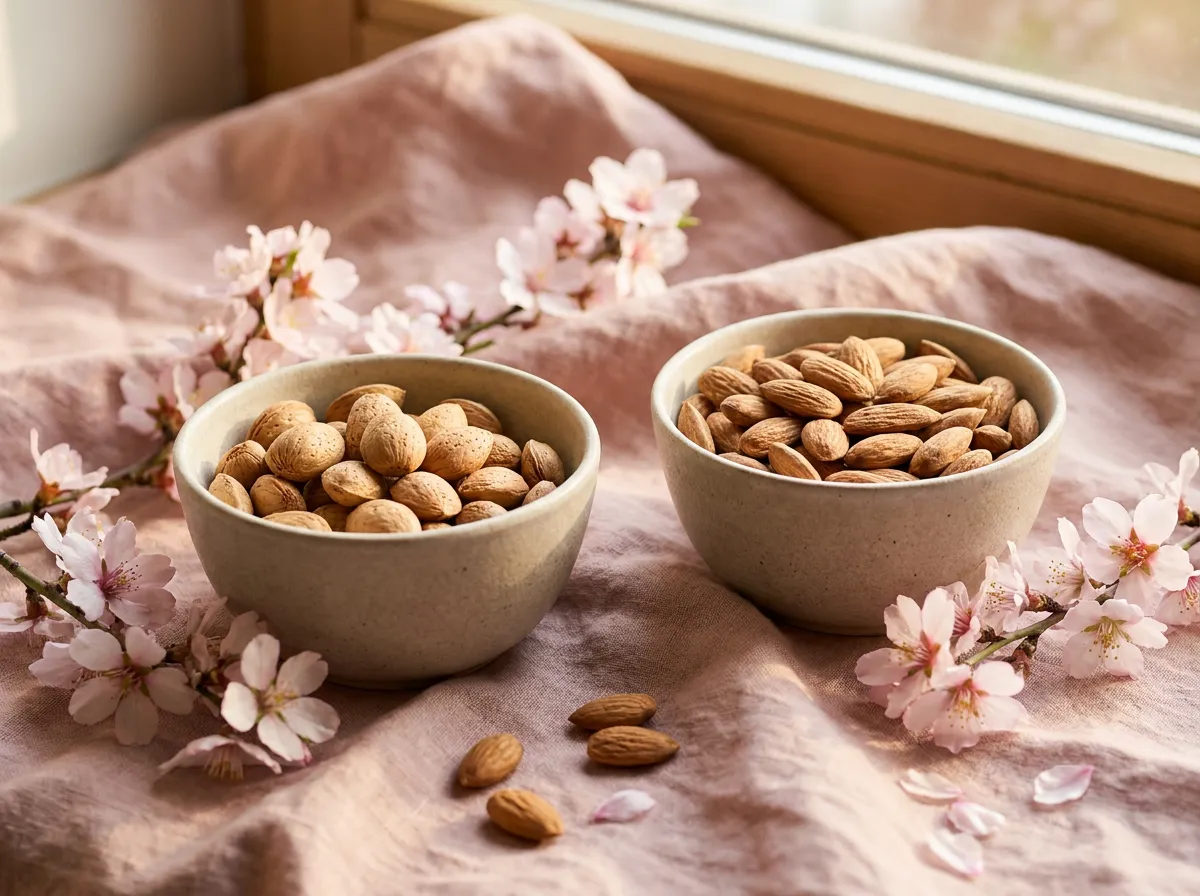
Two shallow bowls of sound shelled almond kernels on linen

Premium Kernels, Not Off-Grade Stock

We press premium kernels: sound, whole and clean, which is a grade above the broken and chipped stock that commodity pressing runs on.

That choice costs more per pound and it shows up twice. Once in the oil, which carries more character when the kernel going in was sound. And once in what is left behind: pressing premium kernels means the cake is good enough to eat, which it would not be from off-grade stock.

It is also the simplest quality decision we make. Everything downstream, the press temperature, the filtering, the dating, only protects what the kernel already had.

The Water Question, Answered Plainly

We are not going to tell you almonds are a low-water crop. They are not. What we can tell you is which water our orchards run on, and whether it will still be there in ten years.

Irrigation is pressurized double-line drip, scheduled by soil moisture probes and pressure-chamber stem water potential readings rather than by a calendar. Through the hull-split window our growers run regulated deficit irrigation, a deliberate and measured stress late in the season that concentrates the kernel, raises oleic acid and reduces hull rot. It uses less water and makes better oil, which is an unusually clean alignment of interests.

Across drip conversion, deficit irrigation and on-farm recharge in wet years, our growers apply roughly thirty to thirty-five percent less water per pound of kernel than the district average. Recharge means flooding fallow ground in winter so surplus soaks back into the aquifer instead of running to the ocean. Applied water efficiency sits above ninety percent, against roughly sixty to seventy percent for the flood irrigation still in use on older orchards.

The wider picture is worth stating too. California recorded its first decline in bearing almond acreage since 1995 this year, driven almost entirely by the southern San Joaquin Valley, where allocations in some subbasins have fallen to 1.6 acre-feet per acre against a crop needing three to four. Orchard values on groundwater-dependent parcels fell twenty-five to fifty percent across 2023 and 2024, and new plantings are moving north toward Sacramento, Yolo and San Joaquin counties for water certainty, accepting lower yields to get it.
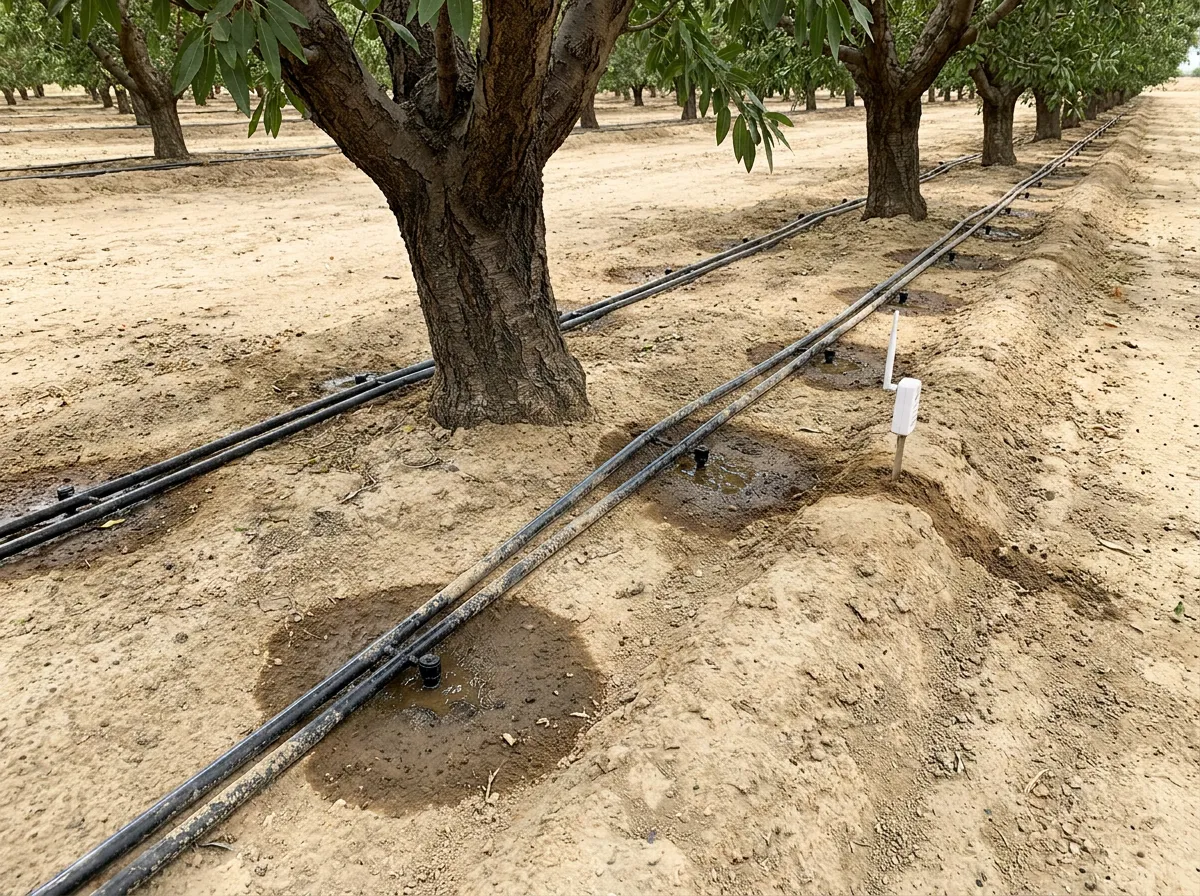
Double-line drip irrigation tubing running along the base of almond trees in an orchard row
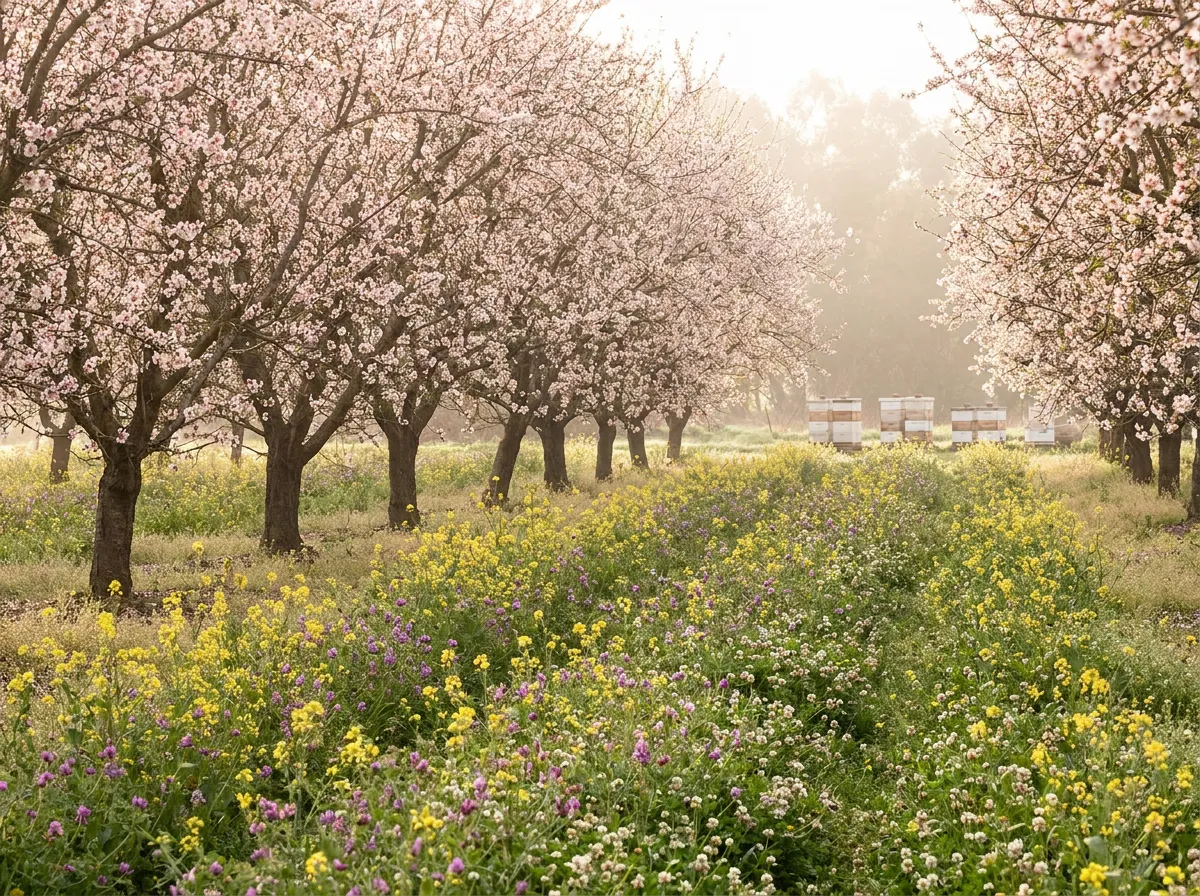
Flowering mustard and clover cover crop growing between rows of almond trees with hives at the orchard edge

Two Million Colonies, and What We Ask of Ours

Almond bloom is the largest managed pollination event on earth: close to two million colonies trucked across the country every February for a three-week window. It is hard on bees, and our almonds do not sit outside it.

What our growers do differently starts with the hives. They are contracted from a small number of regional beekeepers on multi-year agreements rather than bought on the spot market, at a minimum eight-frame strength that is verified at drop-off rather than assumed.

No insecticide goes on during bloom, full stop. That is the single biggest driver of colony loss in almond, and avoiding it is a scheduling decision rather than a technology one. Fungicides, where they are needed, go on in the evening after foraging stops.

Between the rows there is a permanent cover crop, a mustard, clover and vetch mix drilled in autumn, so there is forage before bloom, during bloom, and after the hives leave. That last part matters most: an almond orchard after February is a food desert for a bee, and the cover crop is what turns it back into habitat. Field margins and hedgerows are left uncut for wild pollinators, which do real work in almond and get no credit for it.

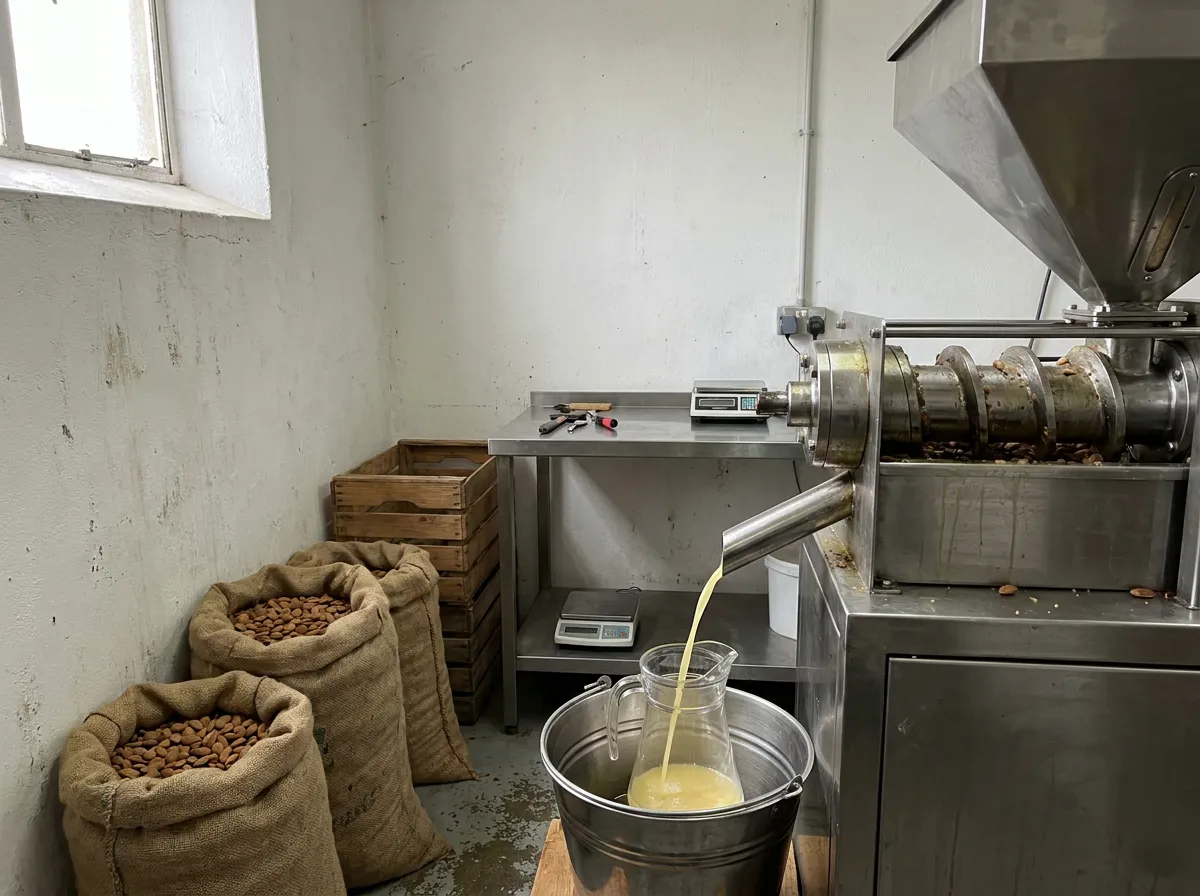
Working expeller press with pale golden almond oil running into a collection vessel beside sacks of kernels

Pressed Below Forty Degrees

Cold-pressed is a phrase anyone can print. Ours is a number we measure. The press stays below forty degrees Celsius, and holding it there takes deliberate restraint, because friction alone will carry an expeller past that if you run it hard for yield.

Unrefined means what it sounds like: no bleaching, no deodorizing, no winterizing, no solvent. The oil is pressed, settled, filtered and bottled.

Refining would strip the color and the smell along with most of the vitamin E and phytosterols, which are the reasons to reach for almond oil at all. Refined oil is paler, blander, cheaper to make and longer-lived on a shelf, and it is most of what the market sells.

Pressing this way recovers only about two thirds of the oil in a kernel, so the cake still holds real value. Ours goes out as food-grade almond flour rather than animal feed.

What We Test For, and Why

Every lot goes to an independent laboratory with no financial stake in us or in our growers. Four measurements, each answering a specific question.

Free fatty acids and peroxide value

Between them these say how fresh the oil actually is, which matters more for a pressed nut oil than any other figure on the sheet.

Fatty acid profile by GC-FID

Confirms the oleic to linoleic ratio sits where sweet almond belongs, which deficit irrigation at hull split nudges upward.

Sterol profile

The adulteration check. Apricot and peach kernel oils are cheaper and chemically close enough that a casual fatty acid profile will not always separate them, and high-oleic sunflower is the other common cut.

Aflatoxin

Almonds carry a genuine mycotoxin risk. Screening for it is not optional.

Results are published against the lot number. Quote the number on your bottle to [email protected] and we'll send its paperwork over, or ask through the contact page.

Two Dates and a Lot

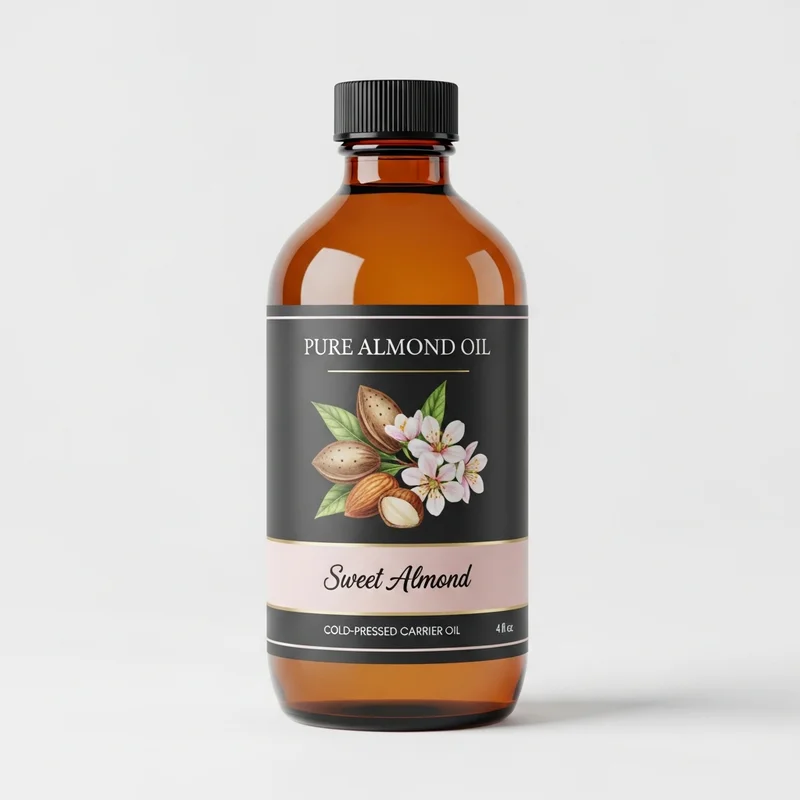
Pressing date, bottling date, and lot number, in amber glass. The pressing date is the one worth reading.

Twelve Months, Said Plainly

That is the shelf life, counted from pressing. Unrefined oil is a fat and fats oxidize. Anyone quoting two or three years is selling refined oil or hoping you don't check. Keep it cool and dark, and refrigerating it does no harm at all.

Not Even Vitamin E

We put nothing in. No tocopherol, no preservatives, no stabilizers. The oil is naturally high in vitamin E and oleic-heavy enough to hold up on its own, so our answer on shelf life is a short honest number rather than an additive.

Nothing Leaves as Waste

The orchards run on an eight to twenty-two year spread of block ages, staggered so no single replant year dominates. An almond tree takes three years to bear and reaches full production around year seven, with a commercial life of roughly twenty to twenty-five years before yield decline justifies removal. Replanting block by block rather than clearing an orchard outright keeps the pollinator habitat, the soil cover and the income continuous.

Nothing is burned. Hulls go to dairy feed, where they are a genuine commodity rather than a disposal problem. Shells go to livestock bedding and biomass.

Removed trees are whole-orchard recycled: chipped and incorporated back into the soil before replanting, which returns carbon, improves the soil's water-holding capacity, and measurably improves the orchard that follows. It replaced open burning, which was the old practice and a serious air quality problem in the valley.

Where We Won't Bend

Six positions that do not move, whatever the season does.

Premium Kernels

Sound, whole, premium kernels, never the broken and off-grade stock that commodity pressing runs on.

Forty Degrees

A measured ceiling on the press rather than a phrase borrowed off somebody else's label.

Unrefined, Always

No bleaching, deodorizing, winterizing or solvent. The color and the smell stay where they started.

District Water First

Surface water through senior contract rights, drip scheduled by probe and stem water potential, groundwater only as a supplement.

No Bloom Insecticide

Nothing sprayed on the bees while the hives are in, and a permanent cover crop feeding them after the hives leave.

Twelve Months, Dated

A short shelf life stated honestly, with the pressing date on the bottle and nothing added to stretch it.

Who Reaches for It

Massage therapists and bodyworkers first, formulators second.

Sweet almond is the default massage carrier for good reason. The slip runs long, it never turns greasy, and it stays out of the way of whatever essential oil you blend into it.

Formulators build balms, serums and soaps on it. Ours is cosmetic grade, and we don't market it for culinary use.

Read This If You Have a Nut Allergy

Almond is a tree nut, and we would rather be blunt than tactful here. Highly refined almond oils have had the protein stripped out and are sometimes handled as low risk. Ours is cold-pressed and unrefined, so trace almond protein is present. If you have a tree nut allergy, do not use this oil. We would rather lose the sale than bury that line in small print.

We make no medical claims. This is sweet almond oil, Prunus dulcis var. dulcis. We do not sell bitter almond oil, which is a wholly different material carrying genuine toxicity concerns.

Patch test before broad skin use, keep it away from your eyes, and store it cool and dark as described above.

If a lot does not meet the standard, we run out rather than fill the gap with refined oil or somebody else's kernels. Being unavailable for a stretch is the honest version of the alternative.

Judge It By the Color and the Smell

Premium California kernels, drip-irrigated on district water, pressed below forty degrees, refined into nothing, and dated the day it came off the press.

Pour a little and compare.

Shop Sweet Almond Oil
These statements have not been evaluated by the FDA. Products are not intended to diagnose, treat, cure, or prevent any disease.