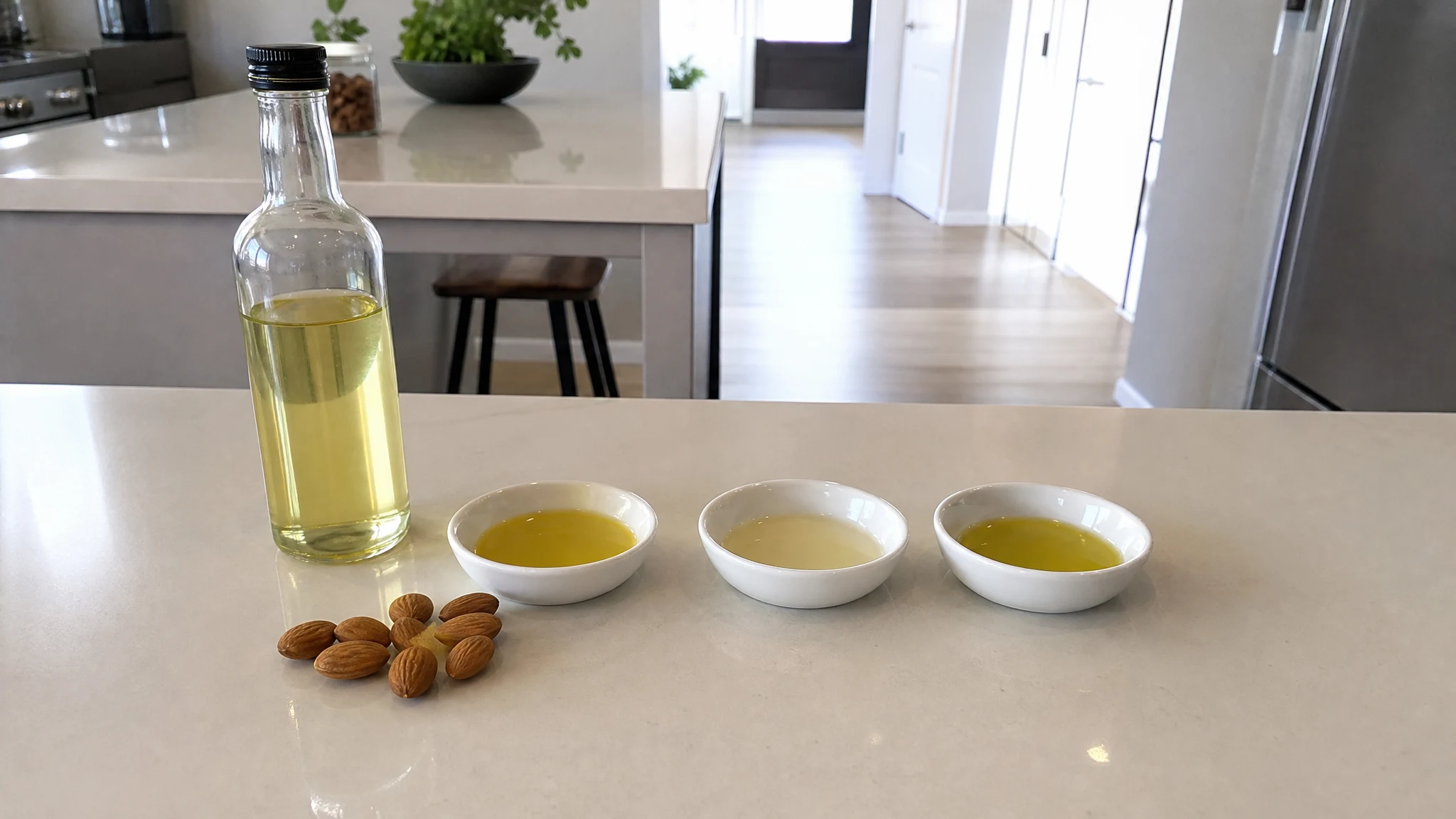
Almond Oil as a Carrier Oil: Blending Essential Oils
When people plan a blend, they spend most of the time choosing the carrier and almost none choosing the percentage. It should be the other way round. Sweet almond oil is a lovely, light carrier with a soft, lightly sweet aroma that lets essential oils shine, but how strong you make the blend and how fresh your essential oil is will shape the result far more.
First, the allergy check
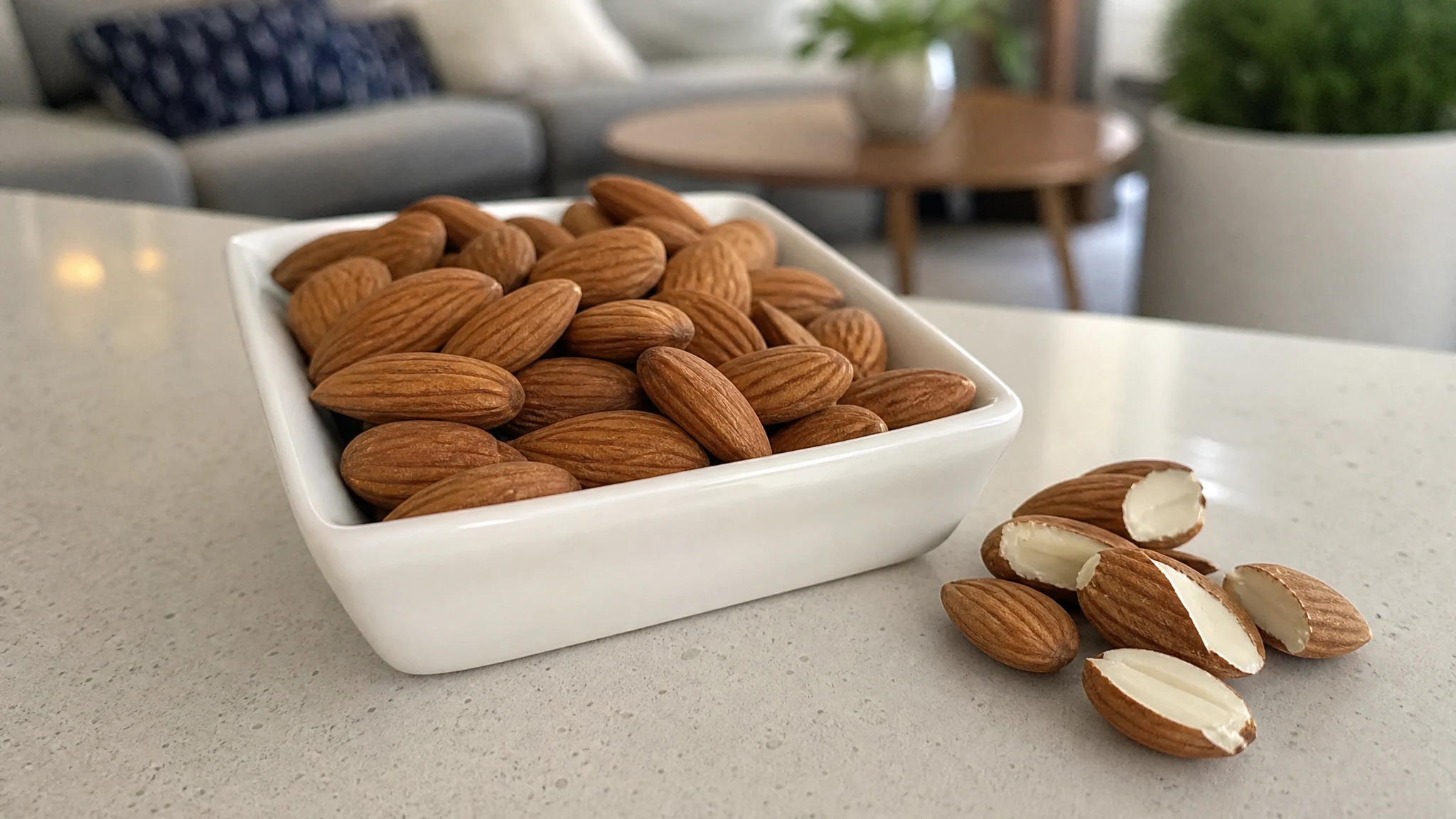
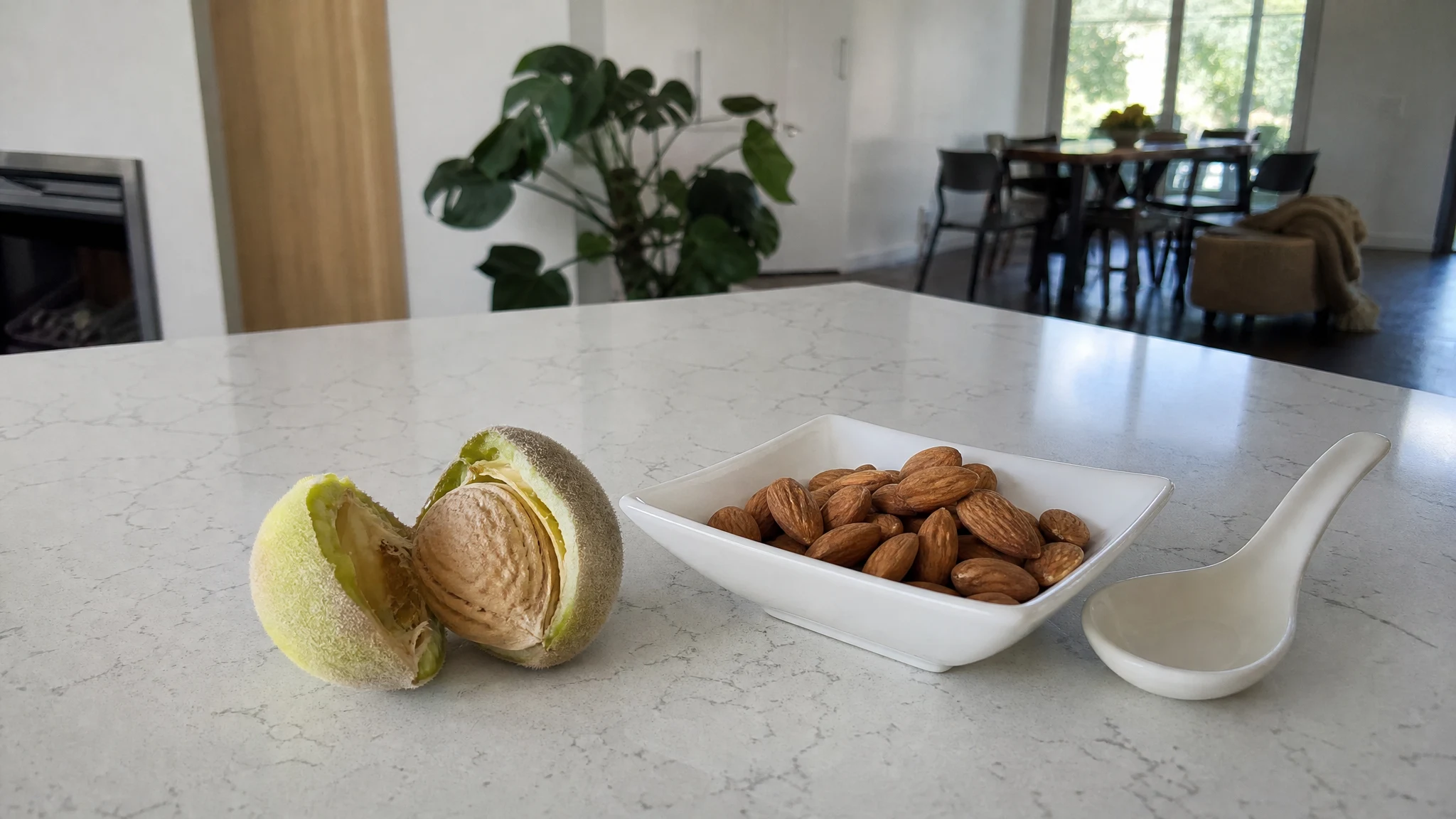
Almond is a tree nut. Our oil is cold-pressed and sold unrefined, so trace almond protein is present, and anyone with a tree nut allergy should not use it, whether they are wearing the blend or you are mixing it for them. An allergist writing for the American Academy of Allergy, Asthma and Immunology explains that refined oils generally lack protein while unrefined, cold-pressed ones keep it, and that topical exposure has not been well studied (Food allergy: nut oils in topical products). Our nut allergy post goes further.
Choose the percentage before you open a bottle
The Tisserand Institute groups dilution into ranges: 0.2 to 1 percent for sensitive or impaired skin, 0.5 to 1.2 percent for facial cosmetics and deodorants, 1 to 3 percent for body oils and lotions, and 2 to 4 percent for bath products (Dilution for essential oils). Reading that table as a suggestion, a daily body oil lives in the 1 to 3 percent band and starting at the low end costs you nothing. Anything for the face, or for skin that already reacts easily, belongs in the lower rows, and sensitive skin is really a conversation for a dermatologist.
Weigh, do not count drops
The same page notes that drop conversions are always approximate, and anyone who has switched droppers knows why: a drop is not a fixed volume. Weight is the honest unit. The Certificate of Analysis we publish for one batch gives a relative density of 0.918, so 100 ml of that batch weighs about 91.8 g. As arithmetic, a 1 percent blend is about 1 g of essential oil to 99 g of almond oil, and a 2 percent blend about 2 g to 98 g. Most kitchen scales are too coarse for a small bottle (1 percent of a 30 ml bottle is under 0.3 g), so make a larger batch or use a scale that reads to 0.01 g.
What a carrier cannot do
Dilution lowers concentration; it does not change what an essential oil is. The clearest example is linalool, a fragrance compound found in many essential oils that becomes a potent allergen when it oxidizes. In a repeated-application study of six people already allergic to oxidized linalool, five reacted to a 3.0 percent cream, three to 1.0 percent and two to 0.30 percent (Air-oxidized linalool elicits eczema in allergic patients - a repeated open application test study). Those participants were already sensitized, so it says nothing about the average blend, but it shows why freshness matters. Buy essential oils with a bottling or distillation date, and keep them capped, cool and dark.
The Cosmetic Ingredient Review panel concluded that 244 plant-derived fatty acid oils are safe as used in cosmetics, with a dermal focus (Safety Assessment of Plant-Derived Fatty Acid Oils). That covers the carrier, not what you dissolve in it.
Does almond earn the slot?
As a leave-on oil, the evidence does not crown a winner. In a small randomized pilot, almond, coconut and jojoba oils and petrolatum were applied twice daily for two weeks; all four raised hydration with no significant differences between them (Multi-Center Randomized Clinical Study of The Effects of Natural Oils on Xerosis and Skin Barrier Properties). So the choice comes down to feel, scent and handling. Almond oil is light, nearly scentless apart from its soft nutty note, and sold neat by us with nothing added. Our mixing FAQ covers combining carriers.
If you need fatty acid or peroxide numbers for a formulation file, write to us through the contact page and ask for the lot's paperwork; the certificate we publish does not include them.
Making the blend, in order
- Decide the use and pick the percentage from the table.
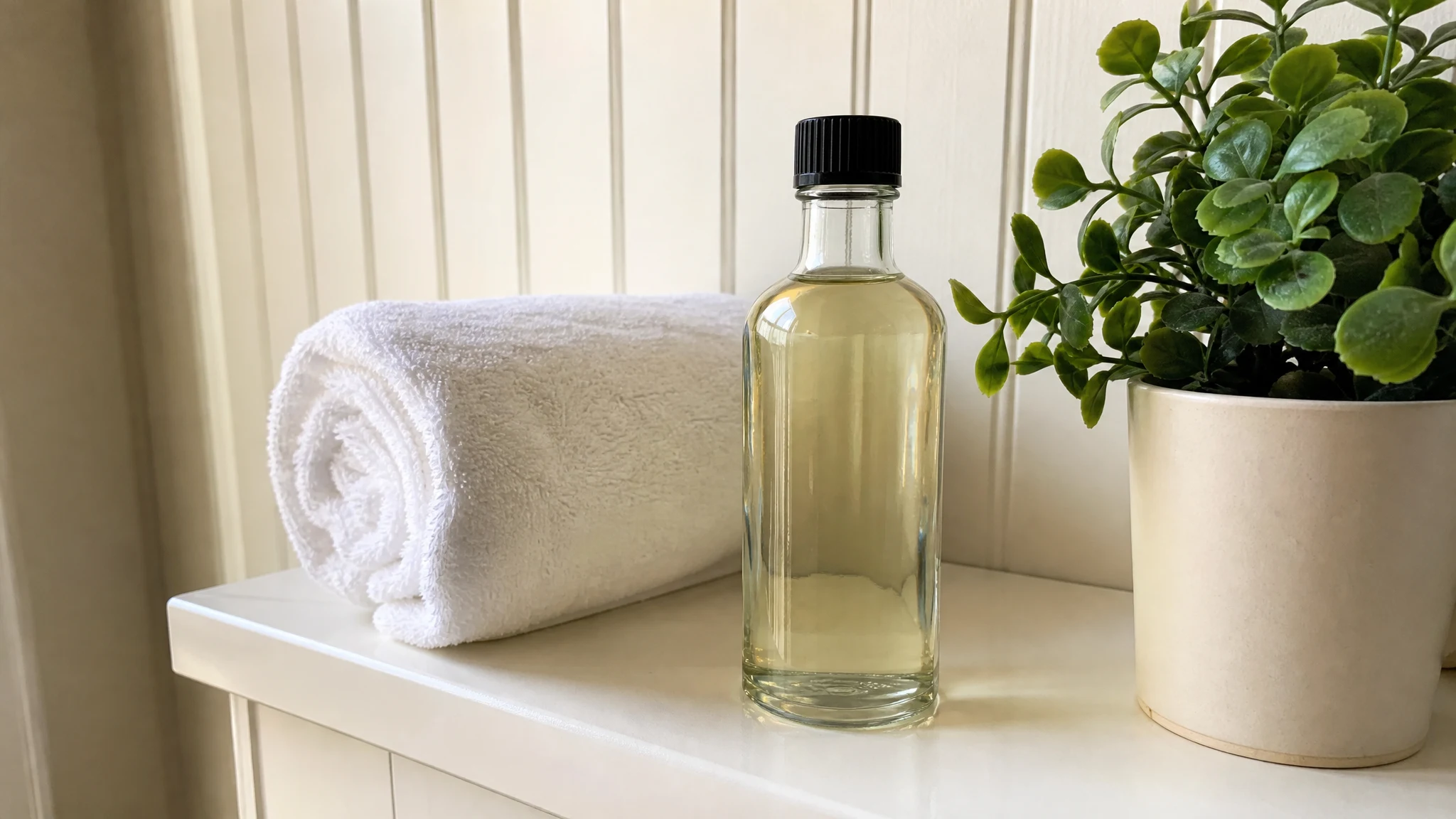
- Weigh the almond oil into a clean, dry container, then add the essential oil by weight.
- Label the ingredients, percentage and date.
- Make small batches. We describe our oil as keeping about a year from pressing when stored cool and dark, and adding an essential oil changes that picture.
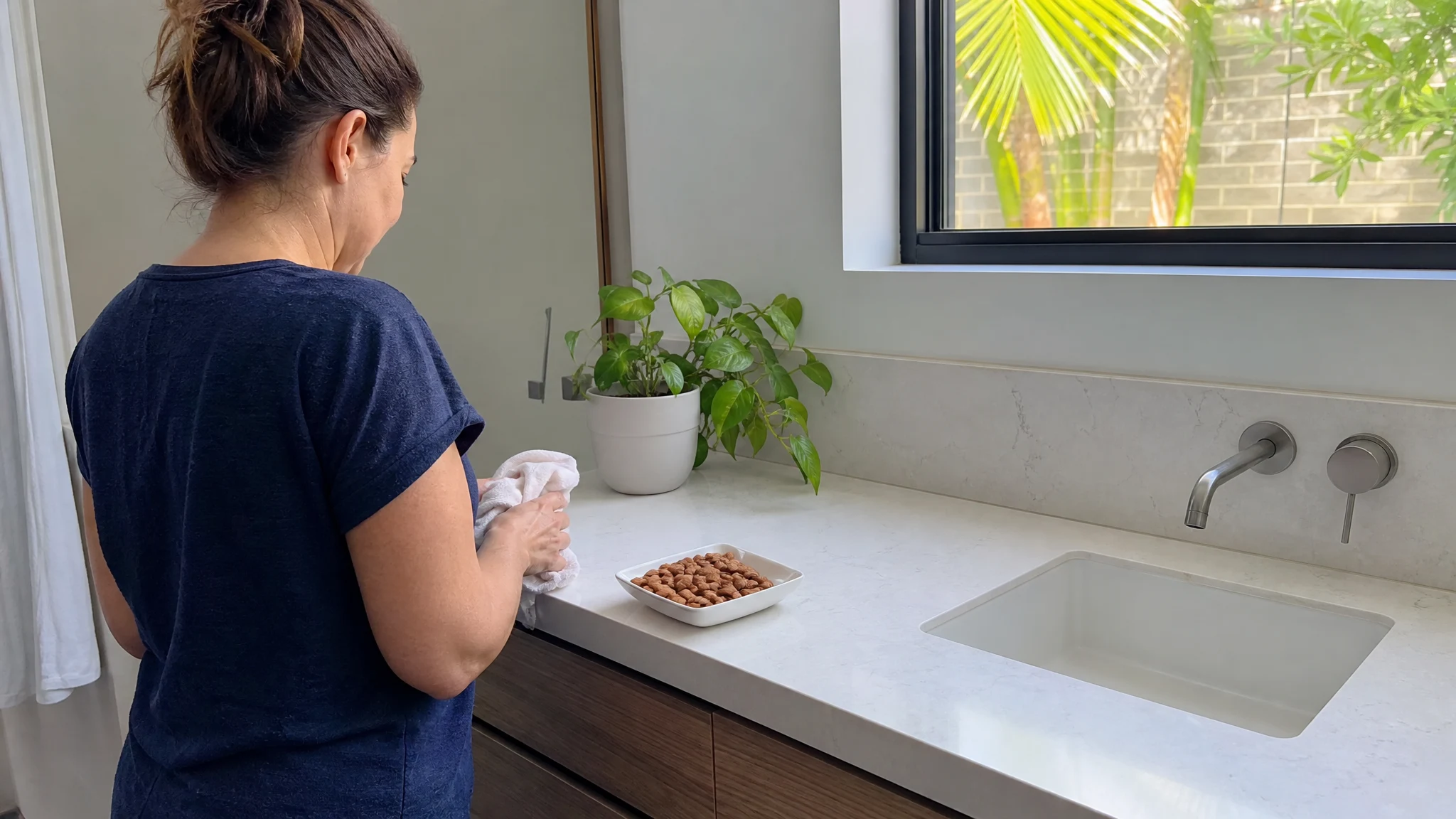
- Patch test the finished blend: the American Academy of Dermatology suggests a quarter-sized spot on the inner arm, twice a day for seven to ten days, stopping at redness, itching or swelling (How to test skin care products).
Keep blends away from eyes, and see our storage guide for the rest.
Scent and feel
Once your blend is mixed, give it a day in a cool, dark place before judging the scent, since you may find the first impression changes. Almond oil's own aroma is so quiet that the essential oil stays in front, and the feel is light enough to use on shoulders and arms without the heavy slick of a thicker oil.
When not to blend
Children are the clearest case. A 2007 report described three prepubertal boys who developed breast tissue enlargement while using products containing lavender and tea tree oils, which resolved when they stopped (Prepubertal gynecomastia linked to lavender and tea tree oils). Three cases do not tell us how common this is, but they are reason enough to ask a pediatrician first. Pregnancy is a question for your obstetrician or midwife.
We make one oil and do not sell essential oils, so we have no stake in which you pick. We just like a base that stays out of the way, and a careful hand with the rest.

Sweet Almond Oil
Sweet Almond Oil from our own shop, in sizes from 0.5 oz to bulk.
From $9.99
Shop Now →Sources & Further Reading
- American Academy of Allergy, Asthma and Immunology. Food allergy: nut oils in topical products.
- Tisserand Institute. Dilution for essential oils.
- Andersch Björkman Y et al., 2014. Air-oxidized linalool elicits eczema in allergic patients - a repeated open application test study. Contact Dermatitis.
- Burnett CL et al., 2017. Safety Assessment of Plant-Derived Fatty Acid Oils. Int J Toxicol.
- Vaughn A et al., 2018. Multi-Center Randomized Clinical Study of The Effects of Natural Oils on Xerosis and Skin Barrier Properties. SKIN The Journal of Cutaneous Medicine.
- American Academy of Dermatology. How to test skin care products.
- Henley DV et al., 2007. Prepubertal gynecomastia linked to lavender and tea tree oils. N Engl J Med.