Almond Oil for Dark Circles? Start With the Cause
Ask ten people what causes dark circles and you will hear sleep, screens and not enough water. Dermatologists tell a more tangled story: under-eye darkness is really a handful of different things that happen to look alike, and which one you have decides what is worth doing about it. That is also why we keep our almond oil away from the eye area, and why this post is about understanding the circles rather than handing you a routine.
Several look-alikes under one name
The most complete review we found, a 2016 paper in the Journal of Clinical and Aesthetic Dermatology, calls the condition periorbital hyperpigmentation and lists a surprisingly long set of contributors. Some people inherit a tendency to deeper pigment in that skin. Others get darkening after an inflamed patch of eczema or an allergic reaction has settled. In some faces the skin under the eye is so thin that blood vessels show through, giving a bluish or purplish cast. In others the colour is mostly shadow, thrown by a hollow where the lower lid meets the cheek. Puffy lids can add to the effect, and certain glaucoma eye drops (the prostaglandin analogues) are known to darken the skin around the eye.
Sunlight makes pigment-related darkening worse. The popular culprits, lack of sleep, stress, alcohol and smoking, are described in the same review as possible contributors that have not been clinically substantiated. In plain English: a long night may leave you looking tired, but it is not the proven villain the internet makes it.
A thirty-second check at the mirror
Here is the part we enjoy passing along, because it costs nothing. The review describes a simple bedside test dermatologists use: gently stretch the skin of the lower lid and watch. If the colour holds when the skin is pulled taut, it is true pigmentation. If it fades or disappears, you are most likely looking at shadow from the shape of the lid. If it turns more violet, thin skin or visible vessels are the likelier story. This is a self-check and not a diagnosis, and a dermatologist is the person who can sort out cases where more than one cause is at work.
It is worth doing before you buy anything. A shadow cast by anatomy will not change with anything you spread on the surface, and judging a product for a month against a cause it cannot reach only leads to disappointment.
What the professionals reach for
The same review lists the dermatologist toolkit: topical lightening agents such as hydroquinone, kojic acid and azelaic acid, retinoic acid, chemical peels, lasers and surgical correction, with the authors noting that many of these were tried first for melasma rather than for the eye area. Their conclusion is a sensible one: find the main cause and treat that. A cold-pressed plant oil is not on the list, and we would not ask it to do a job it was not built for.
Where an oil does shine
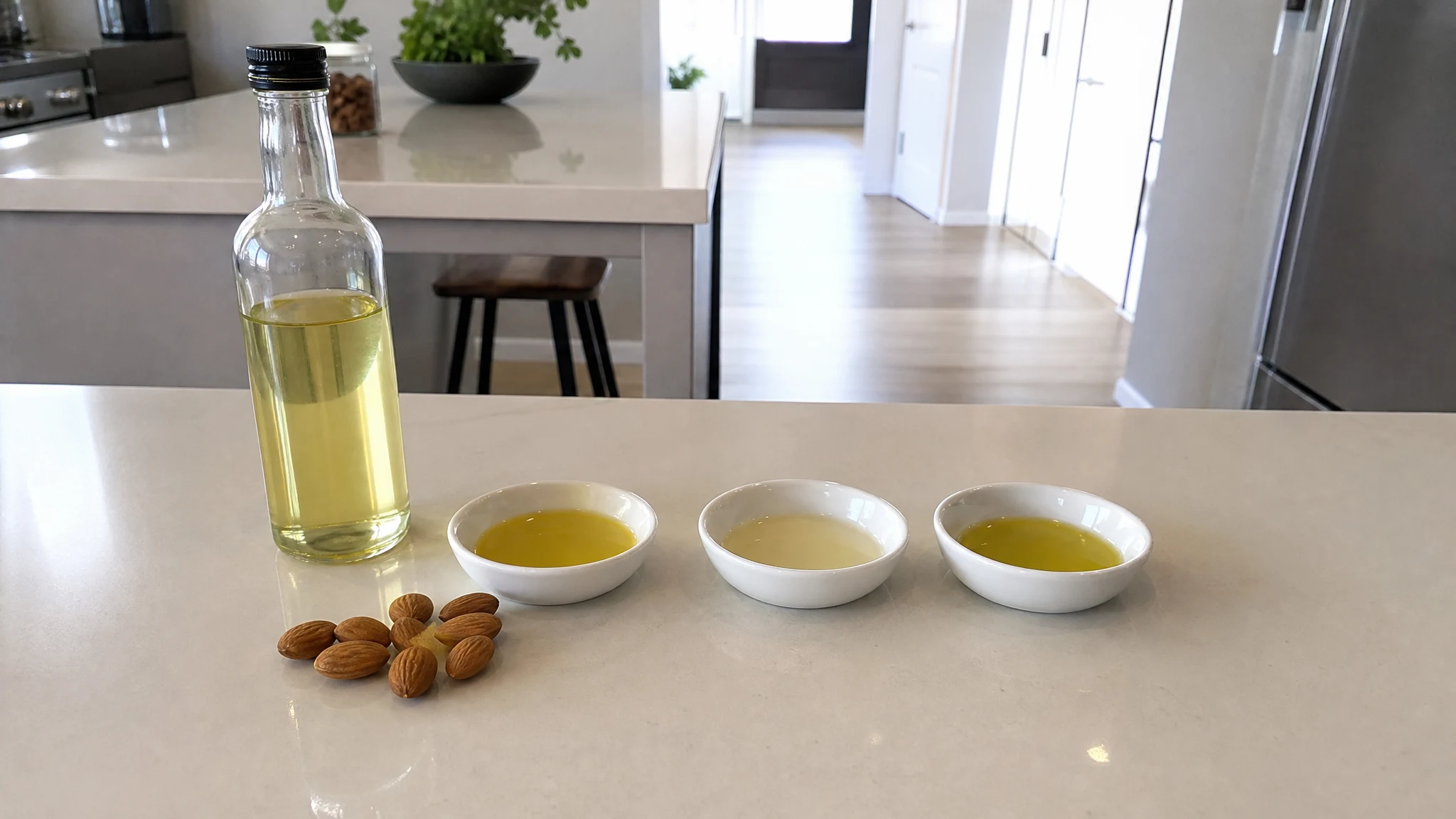
What sweet almond oil does well is the everyday work of a moisturizer. In a 2018 randomized pilot in the journal SKIN, 32 people who finished the study put almond oil, coconut oil, jojoba oil or white petrolatum on dry skin twice a day for two weeks. All four raised skin hydration by the second week, and almond oil was the one the largest share of participants liked best (38 percent). That trial was not about the eye area and it is not about colour, but it captures what we love about the oil: a soft, lightly nutty scent, a quick-absorbing feel and a non-greasy finish on dry skin elsewhere on the body. You will find more on that in our dry skin post.
Why we say no to the eye area
Our safety guidance is to keep the oil away from the eyes, and we mean it. Our oil is cold-pressed and unrefined, so trace almond protein is present, which is why we ask anyone with a tree nut allergy not to use it at all. On top of that, the FDA’s eye cosmetic safety page advises against using any cosmetic near the eyes unless it is intended specifically for that use. The review we cited adds one more reason for care: it lists darkening after an allergic contact reaction as a cause of under-eye pigment, so irritating that skin can work against what you are hoping for.
If you try any new product on your face, test it first the way dermatologists suggest. The American Academy of Dermatology recommends a quarter-sized spot on the inner arm or elbow bend, twice a day for seven to ten days, and stopping if you notice redness, itching or swelling. Our shop guidance is a patch test with a day’s wait; for something near the face, take the longer route. Our patch-testing guide walks through it, and our nut allergy post explains why the allergy question comes first.
If you like a small ritual around your eyes, a splash of cool water and a soft towel costs nothing and asks nothing of the skin. And keep the popular worries in perspective: the review we cited describes those everyday habits as possible, unproven contributors.
What we would do instead
If the circles bother you, book a visit with a dermatologist who can tell which kind you have; that is the step that saves the most time and money. Daily sun protection is a standard dermatology recommendation, and almond oil is not a sunscreen, as we explain in our sunscreen post. If you are curious about homemade eye creams, our DIY eye cream post looks at why those recipes are harder than they appear, and our dark spots post covers pigment on the rest of the body and face.
Dark circles are common, mostly harmless and wonderfully varied. A little knowledge of which kind you have makes the whole thing less mysterious.

Sweet Almond Oil
Sweet Almond Oil from our own shop, in sizes from 0.5 oz to bulk.
From $9.99
Shop Now →Sources & Further Reading
- Sarkar R, et al. (2016). Periorbital Hyperpigmentation: A Comprehensive Review. Journal of Clinical and Aesthetic Dermatology.
- Vaughn A, et al. (2018). Multi-Center Randomized Clinical Study of The Effects of Natural Oils on Xerosis and Skin Barrier Properties. SKIN The Journal of Cutaneous Medicine.
- American Academy of Dermatology. How to test skin care products.
- U.S. Food and Drug Administration. Eye Cosmetic Safety.