Almond vs Coconut Oil on Eczema-Prone Skin: The Evidence
Which oil is gentler on eczema-prone skin, almond or coconut? It is a fair question, and the honest first answer is that nobody has tested the two against each other. What exists is one trial of coconut oil in children, a small dry-skin pilot that included both, and some practical guidance from the groups that support people with eczema. Eczema is a medical condition, so this page reports what is known and leaves decisions to a dermatologist or pediatrician.
If you came here hoping for a winner, we understand. When skin is dry and uncomfortable, a clear answer is appealing. We would rather give you an honest map than a confident guess, so think of this page as a set of facts and questions to take along to your appointment.
Start with the nut question
Our oil is unrefined sweet almond oil, so trace almond protein is present, and anyone with a tree nut allergy should not use it. Food Allergy Research & Education lists almond oil among products to avoid with a tree nut allergy. An allergist writing for the American Academy of Allergy, Asthma and Immunology explains that refined oils generally lack protein, unrefined cold-pressed ones retain it, and that topical use has not been well studied. For skin that is cracked or inflamed, whether to use an unrefined nut oil at all is a conversation for an allergist.
For babies, the American Academy of Pediatrics says not to use nut-based oils for massage, since they might cause an allergic reaction, and suggests a natural oil like coconut. Our baby massage page covers that guidance.
What eczema groups actually recommend
The National Eczema Association organises its advice by product type, not by oil. Ointments hold the most oil, then creams, then lotions, which are mostly water. Its moisturizing page says products high in oil, such as petroleum jelly and mineral oil, are particularly good for eczema, and that creams and ointments are the most effective at keeping moisture in. It suggests applying a thick layer within three minutes of bathing and choosing fragrance-free products. It does not single out coconut or almond oil.
That is the most useful fact for an almond-versus-coconut decision: the leading patient group is telling you to think about how much oil a product has before you choose which oil it contains.
A quick word on how to read the next section. A study tells you what happened to the particular people in it, with the particular product they were given, over the weeks it ran. It is useful for forming a question, and less useful for deciding what to do on a Tuesday evening with your own skin. Keep that in mind as you read on.
What was actually tested
For coconut, the main evidence is a randomized, double-blind trial in 117 children with mild to moderate atopic dermatitis. Virgin coconut oil was compared with mineral oil for eight weeks, and the coconut group improved more on the clinical score. Almond oil was not part of it, and it concerns mild to moderate disease in children, so it is a data point and not a recommendation.
For almond, we know of no eczema trial. The nearest thing is the 2018 dry-skin pilot in 32 participants, where almond, coconut, jojoba and white petrolatum all raised hydration after two weeks with no significant differences. Dry skin is not atopic dermatitis, so we would not stretch that result.
There is also a useful caution from a different pair of oils. A forearm study in 19 adults found that olive oil reduced skin barrier integrity and caused mild redness, while sunflower seed oil preserved integrity. Oils are not interchangeable, and calling something natural does not tell you how it will behave on a compromised barrier. Almond oil was not tested there, and we are not suggesting it behaves like olive oil.
How the two oils differ in the hand
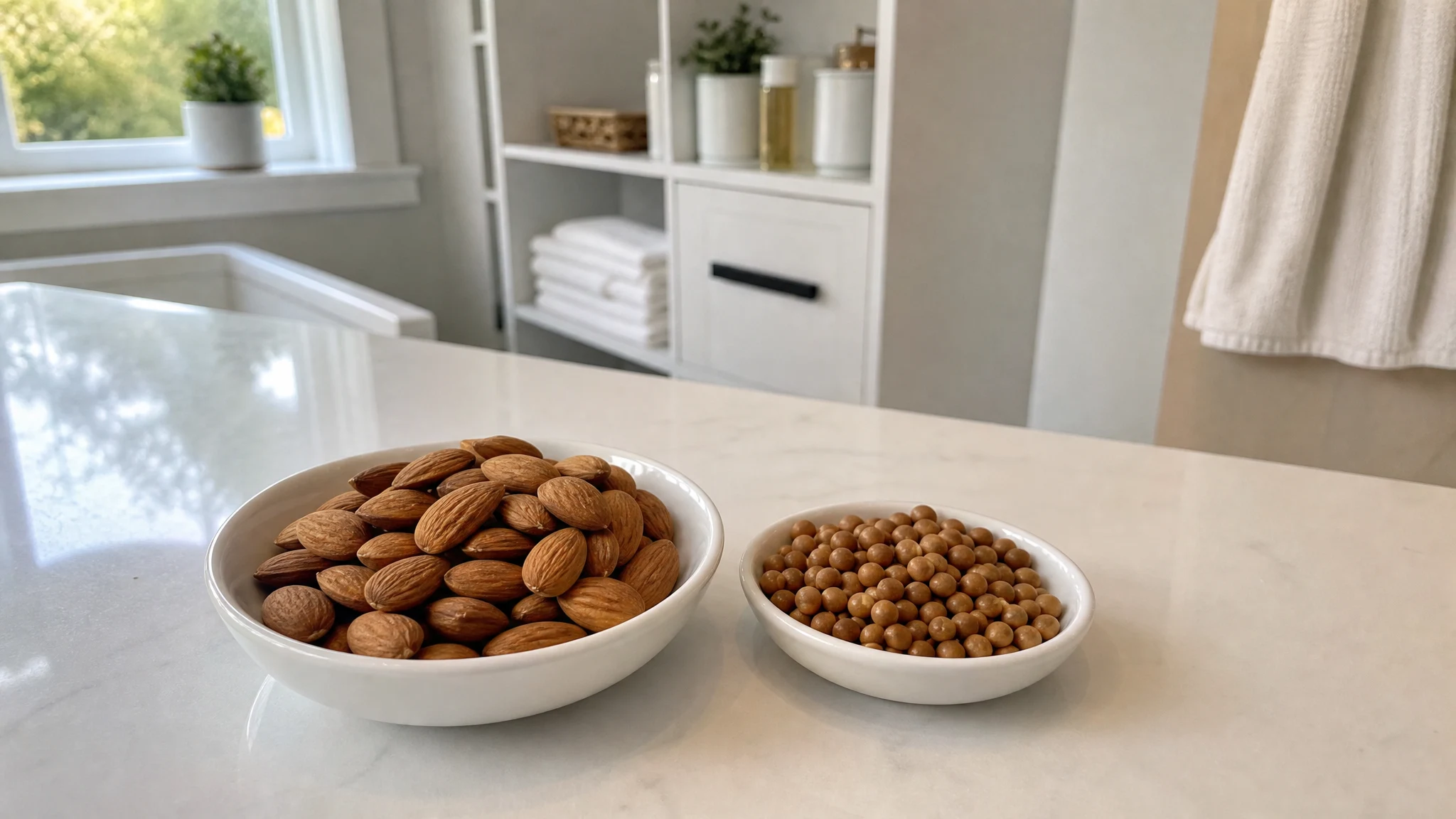
Setting the studies aside, the two oils feel quite different, and that matters for what you can live with day to day. Almond oil is liquid at room temperature and light on the fingers, with a soft nutty scent that does not linger. Coconut oil is firmer and has its own distinct aroma. Neither feel is better or worse, it is a personal preference, and a scent you dislike is a perfectly good reason to leave a product on the shelf.
Questions worth bringing to your appointment
- Is an oil of any kind sensible for my skin, or my child's skin, right now?
- Should it go on before or after a prescribed treatment, and on damp or dry skin?
- Given our family history of allergies, is a tree nut oil a good idea at all?
- Would you pick an ointment or a cream instead, and how often should I apply it?
Writing the answers down on your phone means you will not have to remember them later.
So which one?
The evidence does not choose for you. Both are plain oils, neither has been compared with the other for eczema, and the eczema groups emphasise thick moisturizers and fragrance-free products. If a dermatologist or pediatrician is happy for you to try an oil, our patch test guide shows how to do a small test first, and our sensitive skin FAQ covers who should skip almond. For the broader oil comparison outside eczema, see our almond and coconut guide.
We sell a cosmetic almond oil for external use and make no medical claims for it. Your clinician knows your skin, and their guidance comes first.

Sweet Almond Oil
Sweet Almond Oil from our own shop, in sizes from 0.5 oz to bulk.
From $9.99
Shop Now →Sources & Further Reading
- Food Allergy Research & Education. Tree Nut. foodallergy.org
- Pongracic J, American Academy of Allergy, Asthma and Immunology. Food allergy: nut oils in topical products. aaaai.org
- American Academy of Pediatrics. The Benefits of Baby Massage. healthychildren.org
- National Eczema Association. The Best Eczema Lotions and Moisturizers. nationaleczema.org
- Evangelista MT et al., 2014. The effect of topical virgin coconut oil on SCORAD index, transepidermal water loss, and skin capacitance in mild to moderate pediatric atopic dermatitis: a randomized, double-blind, clinical trial. Int J Dermatol 53:100-108. PubMed 24320105
- Vaughn A et al., 2018. Multi-Center Randomized Clinical Study of The Effects of Natural Oils on Xerosis and Skin Barrier Properties. SKIN The Journal of Cutaneous Medicine. skin.dermsquared.com
- Danby SG et al., 2013. Effect of olive and sunflower seed oil on the adult skin barrier: implications for neonatal skin care. Pediatr Dermatol 30:42-50. PubMed 22995032