Almond Oil vs Argan Oil: Which Fits You Better?
Argan oil arrives with a story, a far-off origin and a price that tells you it is special. Sweet almond oil arrives with a quiet reputation for being the oil people actually reach for. When you read the skin studies behind each, the gap in evidence turns out to be far smaller than the gap in glamour, which makes the choice more about fit than prestige.
Check the nut question before anything else
Almond is a tree nut. Food Allergy Research & Education lists almond oil among the products to avoid with a tree nut allergy and notes that oils such as walnut and almond often are not highly refined and turn up in lotions, hair care and soaps. Ours is cold-pressed and sold unrefined, so trace almond protein is present, and we ask anyone with a tree nut allergy not to use it. That holds whatever oil you are comparing us with.
Argan does not make the question disappear. We are not the right source on whether it suits an allergic person, and a cosmetic-oils review lists a potential for allergic reactions as an argan drawback without giving data, so an allergist is the person to ask.
Two oils built from the same two fatty acids
Both oils are mostly oleic and linoleic acid, and the balance between them is the main chemical difference. In a study of 31 sweet almond genotypes, oleic acid ranged from about 62 to 76 percent and linoleic acid from about 14 to 30 percent. A review of plant-based cosmetic oils puts argan at roughly 43 to 49 percent oleic and 29 to 37 percent linoleic. Those are general figures, not measurements of our oil: the certificate we publish for one batch covers density, refractive index and optical rotation only, and if you need a fatty-acid profile for a lot, ask us in writing through the contact page.
What does that mean in practice? Reasoning from the numbers, argan carries more linoleic acid, and linoleic acid is the more delicate of the two. A 2025 review of oil oxidation gives relative oxidation rates of 10 for oleic acid and 100 for linoleic. Argan's natural tocopherols balance that in its favour. We have not seen a head-to-head shelf-life test of the two, so treat any claim about which keeps longer as reasoning.
What the skin studies tested
The most-cited argan skin trial involved 60 postmenopausal women over 60 days. Half of the design concerned eating argan oil, and every woman also applied cosmetic argan to a forearm each night, so the study tells you little about a bottle on a bathroom shelf (Boucetta et al., 2015). For hair, a systematic review of 22 articles on coconut, castor and argan concluded that argan does not have significant evidence behind its use for hair.
Almond oil's record is modest too, in a different way. In a randomized pilot, 32 participants applied almond oil, coconut oil, jojoba oil or white petrolatum twice a day for two weeks. All four raised skin hydration by week two with no significant difference between them. In plain terms, almond did about as well as the other moisturizers in that trial, and no trial we know of puts almond and argan head to head.
Ask for the story, then check it
We love a good origin story, and we think you should ask for one. Whichever oil you are looking at, a seller who can tell you the botanical name, how the oil was pressed and where the lot paperwork lives is a seller worth listening to. Ours is cold-pressed and sold unrefined, and every bottle carries a pressing date, a bottling date and a lot number, so you can see for yourself how old it is.
Feel and scent count too
Beyond the studies, oils simply feel different, and that matters when you will use one every day. Ours is a thin, faintly golden oil with a soft, lightly sweet, nutty scent. It pours easily and spreads in a light film. Whichever oil you try, do the same quick test: warm a drop in your palm, smell it, rub it into the back of your hand and see how it sits after a few minutes. You will learn more from that than from any label.
How we would choose
Nobody has earned the crown, so choose on practical grounds.
- Tree nut allergy in the household: leave almond oil out, and ask an allergist about any alternative.
- No allergy and you like a light, fragrance-free oil: either is a reasonable skin or hair finishing oil, and almond has a gentle nutty sweetness. For a face routine, our face guide covers how we think about it.
- Very dry skin: the American Academy of Dermatology says ointments and creams add more moisture than lotions, and the ingredients it lists for dry skin do not include almond or argan. An oil can sit on top of that, and persistent dryness deserves a dermatologist.
- Paying for the origin story: ask for the botanical name and the lot paperwork, the same questions we would want answered about ours.
Whichever you try, patch test a small area and wait a day. Our patch test guide shows how, and the research round-up covers what is known about almond oil itself.
Oils earn their place by how they feel and how they fit your life, and on that score a plain, honest almond oil holds its own beside a famous one.
Pick the one you will enjoy opening every morning, and keep the cap on tight.
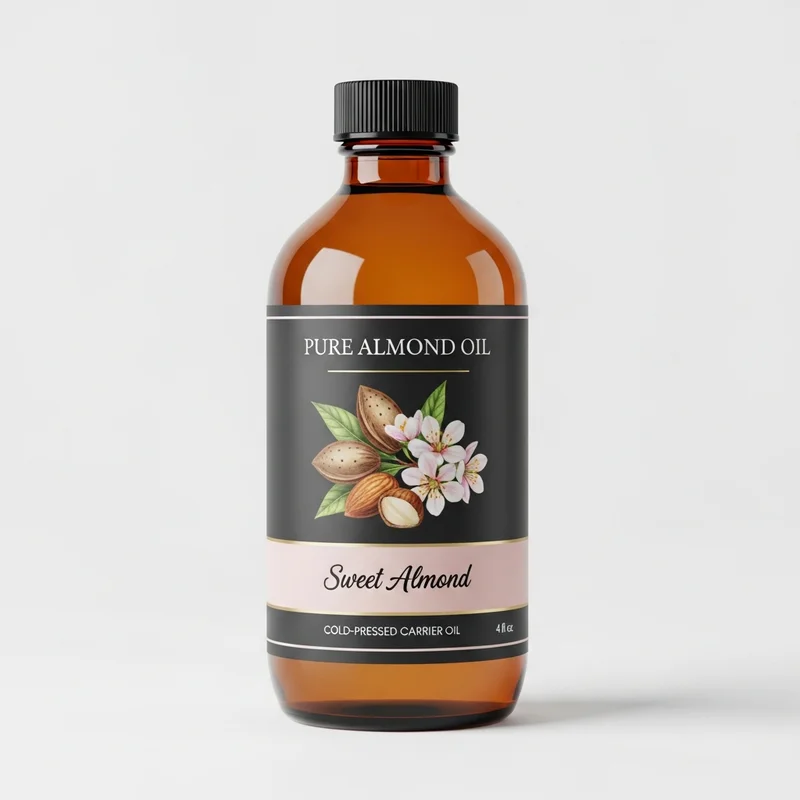
Sweet Almond Oil
Sweet Almond Oil from our own shop, in sizes from 0.5 oz to bulk.
From $9.99
Shop Now →Sources & Further Reading
- Food Allergy Research & Education. Tree Nut. foodallergy.org
- Ozcan MM et al., 2020. Effect of almond genotypes on fatty acid composition, tocopherols and mineral contents and bioactive properties of sweet almond (Prunus amygdalus Batsch spp. dulce) kernel and oils. J Food Sci Technol 57(11):4182-4192. PMC7520497
- Abdalla S, Aroua MK, Gew LT, 2024. A Comprehensive Review of Plant-Based Cosmetic Oils (Virgin Coconut Oil, Olive Oil, Argan Oil, and Jojoba Oil): Chemical and Biological Properties and Their Cosmeceutical Applications. ACS Omega 9:44019-44032. PMC11541506
- Gharby S et al., 2025. Vegetable oil oxidation: Mechanisms, impacts on quality, and approaches to enhance shelf life. Food Chem X 28:102541. PMC12146556
- Boucetta KQ et al., 2015. The effect of dietary and/or cosmetic argan oil on postmenopausal skin elasticity. Clin Interv Aging 10:339-349. PMC4321565
- Phong C et al., 2022. Coconut, Castor, and Argan Oil for Hair in Skin of Color Patients: A Systematic Review. J Drugs Dermatol 21(7):751-757. PubMed 35816075
- Vaughn A et al., 2018. Multi-Center Randomized Clinical Study of The Effects of Natural Oils on Xerosis and Skin Barrier Properties. SKIN The Journal of Cutaneous Medicine. skin.dermsquared.com
- American Academy of Dermatology. Dermatologists' top tips for relieving dry skin. aad.org