Sunflower Oil vs Almond Oil: Which Type Do You Have?
A bottle labeled "sunflower oil" does not tell you much, and that is the first thing worth knowing before you compare it with almond oil. Depending on the seed variety, sunflower oil can be built mostly from linoleic acid or mostly from oleic acid, and the two behave differently. Almond oil sits in a steadier spot, and that makes the comparison more interesting than it looks.
Three sunflower oils wearing one name
Health Canada's novel food information on a mid-oleic sunflower oil spells the spread out: traditional sunflower oils run about 13 to 40 percent oleic acid and 40 to 74 percent linoleic acid, while the mid-oleic type runs 55 to 75 percent oleic and 15 to 35 percent linoleic (Novel food information: NuSunTM mid-oleic sunflower oil). There are also high-oleic sunflower oils, which we do not quote figures for here.
Now set almond oil beside that. In cold-pressed oils from three almond cultivars, oleic acid ran about 74 to 77 percent and linoleic about 20 to 22 percent (Özcan et al., 2020). Those are general almond oil figures, not a measurement of ours; the Certificate of Analysis we publish for one batch covers density, refractive index and optical rotation only.
The takeaway is practical: an oleic-rich almond oil looks a lot more like a mid-oleic sunflower oil than like a traditional high-linoleic one. So the real question is rarely "almond or sunflower?" It is "almond or which sunflower?" If the label does not say, ask the seller.
Next time you are in the kitchen aisle, turn the sunflower bottle around and see how much the label tells you. Many say only "sunflower oil," which can hide a big difference. It is a small habit, reading the back of a bottle, but it saves a lot of guesswork later.
What the skin studies do and do not tell us
You will often read that sunflower oil is kind to the skin barrier and that oleic-rich oils are not. The best-known human data comes from a small study of 19 adults, using forearm applications, in which olive oil reduced the integrity of the outer skin layer and caused mild redness, while sunflower seed oil preserved integrity and improved hydration (Effect of olive and sunflower seed oil on the adult skin barrier: implications for neonatal skin care). Almond oil was not part of it.
It is tempting to file almond oil with olive oil because both are oleic-rich, but nobody has run that test on almond oil, so that would be a guess. What we can say is that if barrier health is your main concern, sunflower has the one small adult study in its corner, and a dermatologist is the right person to ask which oil, if any, suits you. For a different angle on almond oil and skin, our almond versus olive oil post covers that neighbor.
A note on babies
The same group later ran a pilot with 115 healthy newborns who received olive oil, sunflower oil or no oil twice a day for four weeks. Hydration was better in the oil groups, but the skin's lipid layers developed less well than with no oil, and the authors advised caution about recommending oils for newborn skin (Olive oil, sunflower oil or no oil for baby dry skin or massage: the OBSeRvE study). Neither oil on this page is baby advice; a pediatrician is the right conversation.
Where we would reach for each
For a soft, lightly sweet, subtly nutty liquid carrier, and for massage, almond oil is what we make and love working with. Our oil is cold-pressed, sold unrefined and sold neat, which suits blending because it does not drown out essential oils. For cooking or a cost-driven bulk purchase where sunflower is the usual workhorse, you will find sunflower at any grocery or supplier. We do not quote prices in articles, so we will leave cost comparisons to current quotes, with one tip: compare the type of sunflower oil and the date on the bottle as carefully as the price.
One difference is not up for debate. Almond is a tree nut and our oil is unrefined, so trace almond protein is present. If you have a tree nut allergy, do not use it. The allergist's explanation of refined versus unrefined nut oils is on the AAAAI page listed below, and our nut allergy post goes deeper.
Picking by feel
If you can sample both, put a drop of each on your hand and rub them in. Pay attention to how fast each spreads, whether it leaves any slickness and what it smells like after a minute. Almond oil tends to feel soft and light with a faint nutty note. Sunflower oils vary a lot by type, which is why the label matters. Your own hands are a fair judge of which one you will reach for again.
What to look for on any bottle
- Type: for sunflower, high-linoleic, mid-oleic or high-oleic. If it is not stated, ask.
- Refined or not: our refined versus unrefined guide unpacks what the words mean.
- Dates: we describe our oil as keeping about a year from pressing when stored cool and dark. The storage guide has the details.
- Paperwork: for peroxide value or fatty acid results on one of our lots, ask us in writing through the contact page.
Whatever you choose, patch test on a small area and wait a day. And if you enjoy comparing carriers, our almond versus coconut post is a good next stop.
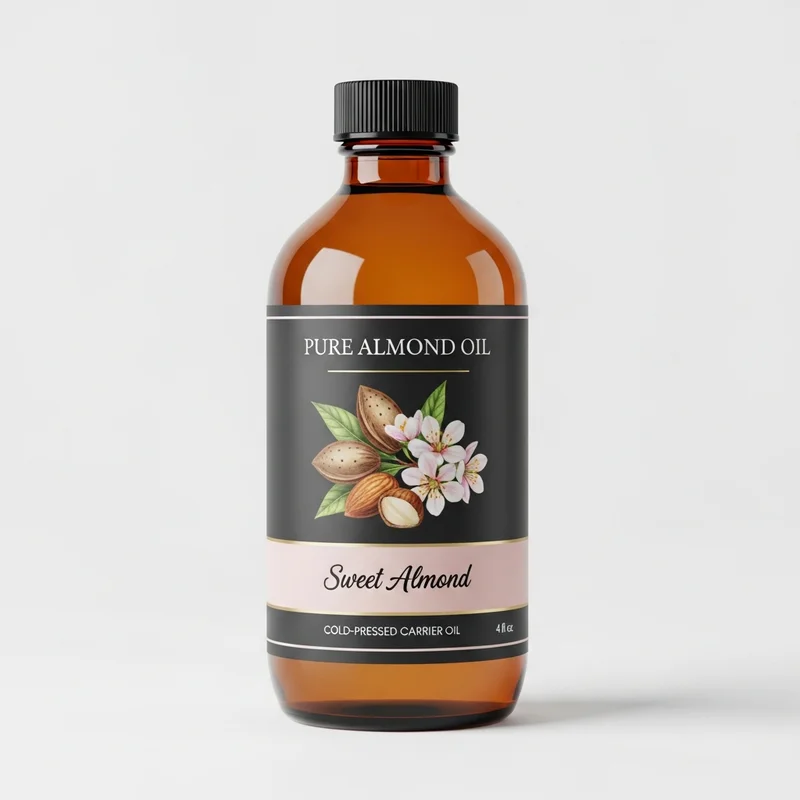
Sweet Almond Oil
Sweet Almond Oil from our own shop, in sizes from 0.5 oz to bulk.
From $9.99
Shop Now →Sources & Further Reading
- Health Canada. Novel food information: NuSunTM mid-oleic sunflower oil.
- Özcan MM et al., 2020. Characterization of physico-chemical and bioactive properties of oils of some important almond cultivars by cold press and soxhlet extraction. J Food Sci Technol.
- Danby SG et al., 2013. Effect of olive and sunflower seed oil on the adult skin barrier: implications for neonatal skin care. Pediatr Dermatol.
- Cooke A et al., 2016. Olive oil, sunflower oil or no oil for baby dry skin or massage: the OBSeRvE study. Acta Derm Venereol.
- American Academy of Allergy, Asthma and Immunology. Food allergy: nut oils in topical products.