Jojoba vs Almond Oil: Why One Is a Liquid Wax
Jojoba oil is not, strictly speaking, an oil. It is a liquid wax, and almond oil is a true oil, and that single fact quietly explains most of what people ask when they hold the two bottles side by side. It is the detail the "which is better for your skin" articles tend to skip, and it is the one that actually helps you choose.
Wax on one side, triglycerides on the other
A 2021 review of jojoba oil describes it as roughly 98% wax, mostly wax esters, with small amounts of free fatty acids, alcohols and hydrocarbons, which is why the authors say it is known as a liquid wax rather than an oil or fat. Almond oil, like most plant oils, is a triglyceride: three fatty acids on a glycerol backbone, mostly oleic acid with some linoleic. In a study of 31 almond genotypes, oleic acid ran from about 62% to 76%. That is a general figure for the plant, since our own oil does not come with a fatty-acid profile attached.
Both pour from a bottle and both feel silky, so from the outside they look alike. In a jar, a balm or a blend they are not interchangeable.
What the difference means in practice
Keeping. The jojoba review reports high thermal and oxidative stability for crude jojoba oil, which it ties to natural tocopherols, and says that bleached oil loses those antioxidants and with them much of its stability. Reasoning from that, a crude jojoba will usually outlast most triglyceride oils in the cupboard, and processing matters as much as the plant. Almond oil is more sensitive, which is why we say to store ours cool and dark, in amber glass, and to use it within about a year of pressing.
Recipes. A wax ester and a triglyceride will not always mix and set the same way, so do not assume you can swap them gram for gram in a balm or a blend. If you are adapting a recipe, start with a small test batch.
Label reading. For jojoba, look for the botanical name, Simmondsia chinensis, and ask whether it is crude or bleached. For almond, look for sweet almond, Prunus amygdalus dulcis. Ours is cold-pressed from raw kernels and sold unrefined, with the pressing date and lot number on the bottle.
What the one head-to-head trial showed
Only one randomized pilot we can point to puts almond and jojoba in the same design. Thirty-two people with dry skin applied almond oil, coconut oil, jojoba oil or white petrolatum twice daily for two weeks. All four raised skin hydration by week two, and the differences between them were not statistically significant. Almond oil was the favorite, picked as most liked by 38% of participants.
That is a small, open-label study, so it does not rank anything, but it is a useful corrective to the idea that one of these is a clear winner for dry skin. The American Academy of Dermatology lists jojoba oil among ingredients to look for in creams and ointments for dry skin; that is a mention of an ingredient, not a contest between oils.
One claim you will see everywhere is that jojoba "mimics" the skin's own oil. We have left it out because we could not trace it to a trial that tests it. The jojoba review also reports mostly animal data and human patch tests with unstated group sizes, so we would call it a well-liked cosmetic ingredient and leave it at that.
Feel and aroma: the part you can check yourself
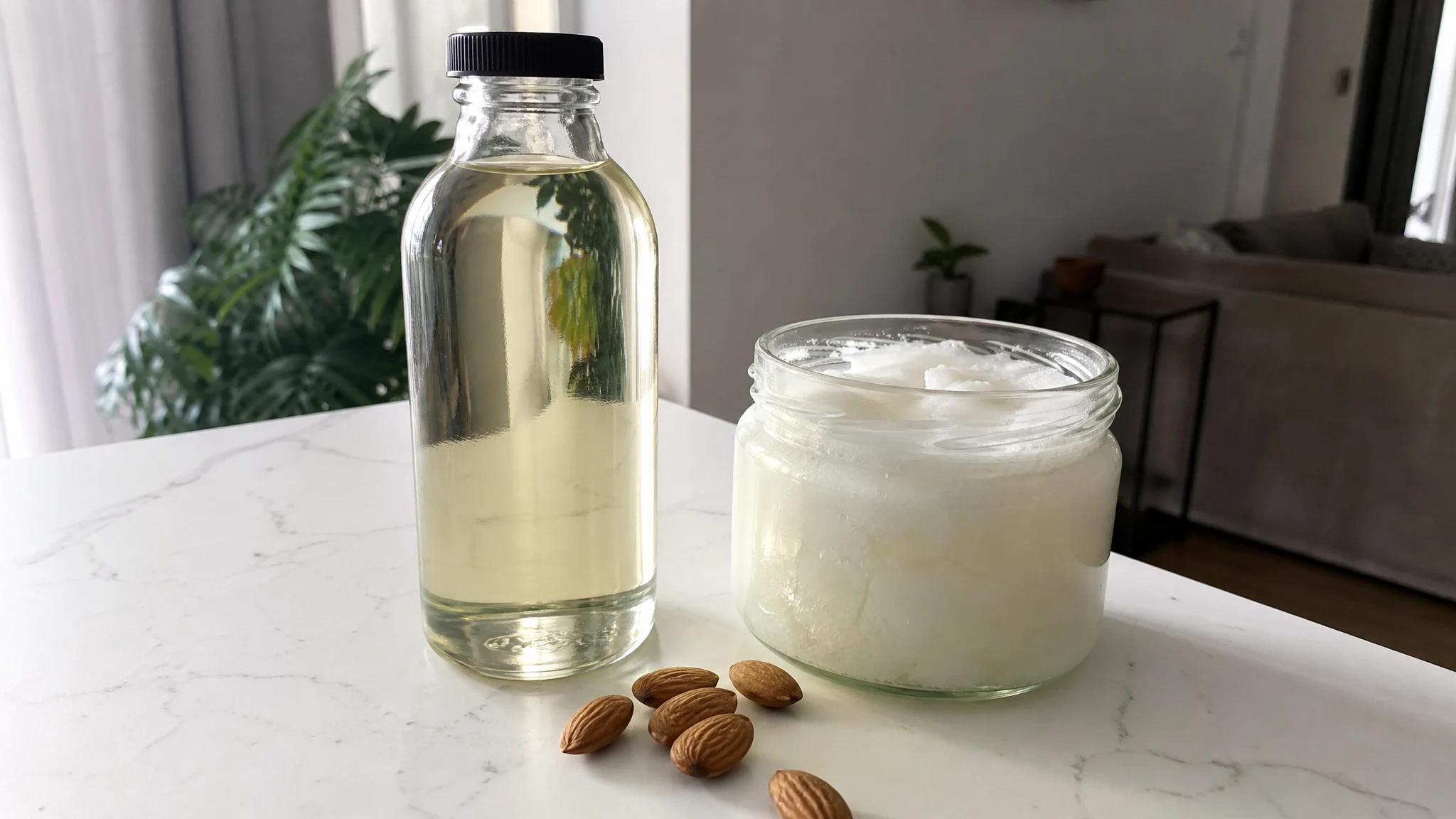
Specs aside, you will learn a lot from simply holding the two bottles. Almond oil is faintly golden with a soft, nutty, lightly sweet scent. Put a drop of each on the back of separate hands, after a patch test if you have not tried them before, and compare how quickly each one glides, how it settles, and what is left after a minute. Preferences about feel are personal, and no chart replaces them.
A tip for balm makers
If you do plan to experiment with a recipe, change one thing at a time. Swap only the oil, keep every other amount the same, make a spoonful rather than a jar, and let it cool fully before judging the texture. Label the trial so you remember which was which.
Allergy first
Almond is a tree nut. Since our oil is unrefined, trace almond protein remains, and we ask anyone with a tree nut allergy to skip it. Jojoba comes from a jojoba seed, not an almond kernel, but that does not guarantee a given commercial bottle suits an allergic reader, so read the full ingredient list and check with an allergist. Our nut allergy guide has the detail.
How we would choose
- You want the longest shelf life from a single bottle: jojoba, if it is crude and not bleached.
- You want a soft-gliding, quick-absorbing carrier for massage or for essential oil blends: almond. It blends well with lavender, rose, geranium, chamomile, sandalwood and ylang ylang, and our blending guide shows how to dilute.
- You are making balms: treat the wax and the oil as separate ingredients and test small.
- You have a tree nut allergy: almond is out.
If you are weighing other oils too, we compare almond with argan and marula as well, and the storage guide explains how to keep any oil fresh. Whichever way you lean, patch test first and let your own skin decide. If you pick almond, our shop has our cold-pressed oil, and our bulk sizes and guide to buying sweet almond oil in bulk cover larger amounts.

Sweet Almond Oil
Sweet Almond Oil from our own shop, in sizes from 0.5 oz to bulk.
From $9.99
Shop Now →Sources & Further Reading
- Jojoba Oil: An Updated Comprehensive Review on Chemistry, Pharmaceutical Uses, and Toxicity, Polymers, 2021.
- Effect of almond genotypes on fatty acid composition, tocopherols and mineral contents and bioactive properties of sweet almond (Prunus amygdalus Batsch spp. dulce) kernel and oils, 2020.
- Multi-Center Randomized Clinical Study of The Effects of Natural Oils on Xerosis and Skin Barrier Properties, SKIN The Journal of Cutaneous Medicine.
- Dermatologists' top tips for relieving dry skin, American Academy of Dermatology.