Shea Butter vs Almond Oil: Solid or Liquid?
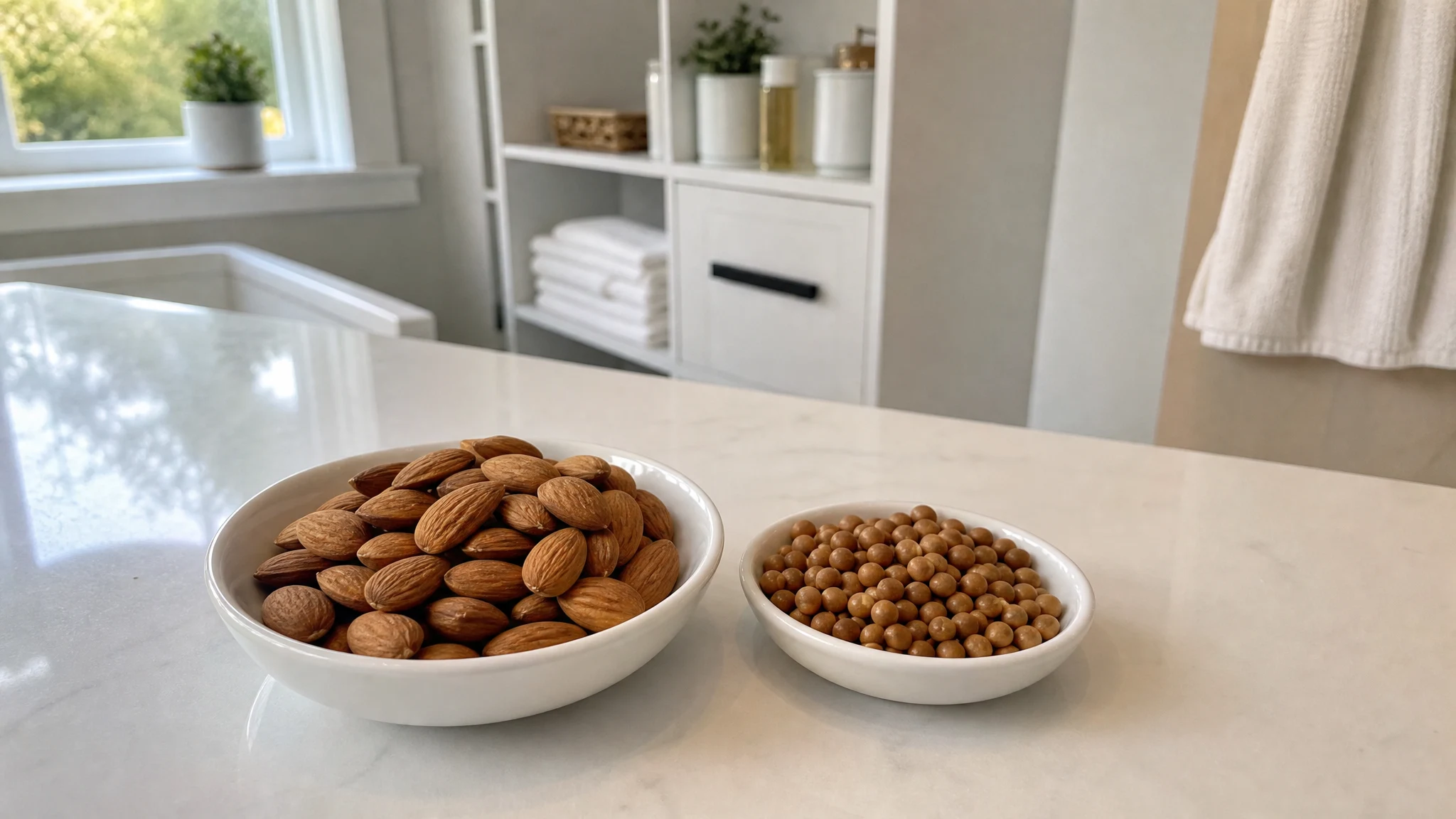
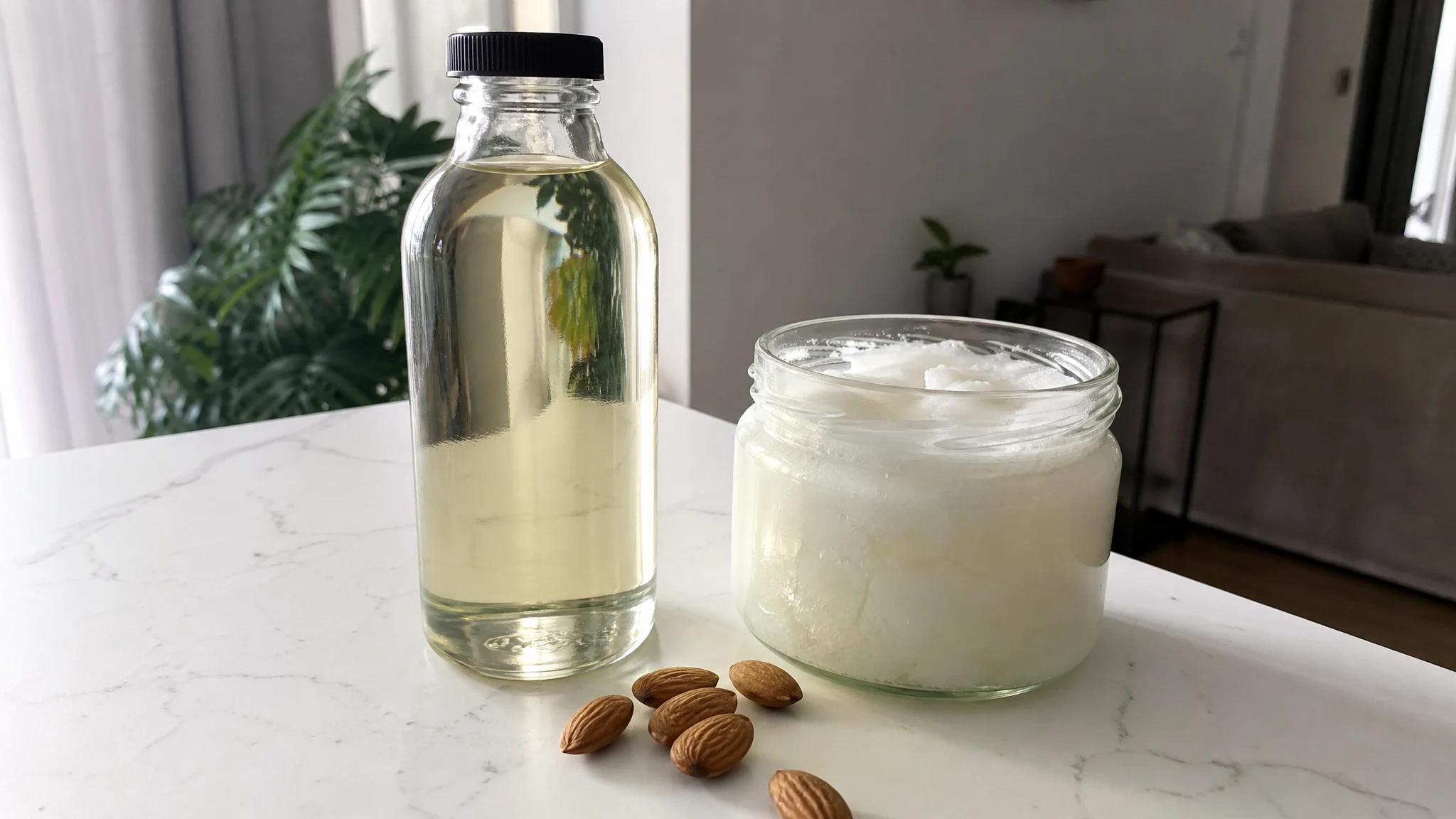
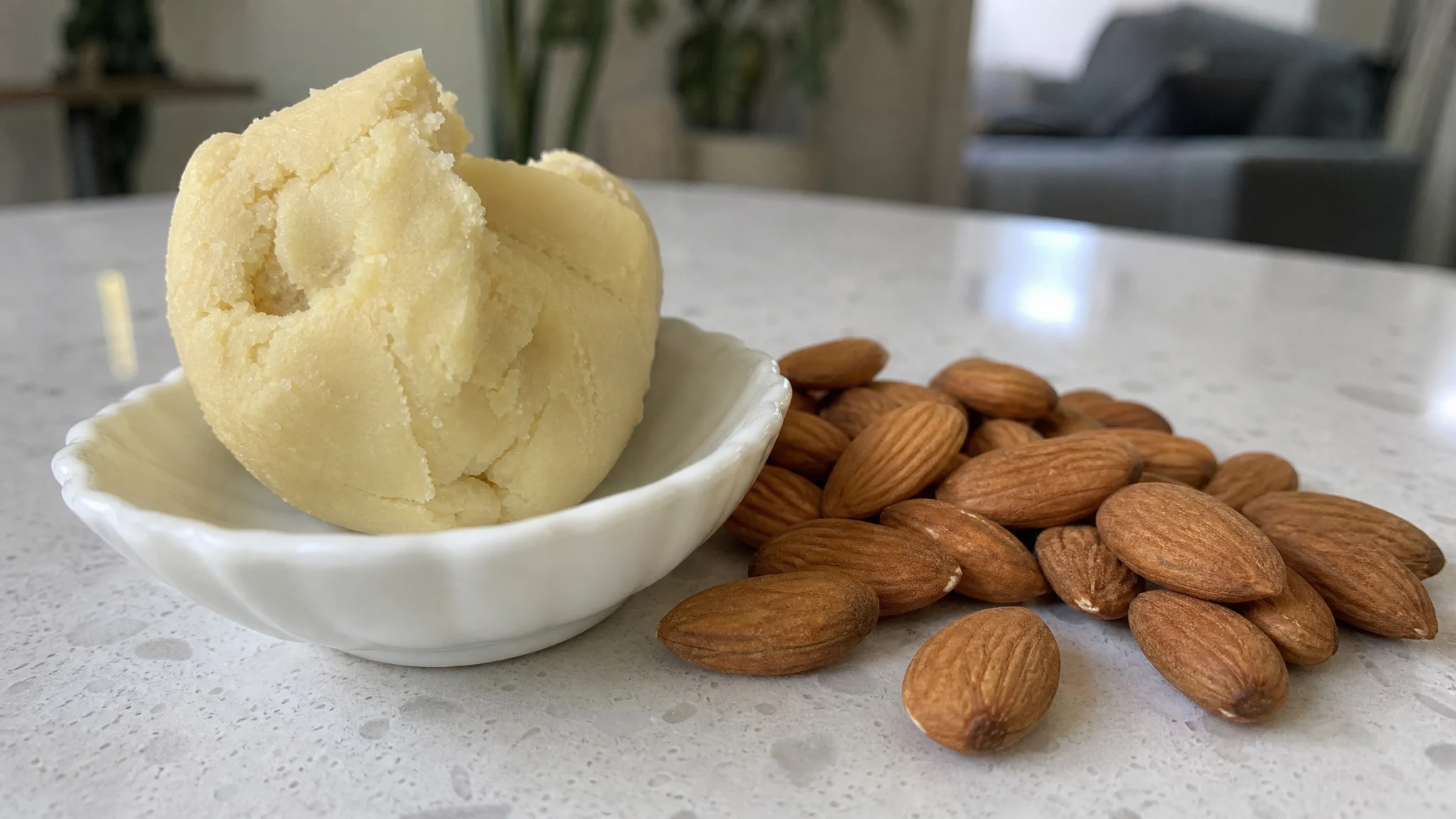
Pick up a jar of shea butter and a bottle of sweet almond oil and you already know most of what matters: one is a soft solid you scoop, the other is a liquid you pour. Everything else in this comparison grows out of that difference, which is why we like to start with the texture you want rather than a feature chart.
Start with the job
If you are making a balm, a stick or a thick body butter, shea is the natural base because it gives the finished product structure. Our sweet almond oil is a liquid and will not set a balm on its own. If you want a light liquid for massage, for carrying essential oils, or as the oil part of a lotion or serum you are blending yourself, almond oil is the better fit. We press ours cold and sell it unrefined, with a soft, lightly sweet, subtly nutty aroma and a non-greasy finish, and it carries essential oils without covering them up.
We only sell the almond oil, so shea itself is something you will find at a craft supplier or grocery. But the two work well together in homemade formulas, and our whipped body butter walk-through shows one way to combine a solid and a liquid.
If you are the kind of person who likes to touch things before deciding, try this: scoop a pea-sized bit of shea and hold it in your palm. It softens as it warms and turns glossy. Then pour a few drops of almond oil in the other hand and watch how quickly it spreads. You are feeling the whole comparison in about thirty seconds, and it tells you which one belongs in your routine.
Why one is solid and one is not
It comes down to the fats. In a laboratory study of crude shea butter, stearic acid made up roughly 44 percent of the fatty acids and oleic acid about 46 percent (Abdel-Razek et al., 2023). In cold-pressed almond oil from three cultivars, oleic acid ran about 74 to 77 percent, with most of the rest linoleic (Özcan et al., 2020). Stearic acid is a saturated fat that packs tightly, and that is the usual reason a fat sets firm at room temperature. Almond oil's mostly oleic profile stays liquid and spreads easily.
Those are two different studies on different samples, so treat the numbers as a picture of typical profiles rather than a measurement of any bottle you can buy, ours included. The Certificate of Analysis we publish for one batch lists density, refractive index and optical rotation; if you want fatty acid or peroxide results for a lot, ask us in writing through the contact page.
A surprise about vitamin E
People often assume shea is the "richer" ingredient. In those same two papers, the almond oil carried more alpha-tocopherol (a form of vitamin E) per 100 grams than the crude shea butter, and the shea paper found that refining stripped much of the tocopherol out of one fraction. So what you get depends on whether the shea is crude or refined, and on which almond oil. Neither is automatically the more nourishing choice on paper.
For very dry skin, a dermatologist's view
The American Academy of Dermatology notes that ointments and creams add more moisture than lotions, and its list of helpful ingredients includes shea butter, petrolatum, glycerin and lanolin, among others (Dermatologists' top tips for relieving dry skin). A liquid oil is not on that list. That is not a verdict against almond oil; it simply means that for skin that is cracked or very dry, a thick, solid-style moisturizer is what that page points toward. It also says dryness that persists can be a sign of a condition worth a visit to a board-certified dermatologist.
For everyday smoothing after a bath, a few drops of a liquid oil on damp skin is a pleasant, simple habit, and our dry skin guide goes through how we would approach it.
The tree nut question
This is where the two part ways. Almond is a tree nut, and because our oil is cold-pressed and unrefined, trace almond protein is present. If you have a tree nut allergy, do not use our oil. An allergist writing for the American Academy of Allergy, Asthma and Immunology explains that refined nut oils generally lack protein while unrefined, cold-pressed ones keep it, and that anyone unsure should ask the manufacturer whether an oil is refined (Food allergy: nut oils in topical products).
Shea sits in a different place. Food Allergy Research & Education reports no documented food allergy reactions to shea nut oil or butter, while still listing shea nut among the items people with tree nut allergy are advised to ask about (Tree Nut - FoodAllergy.org). Those statements concern food, not cosmetics, so if allergy is in your household, your allergist is the person to decide on shea.
Using them together
Home makers often find that the two are better as partners than rivals. A little liquid oil makes a solid butter easier to scoop and spread, and a little butter gives a liquid oil more body. If you are experimenting, change one thing at a time and keep notes, because it is easy to forget which version you liked. Label every jar with the date and the ratio. A small notebook next to the kitchen scale is one of the nicest things you can have for this kind of project.
How we would choose
Reach for shea when you need something firm: a balm, a body butter, a lip product. Reach for a liquid oil like ours when you want glide, a carrier for essential oils, or a light touch. Plenty of home formulators use both. Whichever you use, patch test a small area first and wait a day, keep oil away from your eyes, and see our dilution ratios post if you plan to scent it.
It really is a one-minute decision once you know what you are making, and a satisfying one, because both ingredients reward a little hands-on experimenting.

Sweet Almond Oil
Sweet Almond Oil from our own shop, in sizes from 0.5 oz to bulk.
From $9.99
Shop Now →Sources & Further Reading
- Abdel-Razek AG et al., 2023. Effect of Refining and Fractionation Processes on Minor Components, Fatty Acids, Antioxidant and Antimicrobial Activities of Shea Butter. Foods.
- Özcan MM et al., 2020. Characterization of physico-chemical and bioactive properties of oils of some important almond cultivars by cold press and soxhlet extraction. J Food Sci Technol.
- American Academy of Dermatology. Dermatologists' top tips for relieving dry skin.
- American Academy of Allergy, Asthma and Immunology. Food allergy: nut oils in topical products.
- Food Allergy Research & Education. Tree Nut - FoodAllergy.org.