Almond Oil vs Castor Oil for Hair: Weight and Feel
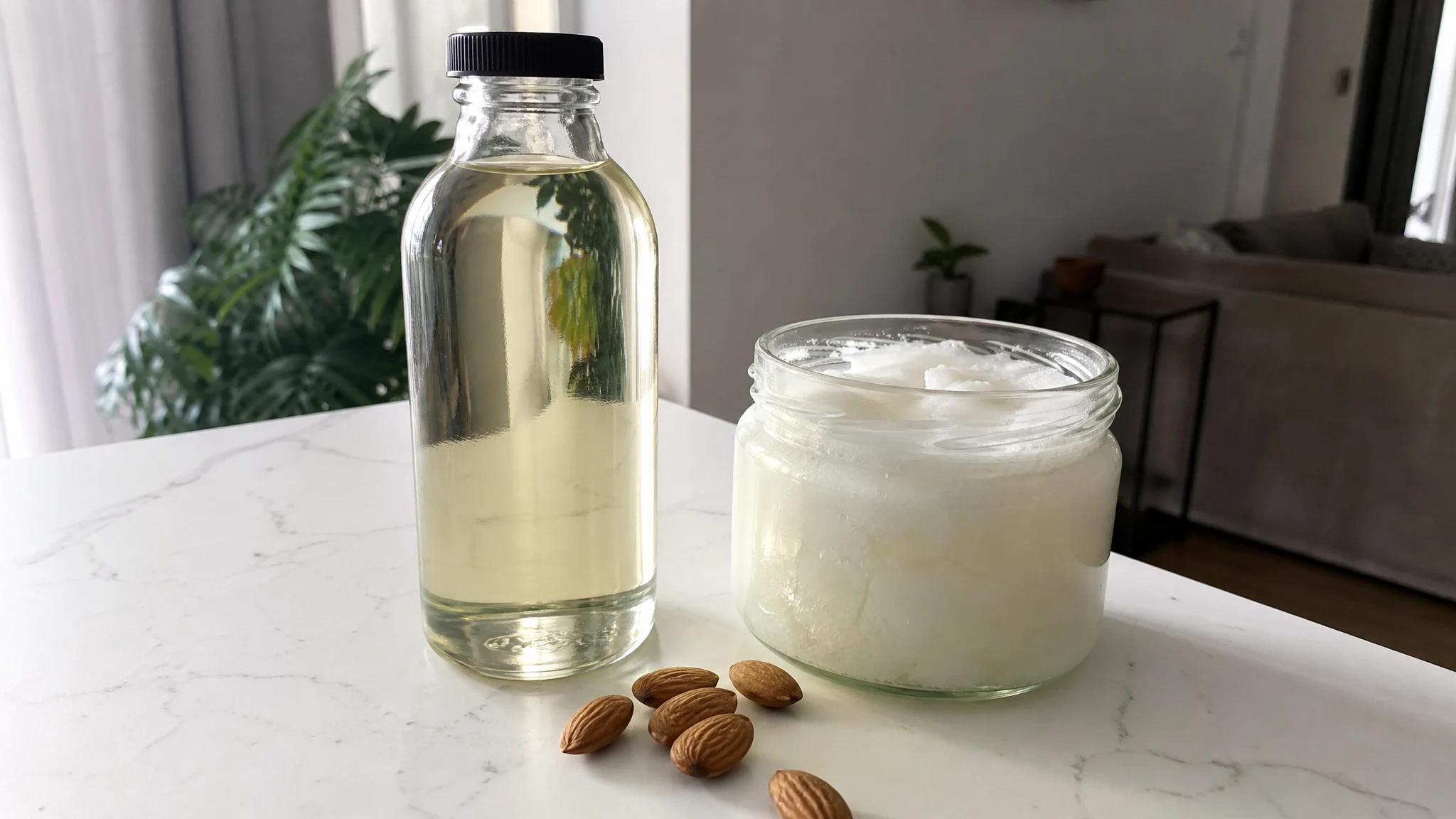
Anyone who has handled castor oil knows it is a different animal. It is thick, slow and clingy, like syrup made of oil. Sweet almond oil, by comparison, pours easily and spreads in a thin, soft film. That difference in texture is the real reason the two behave differently on hair, so it is worth starting there, then looking at what the studies actually covered.
Why castor is so thick
Castor oil is dominated by one unusual fatty acid, ricinoleic acid. A review of its properties gathered values by growing region and reported ricinoleic acid anywhere from about 76 to 95 percent, and calls it unique among vegetable oils. That structure is what gives castor its heavy body.
Sweet almond oil is mostly oleic and linoleic acid, the same pair found in many light oils. Across eight California almond cultivars, oleic acid ran from roughly 58 to 74 percent and linoleic from 19 to 35 percent. Those figures describe almonds in general, not our oil: the certificate we publish for one batch lists density, refractive index and optical rotation, and no fatty-acid profile.
The practical result is reasoning, not a test. A thick oil sits heavily on hair and takes more shampoo to rinse out, while a lighter oil spreads thinly and leaves less behind. For fine or straight hair, a drop of almond oil smoothed on the ends is a gentler place to start. For thick, dry or curly hair, a heavier oil is easier to justify, and castor is the heavier one. We do not sell castor oil, so that is a call you can make at any pharmacy or grocery.
Put them side by side
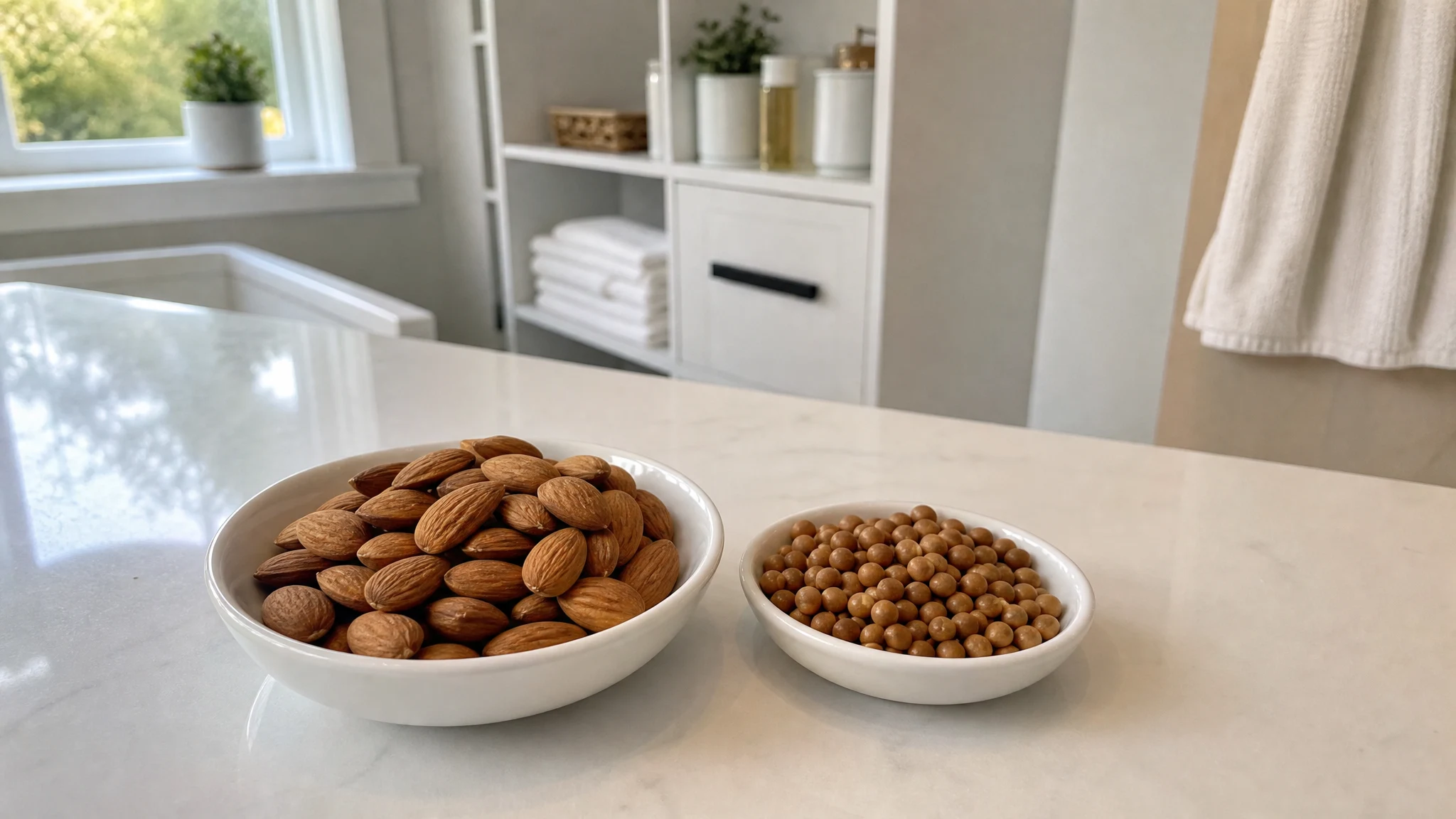
If you have both bottles, put a drop of each on the back of your hand. Sweet almond oil pours easily and spreads in a thin film, and ours has a soft, lightly sweet, nutty scent. Castor oil is the slow one: it stays where you put it and needs more spreading. Rinse each patch with a little soap and water and notice which one leaves a trace behind. That quick test teaches you more about rinse-out than any description can.
What the studies actually tested
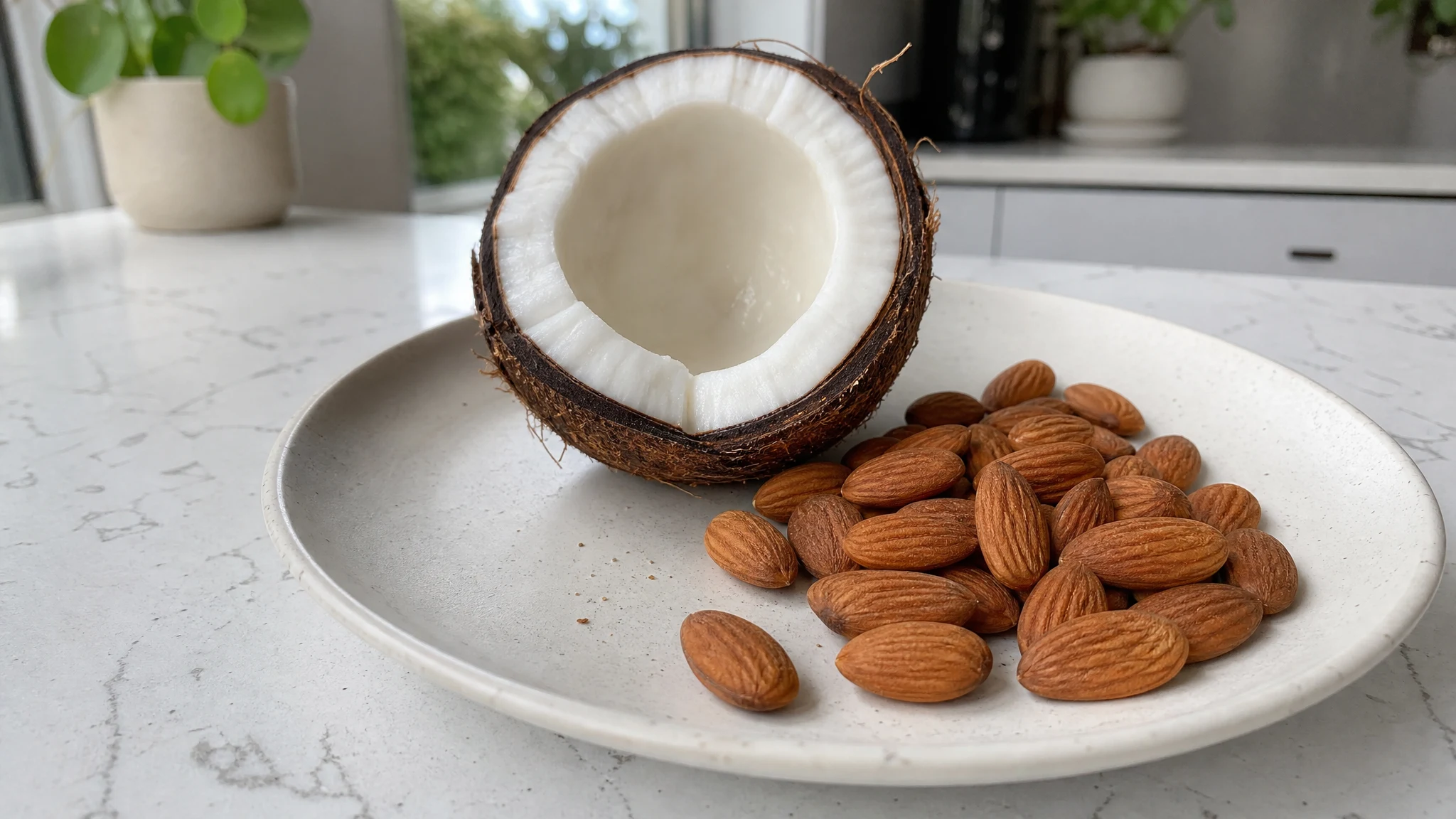
People often quote oil studies as if one oil stands in for another. They do not. The best-known hair-oil study, Rele and Mohile in 2003, compared coconut, sunflower and mineral oil on protein loss from hair during combing. Coconut oil reduced loss in damaged and undamaged hair, and the others did not. Neither almond nor castor was in it.
The closest look at castor is a systematic review of 22 articles on coconut, castor and argan oil for hair. It reported weaker evidence that castor improves luster and no strong evidence for growth. It says nothing about almond oil, and we are not aware of a human hair trial of sweet almond oil, so we treat almond as a conditioning and feel choice, not a performance one.
The same idea applies to scent and texture. Some people love the feel of a rich oil on their hair, and others find it heavy. Neither is wrong. Our oil has a soft, nutty sweetness that fades quickly, so it will not compete with your shampoo or your perfume, and a drop warmed in your palm is the easiest way to see whether you like it.
A note on shedding
A little perspective helps, because it explains why oils pick up reputations they have not earned. The American Academy of Dermatology notes that excessive shedding can follow a big life event, such as childbirth, usually starting a couple of months afterwards and settling as the body readjusts, with fullness returning within six to nine months. If you begin a new oil in month three, you might credit it with a recovery that was going to arrive anyway. When hair thinning worries you, a board-certified dermatologist can work out why, and an oil is not a substitute for that conversation.
Choosing for feel
- Fine or oily hair: a few drops of almond oil on the ends, worked through with your fingers, is a light-handed place to start. Our guide to avoiding greasy hair covers how much.
- Thick, dry or curly hair: a pre-shampoo mask is a natural fit. Our hair mask guide shows the method.
- Scalp massage: see our scalp massage routine.
How much to use
Whichever oil you pick, start with less than you think you need. Warm a few drops between your palms, smooth them over the ends and then the mid-lengths, and keep the oil away from the roots if your hair gets oily quickly. Wash it out the same day at first so you can see how your hair responds, and drape a towel you do not mind getting oily over your shoulders. Adjust by a drop at a time. Hair is forgiving when you go slowly, and a light hand is easier to rinse than a heavy one.
Almond is a tree nut. Our oil is unrefined and contains trace almond protein, so anyone with a tree nut allergy should not use it. If you want to know more about the evidence, our overview of almond oil and hair goes through it from the almond side. Patch test a small area and wait a day before regular use, keep oil out of your eyes, and stop if skin turns red, itchy or swollen.
If you came to pick a winner on results, the evidence does not name one. Pick the oil whose weight and feel you will enjoy using.

Sweet Almond Oil
Sweet Almond Oil from our own shop, in sizes from 0.5 oz to bulk.
From $9.99
Shop Now →Sources & Further Reading
- Castor oil (Ricinus communis): a review on the chemical composition and physicochemical properties. Food Science and Technology 2021;41(suppl 2). scielo.br
- Sathe SK et al., 2008. Fatty acid composition of California grown almonds. J Food Sci 73(9):C607-614. PubMed 19021789
- Rele AS, Mohile RB, 2003. Effect of mineral oil, sunflower oil, and coconut oil on prevention of hair damage. J Cosmet Sci 54:175-192. PubMed 12715094
- Phong C et al., 2022. Coconut, Castor, and Argan Oil for Hair in Skin of Color Patients: A Systematic Review. J Drugs Dermatol 21(7):751-757. PubMed 35816075
- American Academy of Dermatology. Do you have hair loss or hair shedding? aad.org