Olive Oil vs Almond Oil for Cooking: Honest Answer
Almond oil and olive oil sit next to each other in plenty of recipe searches, and it is a fair question. Here is the straightforward answer from a company that sells almond oil: for the stove, olive oil is the oil with the track record, and the almond oil we make is a cosmetic oil for external use, not a pantry oil.
Why we are happy to say that
Our Sweet Almond Oil is cold-pressed from raw kernels, sold unrefined, and intended for external cosmetic use only. We do not market it for cooking, so we will not tell you to fry with it, drizzle it or bake with it. If you want an almond oil for eating, buy one sold as food, from a food seller, with the labeling that goes with it.
That leaves a useful question for anyone curious about the comparison: how do these two oils differ in food terms, and what has actually been tested?
Same family of fat, different evidence
Both oils are mostly oleic acid, a monounsaturated fat. In a study of eight California almond cultivars, oleic acid ranged from about 58% to 74% of the soluble lipids, with linoleic acid from about 19% to 35%. Those are numbers for almonds in general. Olive oil is also oleic-led, so the fat type is less different than the shelves suggest.
Where they truly differ is the pan. A Portuguese study fried repeatedly in several commercial olive oil categories and in a commercial vegetable oil blend, sampling every three hours until the oil reached the legal limit for polar compounds, which signals that frying oil has broken down. The olive oils lasted 24 to 27 hours; the blend lasted 15. The extra virgin oil showed the least oxidation and the most natural antioxidants, and the authors concluded that olive oil stands up well to frying whatever its commercial category. Notice what that is: a result for deep-frying under particular conditions, not a promise about every dish.
We are not aware of a comparable frying test for almond oil. That is not a mark against almond oil; it is simply a gap in the record.
Smoke point is only part of the story
Charts list a smoke point beside every oil, and it is tempting to treat the highest number as the winner. A smoke point tells you when visible smoke begins; it does not measure how quickly an oil breaks down over a long cook, and the frying study above points to composition and natural antioxidants as important predictors. Refined and unrefined oils also behave differently when heated, which is another reason to buy a bottle made for food and read what it says.
A word on the nutrition angle
If you came for health claims, here is the short version from an authority rather than from us. The American Heart Association's 2017 advisory on dietary fats found that replacing saturated fat with unsaturated vegetable oils lowers LDL cholesterol and is linked with lower cardiovascular risk, within an overall healthy eating pattern. That points broadly at unsaturated oils, a category that includes both. It does not rank almond against olive, and diet questions belong with your doctor or a registered dietitian. We sell an external cosmetic oil, so we leave it there.
Reading a food oil's label
Whichever oil you choose for the stove, the bottle tells you more than the picture on the front. Look for the oil's name, whether it is refined or cold-pressed, a harvest or best-by date, and where it comes from. A dark bottle or a tin protects oil from light, while a clear bottle on a bright shelf is a gamble. Choose a size you will finish in a few months, then keep it capped and away from the stove at home.
How to choose for the kitchen
- Everyday sautéing and roasting: olive oil, the one with the frying record.
- Where you want almond flavor, in a dressing or a baked good: look for a culinary almond oil from a food seller. Our notes on baking and vinaigrettes go into ratios and storage, and our smoke point piece explains the numbers.
- Any tree nut allergy: Food Allergy Research & Education lists almond oil among the foods to avoid, and notes that nut oils are often not highly refined. Skip almond oil entirely and see an allergist.
And for the bathroom shelf
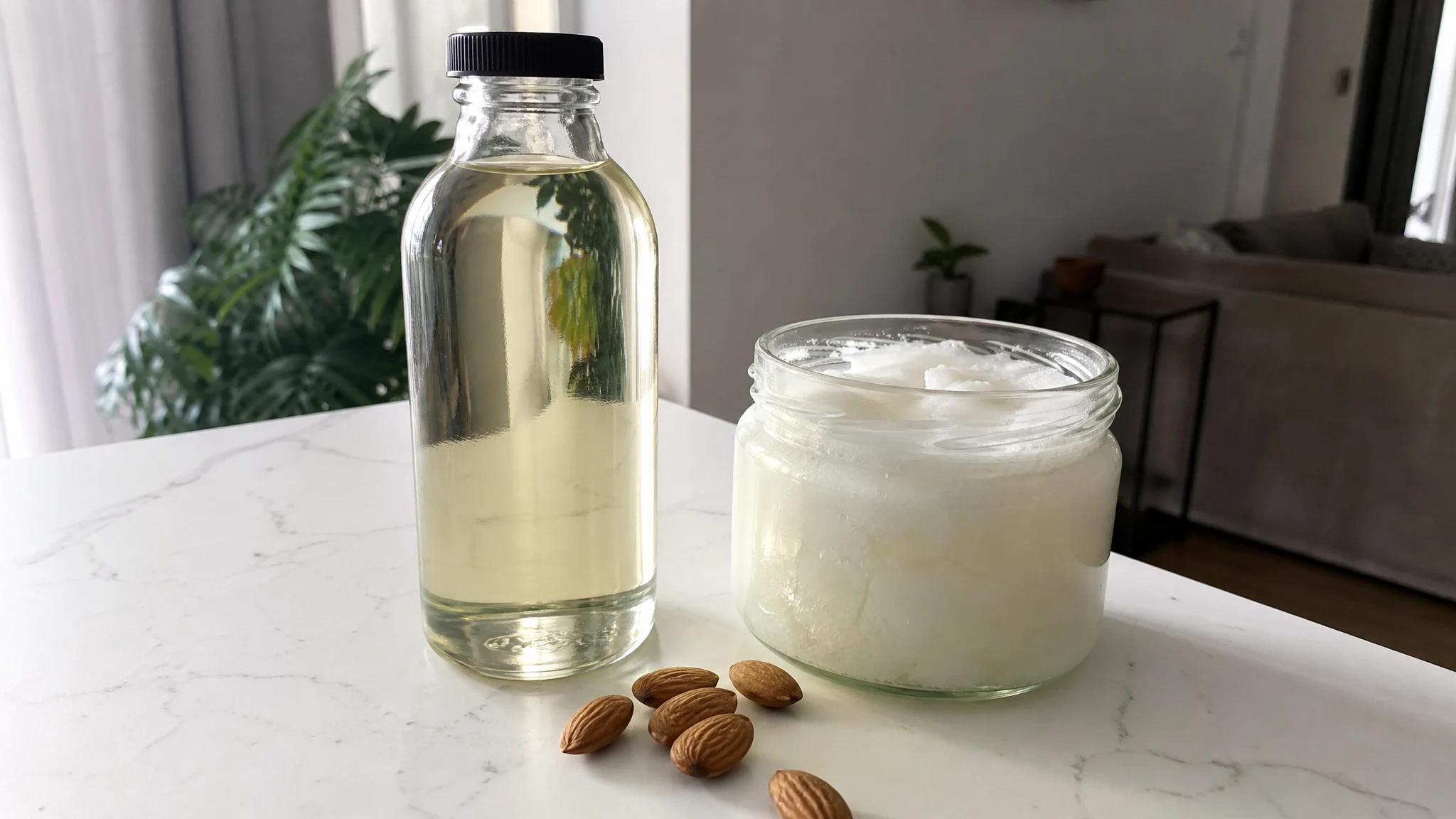
This is where our bottle belongs: moisturizing, massage, a carrier for essential oil blends, and hair and beard grooming blends. Patch test a small area, keep it away from your eyes, store it cool and dark, and plan on about a year from pressing. If you are curious how almond oil sits next to other oils on skin, our olive oil for skin comparison picks up where this one leaves off.
A kitchen habit worth keeping
If you enjoy cooking, two bottles within reach make life easier: one for everyday pan work and a small one for finishing dishes, where flavor is the point. Smell each before you pour, and let the nose decide. The bathroom shelf gets its own bottle, and ours is the one for that. Keep the two on separate shelves, and label them if there is any chance of mixing them up in a hurry.
Two good oils, two different jobs. Pick the one built for the task in front of you.

Sweet Almond Oil
Sweet Almond Oil from our own shop, in sizes from 0.5 oz to bulk.
From $9.99
Shop Now →Sources & Further Reading
- Olive oil stability under deep-frying conditions, Food and Chemical Toxicology, 2010.
- Fatty acid composition of California grown almonds, Journal of Food Science, 2008.
- Dietary Fats and Cardiovascular Disease: A Presidential Advisory From the American Heart Association, Circulation, 2017.
- Tree Nut - FoodAllergy.org, Food Allergy Research & Education.