Almond Oil Fatty Acids: Oleic vs Linoleic Explained
Ask ten sellers for almond oil's fatty-acid profile and you may get ten slightly different numbers, and all of them can be honest. Almond oil is mostly two fatty acids, oleic and linoleic, and the balance between them shifts with the almond variety, where it grew and how the oil was taken from the kernel.
A seesaw, not a fixed recipe
Think of oleic and linoleic acid as two ends of a seesaw. Oleic acid is the smooth, stable one; linoleic acid is the lighter-feeling one that is also quicker to oxidize. In an analysis of eight California almond varieties, Sathe and colleagues found oleic acid between roughly 58% and 74% and linoleic acid between roughly 19% and 35%, and as one went up the other came down almost perfectly. Together they made up about 91% to 94% of the oil. Palmitic acid and a few trace acids share the rest.
Other labs paint the same picture with different numbers. A study of 31 Turkish almond types put oleic anywhere from about 62% to 76% and linoleic from 14% to 30%. Cold-pressed oil from three other cultivars landed near 74% to 77% oleic and 20% to 22% linoleic, while a single cold-pressed sample in another paper came in near 62% and 22%. A commercial refined oil measured about 61% and 28%. The pharmacopoeia specification for refined almond oil is deliberately a window: oleic acid from 62% to 76%, linoleic from 20% to 30%. The takeaway from all that variety is that cultivar and growing place move these figures at least as much as the press does, and that a single "70% oleic, 20% linoleic" line on a product page is one point on a moving scale.
What it means for how an oil feels and keeps
A review of plant oils on skin, by Lin, Zhong and Santiago, describes linoleic acid as important to the skin's water barrier and oleic acid as something that can loosen that barrier with continuous application. It also says much of that evidence comes from animal and laboratory work, and it lists almond oil's barrier effect as only a "possible" one. We take that as a reason to hold the numbers lightly. Nobody has run a controlled test of almond oil's oleic content against barrier function, so we would not choose a bottle because it prints 70% instead of 62%.
The chemistry does give one practical lesson. More linoleic acid means more double bonds, and more double bonds mean more places for oxygen to attack. That is general fat chemistry, not a claim about any one bottle, but it explains why freshness matters with almond oil. In one study, cold-pressed oils from three cultivars had a peroxide value of 3.27 to 4.11, against 5.32 to 6.44 for solvent-extracted oils from the same almonds. The refined commercial oil mentioned above measured 9.65 within its shelf life. They are different oils measured in different labs, so we read this as proof that peroxide value swings widely and is worth asking about, not as a league table of methods.
What we can tell you about our oil
We press whole kernels cold, below 40 degrees C (104 F), and we sell the oil unrefined with nothing added. The Certificate of Analysis we publish for one batch lists relative density of 0.918, refractive index of 1.472 and optical rotation of -0.16 degrees, each inside its standard range. Those are physical constants, so they will not give you oleic or linoleic percentages. If a fatty-acid profile or peroxide value matters to your formulation, ask us in writing through the contact page for the lot's paperwork before you plan around it. Our bottles carry a pressing date, bottling date and lot number, and about a year from pressing, kept cool and dark, is the shelf life to plan on. Our storage guide has the handling details.
How to use all this at the counter
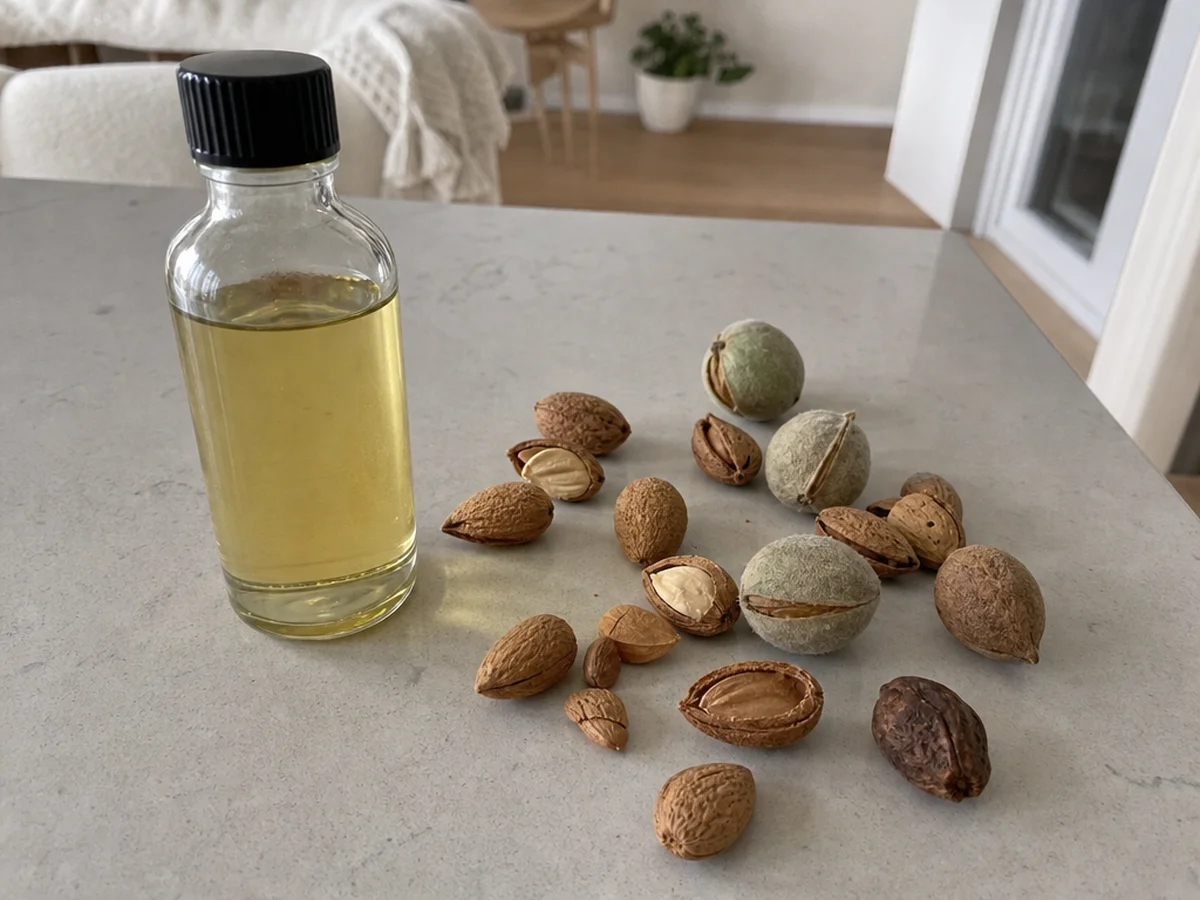
If all of this feels like a lot of numbers, here is the short version of how we think about it. Treat a printed fatty-acid percentage as a rough description, not a promise. Look at the bottle in your hand: the color, the smell and the date matter more in daily life than the second decimal place on a chart. A good almond oil looks clear and faintly golden and smells softly of almonds. If it smells sharp, paint-like or stale, set it aside.
When you rub a few drops between your fingers, you will notice how smoothly it glides. That is the oleic side of the seesaw at work, and it is a nice thing to appreciate without needing a laboratory.
Reading any spec sheet
- Find out whether the numbers describe one lot or a typical value.
- Look for the method and the date.
- Ask for peroxide value too, because a fatty-acid profile will not show whether an oil has begun to oxidize.
- Remember that the smaller compounds in the oil, covered in our pieces on phytosterols and vitamin E, are a separate question from the fatty acids.
This is a tree nut oil, and because ours is unrefined, trace almond protein is present, so anyone with a tree nut allergy should not use it; the allergy guide explains more. It is also for external cosmetic use only. If you are comparing bottles, our refined versus unrefined guide helps with the next step. A fatty-acid table is a good way to compare what sellers put on paper, and a modest guide to how an oil will feel, so use it to ask better questions and patch test before wider use.
We love talking about the details, and a question about a particular lot is always welcome through the contact page.

Sweet Almond Oil
Sweet Almond Oil from our own shop, in sizes from 0.5 oz to bulk.
From $9.99
Shop Now →Sources & Further Reading
- Sathe SK et al., 2008. Fatty acid composition of California grown almonds. J Food Sci. PubMed 19021789
- Özcan MM et al., 2020. Effect of almond genotypes on fatty acid composition, tocopherols and mineral contents and bioactive properties of sweet almond (Prunus amygdalus Batsch spp. dulce) kernel and oils. J Food Sci Technol. PMC7520497
- Özcan MM et al., 2020. Characterization of physico-chemical and bioactive properties of oils of some important almond cultivars by cold press and soxhlet extraction. J Food Sci Technol. PMC7026358
- Al Juhaimi F et al., 2018. Comparison of cold-pressing and soxhlet extraction systems for bioactive compounds, antioxidant properties, polyphenols, fatty acids and tocopherols in eight nut oils. J Food Sci Technol. PMC6045996
- Kozłowska M et al., 2025. Influence of Extraction Techniques on Almond Oil Quality: A Comparative Study of Solvent-Extracted and Commercial Products. Molecules. PMC12429927
- United States Pharmacopeia 35. Almond Oil monograph (online mirror). drugfuture.com
- Lin TK, Zhong L, Santiago JL, 2017. Anti-Inflammatory and Skin Barrier Repair Effects of Topical Application of Some Plant Oils. Int J Mol Sci. PMC5796020