Does Almond Oil Have Squalene? What to Know
"Contains squalene, which mimics your skin's own oils" is a line you will find on plenty of almond oil pages. The first half is true in spirit, and the second half is where the story gets ahead of the science. Squalene is a fascinating molecule, so it is worth understanding properly.
Why squalene gets the spotlight
Squalene is one of the lipids your skin's oil glands make. A review of sebaceous gland lipids by Picardo and colleagues puts it at about 12% of human sebum by weight and notes that it is not found elsewhere in the body. Another review, by Huang, Lin and Fang on squalene in cosmetic dermatology, gives about 13% and describes it as an efficient quencher of singlet oxygen at the skin surface. That is the whole basis for "mimics your skin": the same molecule shows up in sebum and in some plant oils.
The missing step is the one that matters. Having the same molecule in a bottle is not evidence that putting it on skin supports what the glands do. Huang and colleagues say plainly that few human trials of squalene have been done, and that the cosmetic evidence they describe is mostly animal work, laboratory work or studies of delivery systems.
How much is in almond oil
Less than the marketing implies, and measured values are hard to find. The Huang review names shark liver oil as the richest source and lists olive, palm, wheat germ, amaranth and rice bran oils as having reasonable amounts. Almond oil is not on that list. The almond oil papers we read measured tocopherols, sterols and fatty acids with care, but the ones that report squalene give no figures in their abstracts, or measure a different part of the almond's chemistry altogether. Squalene content shifts with cultivar, harvest stage and extraction method, so a single number would not describe every bottle anyway.
That is why we would be cautious about any seller who quotes a squalene percentage without naming the lot and the method. The Certificate of Analysis we publish for one batch of our oil gives density, refractive index and optical rotation, and it does not report squalene, so we make no squalene claim for our oil.
What we can talk about happily is what you can check yourself. Our oil is cold-pressed, unrefined and sold neat. Pour a few drops into your palm and look: it is a thin, faintly golden oil with a soft, lightly sweet, nutty scent, and it spreads easily and sinks in without a heavy film. Those simple sensory checks tell you more about whether a bottle is fresh than any buzzword on the front of it.
What the skin studies compared
When researchers have put almond oil on skin, they compared the whole oil rather than any one ingredient. In a two-week pilot by Vaughn and colleagues, 32 people who completed the study used almond oil, coconut oil, jojoba oil or white petrolatum, and all four raised skin hydration by week two with no significant difference among them. The paper does not say which almond oil was used. White petrolatum contains no squalene at all, and it performed about the same. So, reasoning from that comparison (this is our inference, not the authors' conclusion), a moisturizing effect in those studies fits the idea of an oil sitting on the surface better than it fits a trace component doing special work.
The freshness angle
There is one place where squalene belongs in a conversation about a bottle of oil, and it is oxidation. Picardo's review says squalene is readily oxidized and that its main oxidation product in skin surface lipids is squalene monohydroperoxide. Huang's review is gentler and describes squalene as not very susceptible to peroxidation. The two reviews disagree, so we will not pretend to settle it. What both support is the practical point that oils change as they age. A fresh, well-stored oil is a better bet than any ingredient claim, and the details that tell you about freshness are a pressing or bottling date and a lot number.
Our bottles carry a pressing date, bottling date and lot number, in amber glass, and about a year from pressing, kept cool and dark, is the shelf life to plan on. Our storage guide shows how to look after an open bottle.
A ten-second habit that beats any claim
Write the date you opened the bottle on the label with a marker. Keep the cap on tight, pour rather than dipping your fingers in, and put the bottle back in a cupboard instead of leaving it on a sunny shelf by the sink. It takes almost no time and does more for your oil than anything printed on the front of a bottle. We love a good ingredient story as much as anyone, but a well-kept bottle is the real luxury.
Squalene or squalane?
Squalane is the saturated, more stable form, and it is what you will see in many ingredient lists. Nothing in a bottle of almond oil turns one into the other, and we do not sell either as a separate product. What we sell is cold-pressed, unrefined sweet almond oil, sold neat.
If you are shopping for an almond oil
- Ask for a number and a method whenever a seller cites a compound, and for the lot it came from.
- Check dates, because they tell you more about freshness than an ingredient list does.
- If you have any tree nut allergy, skip ours: it is unrefined, so trace almond protein is present, and the allergy guide explains why.
- Patch test first. Our patch-test walkthrough applies to any oil.
The other compounds people mention alongside squalene have pieces of their own: vitamin E, phytosterols and the fatty-acid profile. Squalene is a lovely thing to know about, and for choosing an oil we would put freshness and handling well ahead of it.
So the next time a label promises something remarkable about a single compound, you can smile, ask for the details and go back to the things you can judge with your own nose and fingertips.
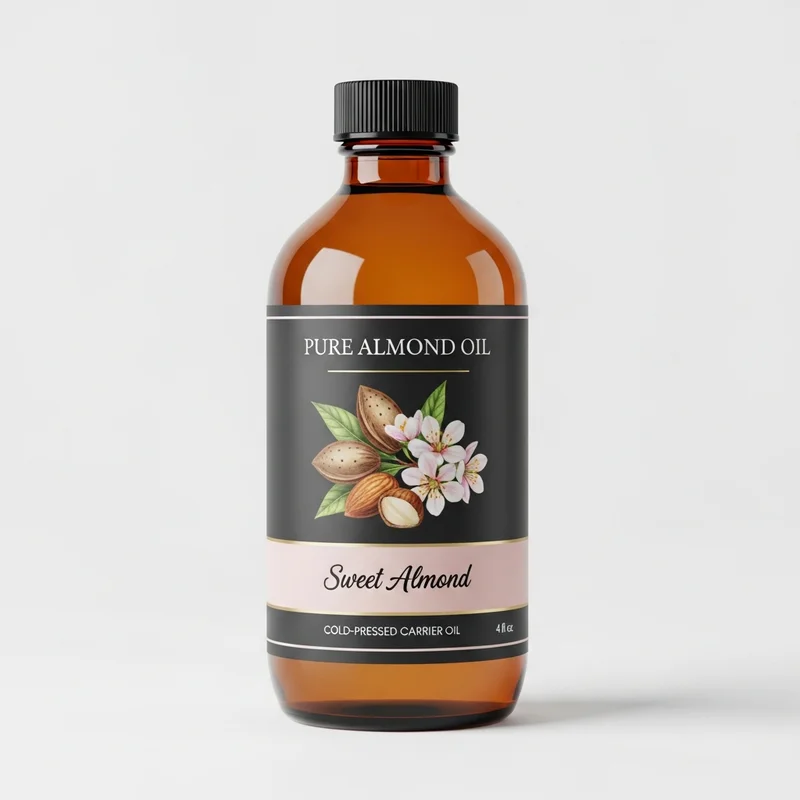
Sweet Almond Oil
Sweet Almond Oil from our own shop, in sizes from 0.5 oz to bulk.
From $9.99
Shop Now →Sources & Further Reading
- Picardo M et al., 2009. Sebaceous gland lipids. Dermatoendocrinol. PMC2835893
- Huang ZR, Lin YK, Fang JY, 2009. Biological and pharmacological activities of squalene and related compounds: potential uses in cosmetic dermatology. Molecules. PMC6253993
- Vaughn AR et al., 2018. Multi-Center Randomized Clinical Study of The Effects of Natural Oils on Xerosis and Skin Barrier Properties. SKIN The Journal of Cutaneous Medicine. skin.dermsquared.com