Does Almond Oil Grow a Beard? What Genes Decide
Beard oil is a big category, and plenty of it comes with a hint that the right oil will make you grow more. We would rather be straight with you: a beard is mostly decided deep in the follicle, long before an oil touches the surface. What almond oil can do for a beard is a different, very pleasant job, and it is the one we are happy to talk about.
What decides a beard
Dermatology research describes beard follicles as unusually responsive to hormones. A review by Inui and Itami in Experimental Dermatology explains an apparent paradox: androgens drive the growth of beard hair while the very same hormones work against scalp hair in people prone to pattern loss. The difference lies in how each follicle responds, including its enzymes and receptors, and it is set from within. Nothing in that picture involves a topical oil.
The American Academy of Dermatology is similarly direct. Its page on common beard problems says genes determine whether thin or sparse areas appear, and its practical advice is to choose a style that works with the pattern you have, and to let longer hairs fill gaps. The same page cautions that minoxidil, an approved scalp treatment, often leaves facial skin raw and irritated, and recommends talking to a dermatologist first. Sudden patchiness, scaling or a rash is also a dermatologist question.
What almond oil can do for a beard
Here is where we get enthusiastic. Our sweet almond oil is light, absorbs quickly and has a soft, subtly nutty, lightly sweet aroma. On a beard it is a conditioning step: a small amount can leave the hairs feeling softer and easier to comb, and the skin underneath less tight. The AAD's own advice for a healthy beard says moisturizing helps soften the skin and the hairs, and recommends beard oil for normal to dry skin, used sparingly so the beard does not look greasy. That is the cosmetic result we describe, and it is plenty.
A few easy habits make the most of it. Warm a small amount between your palms (a suggestion, not a measured recipe), work them through from the skin outward, and comb through. If you want a blend, our beard oil post works through the ratios, and the beard balm post adds wax for hold. For the wider grooming picture, see the beard care guide.
A simple routine
Wash your face and beard, pat dry and leave them slightly damp. Put two or three drops in your palm, rub your hands together and press them onto the skin through the beard before smoothing outward. Finish with a comb or a soft brush. If the beard looks shiny or feels heavy by lunchtime, you used too much, and next time you can halve it.
A note for breakout-prone skin
The one place where oil and a beard can disagree is acne along the jaw. The AAD suggests a conditioner instead of oil for acne-prone skin and, while treating beard acne, a non-comedogenic conditioner but no beard oil. If your jawline breaks out easily, that advice is worth following over any promise from a bottle.
It also helps to be patient with your own expectations. Beards grow slowly, and the look of one changes with length, season and grooming, so a snapshot from one morning is a poor judge of any product.
How to read a beard claim
When you meet a "fuller beard" promise, four questions sort it quickly. Does it name a study you can open? Did that study test the same oil, on the same part of the body? Was there a comparison group? And what was actually measured, since hair count, thickness and speed of growth are three separate things? Most claims fail at the first question. We are not aware of a human trial of sweet almond oil on beard hair, which is why we make no such claim.
If your beard bothers you, a dermatologist can look for a treatable cause and tell you what is worth trying. For the same question about the scalp, see our scalp hair post and the castor oil comparison.
Making peace with the beard you have
We think the happiest bearded people are the ones who stop fighting their pattern. A tidy shape around patchy areas, a trim every few weeks and a conditioned finish can make even a sparse beard look deliberate. Almond oil's job in that plan is small and pleasant: it makes the beard soft to touch and comfortable to wear.
Who should skip it
Anyone with a tree nut allergy. Our oil is cold-pressed and unrefined, so trace almond protein is present, and we say plainly that people with a tree nut allergy must not use it. Food Allergy Research & Education points out that tree nut oils, which are often not highly refined, are sometimes used in lotions, hair care products and soaps, which is a good reason to read labels on grooming products. Everyone else should patch test first: the AAD method is a quarter-sized spot on the inner arm, twice a day for 7 to 10 days, and our own guidance is to test a small area and wait a day. The allergy guide goes into more detail.
A good beard is part genes, part grooming, and almond oil can take care of the grooming with a soft finish. The rest is yours and your dermatologist's to explore.
If you do try it, judge almond oil by how it feels in your hand and along your jaw, not by promises on a label. Our sweet almond oil is in our shop, with bulk sizes and a guide to buying sweet almond oil in bulk for anyone who uses it regularly.
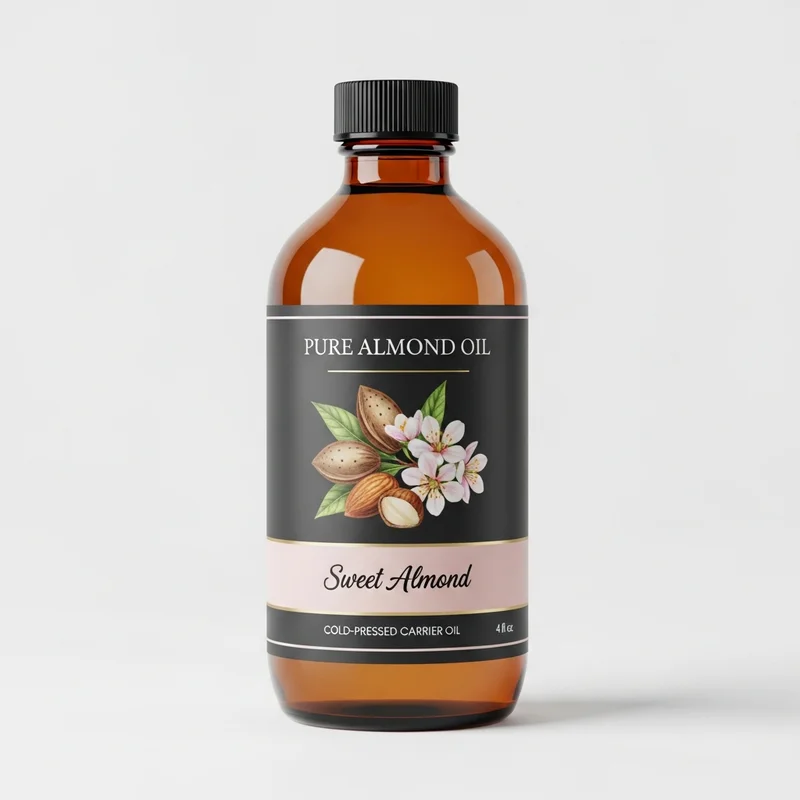
Sweet Almond Oil
Sweet Almond Oil from our own shop, in sizes from 0.5 oz to bulk.
From $9.99
Shop Now →Sources & Further Reading
- Inui S, Itami S, 2013. Androgen actions on the human hair follicle: perspectives. Exp Dermatol. PubMed 23016593
- American Academy of Dermatology. DIY treatment for 5 common beard problems. aad.org
- American Academy of Dermatology. A dermatologist's top tips for a healthy beard. aad.org
- American Academy of Dermatology. How to test skin care products. aad.org
- Food Allergy Research & Education. Tree Nut. foodallergy.org