Almond Oil Hand Balm: Why a Balm Beats a Cream
Hands do more work than any other part of us, and they get washed, sanitized and exposed to cold air all day. A rich almond oil hand product sounds lovely, and it can be. The word "cream", though, hides a decision that changes the whole recipe, and a balm gets you most of the comfort without it.
What dermatologists look for in a hand product
The American Academy of Dermatology offers a clear picture. Choose a fragrance-free, dye-free cream or ointment. Look for lipids such as ceramides, humectants such as glycerin and hyaluronic acid, and occlusives such as mineral oil or petrolatum. Pick tube products over thinner pumped lotions, put moisturizer on after each wash or sanitizer, and for an overnight treatment soak the hands, apply cream and wear cotton gloves with a humidifier running (AAD, 4 skin care tips for your hands). The same body's advice on dry skin lists jojoba oil, mineral oil, shea butter, petrolatum and lanolin as ingredients to look for (AAD, Dermatologists' top tips for relieving dry skin).
That list tells us where a plain oil sits. Almond oil gives hands soft glide and a non-greasy finish, but it does not supply the humectants or the heavier occlusive layer on its own. So we think of it as a lovely base for a balm, where wax and butter add the staying power, rather than as the whole moisturizer. Our shea butter comparison looks at that pairing.
What the research on almond oil and hands shows
One study is worth knowing, and it is about a finished product, not a kitchen mix. A hand moisturizer containing 7 percent sweet almond oil and 2 percent colloidal oatmeal was reported safe and effective in patients with moderate to severe hand dermatitis (Zeichner, Berson and Donald, The Use of an Over-the-Counter Hand Cream With Sweet Almond Oil for the Treatment of Hand Dermatitis, 2018). The abstract is short and gives no design details, so it tells us that almond oil can be part of a hand formula, nothing more. We make no medical claims for our oil. If hands are very dry, painful or cracking despite regular moisturizing, a dermatologist is the right person to see.
The cream or balm fork
A cream contains water, and water changes the safety picture. The FDA lists contaminated water, ineffective preservation and dipped fingers among the routes into cosmetics, and notes that adding water dilutes preservatives (FDA, Microbiological Safety and Cosmetics). A jar of hand cream that you dip into daily meets every one of those. A balm of oil and wax has no water, so the preservation question never arises, and it is still easy to make well.
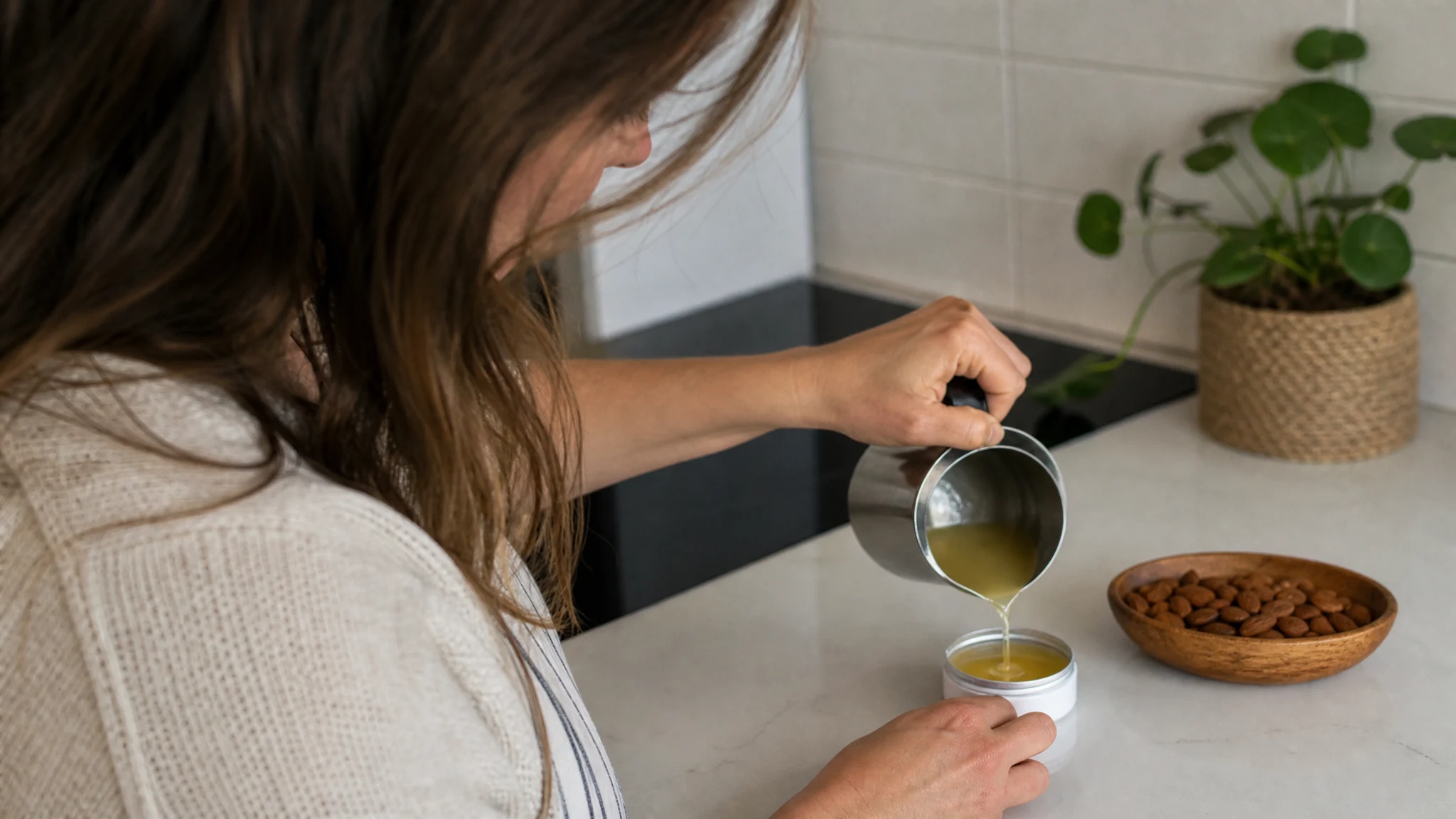
No source we reviewed gives a wax-to-oil ratio, so here is arithmetic, not a tested recipe. A 30 gram balm that is 80 percent oil and 20 percent wax by weight holds 24 grams of oil and 6 grams of wax. At the density measured on the batch on our published Certificate of Analysis (0.918), 24 grams of oil is about 26 milliliters, a little under two tablespoons. If the result is too firm or soft, adjust the ratio next time. Start with a small batch and write the weights on the jar.
We would leave the fragrance out. The AAD asks for fragrance-free and dye-free, and fragrance is the likeliest ingredient to bother hands that are already working hard. If you do add essential oils, our dilution guide goes through the numbers.
Keep it where your hands already are
A balm only works if it is within reach. Put a small jar beside the kitchen sink, another in the bag you carry and a third by the bed. You will find the habit sticks when the jar sits where your hands already are, and fades when it lives in a drawer across the house.
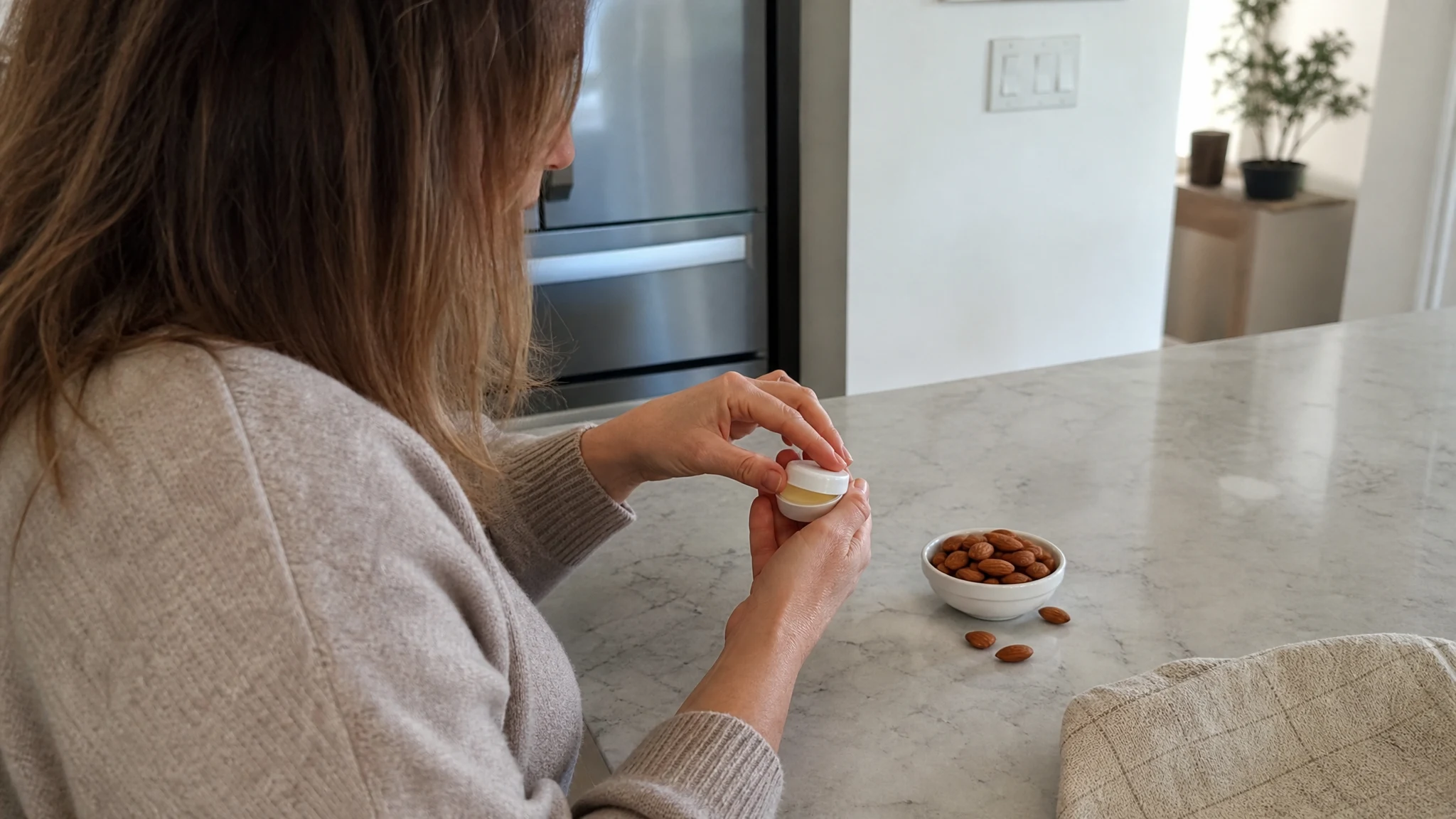
Open a fresh jar and you will notice a soft, faintly nutty smell with a lightly sweet edge, nothing perfumed. A well-set balm feels firm in the jar and melts the moment you drag a fingertip across it. Warm a pea-sized amount between your palms before spreading it over the knuckles and backs of the hands, then work around each finger. If it feels tacky, that was a little too much, and a tissue takes the extra off.
Checking your own reaction
Our Sweet Almond Oil is cold-pressed and unrefined, sold for external cosmetic use. Almond is a tree nut, trace almond protein is present, and anyone with a tree nut allergy should not use it. Unrefined, cold-pressed nut oils can retain protein, while refined ones generally lack it (AAAAI, Food allergy: nut oils in topical products); our nut allergy post has more. Cracked hands are the worst place to find out you react, so patch test on unbroken skin first: a quarter-sized spot, twice a day for 7 to 10 days (AAD, How to test skin care products). Our patch test guide explains it.
Hands that work for a living
For anyone in wet work or around solvents, a good glove routine does more than any cream. Wear gloves suited to the task, wash with a mild cleanser, pat dry and moisturize while the skin is damp. Oil on hands can make tools and handles slippery, so apply a balm at the end of the day rather than before picking up a wrench. Our dry skin post and whipped body butter post carry the same idea further.
A balm makes a friendly small gift
A tin or jar of homemade balm is the kind of present people actually use. If you give one away, write the ingredients on the label and mention the almond oil out loud, since a friend with a tree nut allergy needs to know before the lid comes off.
The nicest hand balm is the one you will actually reach for: small, simple and kept by the sink.

Sweet Almond Oil
Sweet Almond Oil from our own shop, in sizes from 0.5 oz to bulk.
From $9.99
Shop Now →Sources & Further Reading
- American Academy of Dermatology. 4 skin care tips for your hands. aad.org
- American Academy of Dermatology. Dermatologists' top tips for relieving dry skin. aad.org
- Zeichner JA, Berson D, Donald A. The Use of an Over-the-Counter Hand Cream With Sweet Almond Oil for the Treatment of Hand Dermatitis. J Drugs Dermatol, 2018. pubmed.ncbi.nlm.nih.gov/29320591
- U.S. Food and Drug Administration. Microbiological Safety and Cosmetics. fda.gov
- Pongracic JA. Food allergy: nut oils in topical products. AAAAI Ask the Expert. aaaai.org
- American Academy of Dermatology. How to test skin care products. aad.org