Almond Oil Granola: A Weigh-and-Bake Recipe
Granola is the friendliest place to bring almond oil into a kitchen. It needs a liquid fat to coat the oats and carry the toast, a little sweetness, and some nuts, and almond oil quietly ties all three together. One clear note before the formula: the sweet almond oil we make is a cosmetic oil for external use, so for baking you will want a food-grade almond oil from a food seller, or any cooking oil you already like.
Why we weigh instead of scoop
A cup of oats never packs the same way twice, so volume recipes drift. Weights stay put. The formula below is written in grams, with each ingredient's share of the raw mix so you can scale it to any pan. These are our suggested starting proportions, worked out by arithmetic rather than a tested recipe, and the oil share is the one number worth adjusting.
| Ingredient | Grams | Share of raw mix |
|---|---|---|
| Rolled oats | 250 | about 50% |
| Almonds, sliced or chopped, plus seeds | 100 | about 20% |
| Honey or maple syrup | 90 | about 18% |
| Food-grade almond oil | 60 | about 12% |
| Salt and spice | 3 to 5 | about 1% |
| Dried fruit, stirred in after baking | to taste | not counted |
If you do want to measure the oil by spoon, almond oil has a relative density near 0.918 (the figure on the Certificate of Analysis for our own cosmetic batch is 0.918 at 20 C, and a food-grade oil will be close but not identical). On that basis 60 g is roughly 65 ml, or about 4.4 tablespoons.
The method, in the order that matters
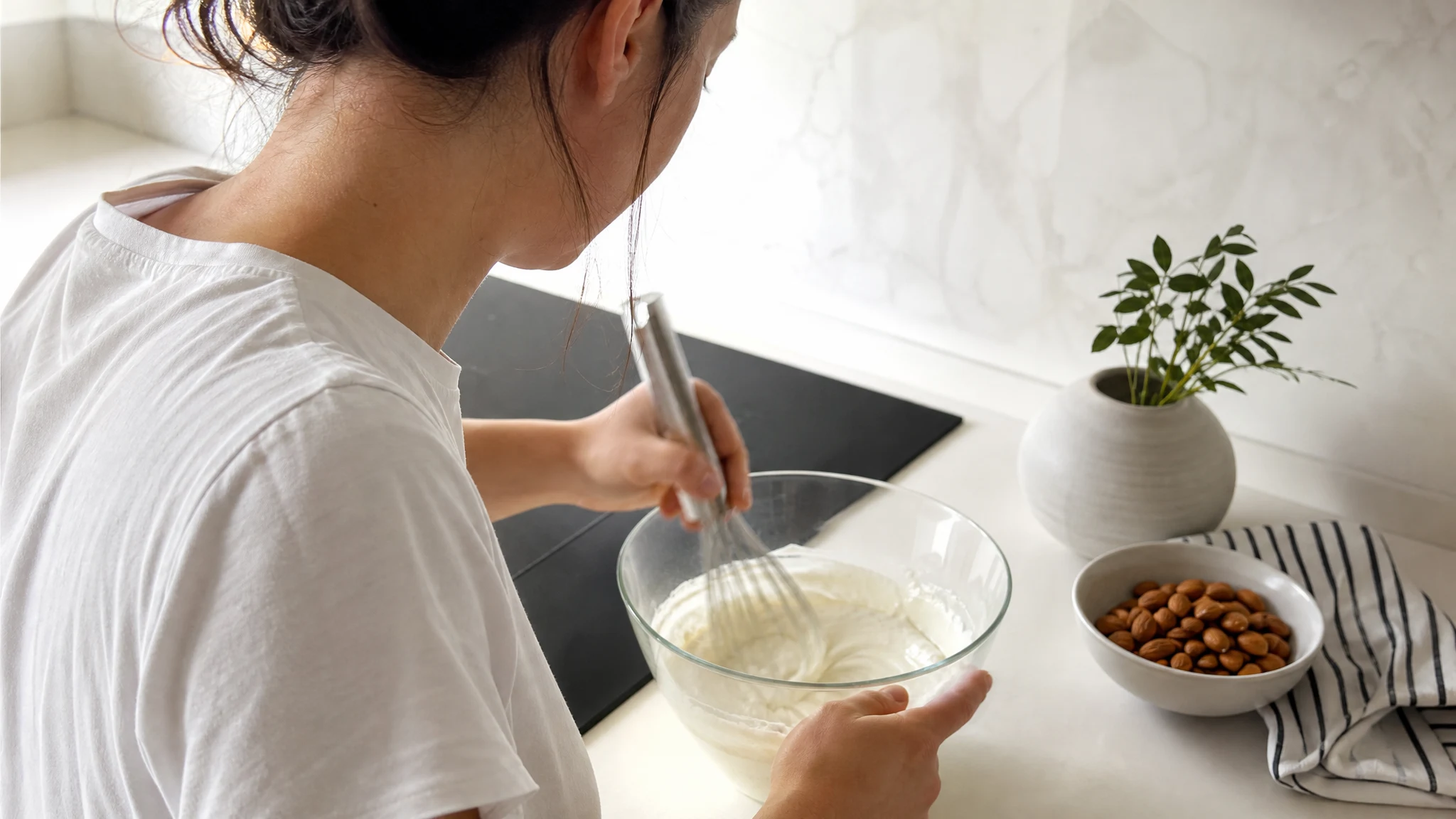
- Whisk the wet ingredients first. Warm the honey or syrup until it pours, whisk it with the oil and salt, then fold in the oats, nuts and seeds until nothing looks dry.
- Spread it thin. A single layer on a lined sheet pan browns evenly; a deep pile steams in the middle.
- Bake low and stir once. A moderate oven, somewhere around 300 to 325 F (150 to 163 C), is a sensible place to begin for oats and sliced nuts. Ovens vary, so watch the color rather than the clock.
- Pull it at golden. Granola crisps as it cools, so it will look slightly soft when it comes out.
- Add the dried fruit afterwards. It holds so little moisture that a long bake scorches it.
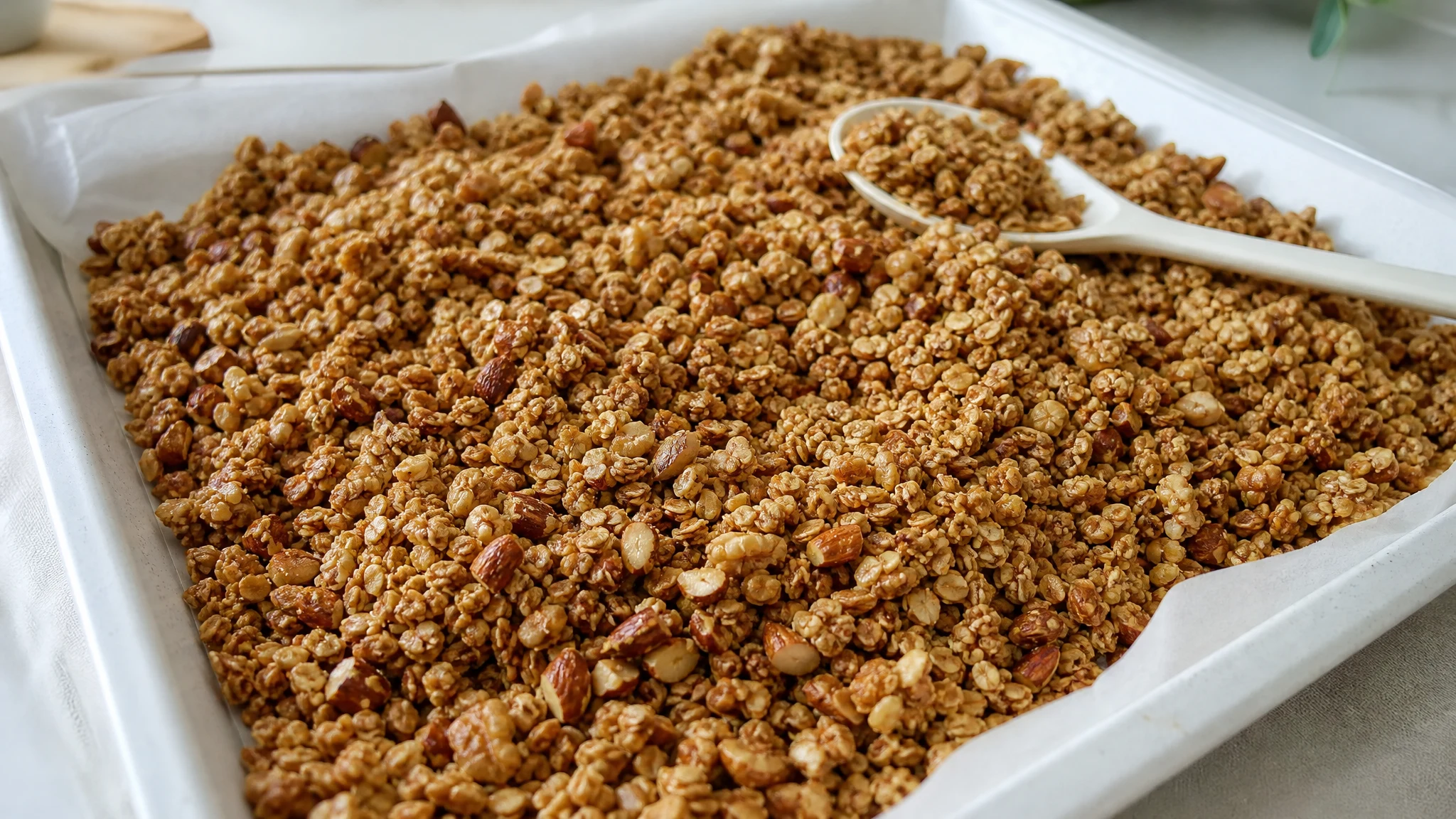
- Decide on clusters. Leave the pan alone while it cools for big clumps, or break it up once cool for a loose granola.
What the kitchen will smell like
Granola announces itself. About ten minutes into the bake, the kitchen begins to smell of toasting oats and warm nuts, with honey caramelizing at the edges of the pan. That smell is your clock: when it turns from sweet to slightly sharp, check the tray straight away. Open the oven door, give the pan a look, and stir the edges inward, since the outer ring cooks faster than the middle. A wooden spoon or a thin spatula works well for this.
Why golden beats dark brown
This is more than taste. The FDA notes that acrylamide forms in foods cooked at high temperatures, that brown areas tend to contain more of it, and that very brown areas should be avoided (Acrylamide and Diet, Food Storage, and Food Preparation). Its examples are potatoes and toast, so applying them to granola is our own extension of the idea, but it is a pleasant habit anyway: golden granola tastes nutty and sweet, while dark granola tastes bitter.
Does it have to be almond oil?
No, and we would rather say so. A plain liquid fat does the structural work whichever oil you pick. What almond oil brings is a gentle, sweet nuttiness that sits well beside toasted almonds, and that is reason enough if you already have a bottle in the pantry.
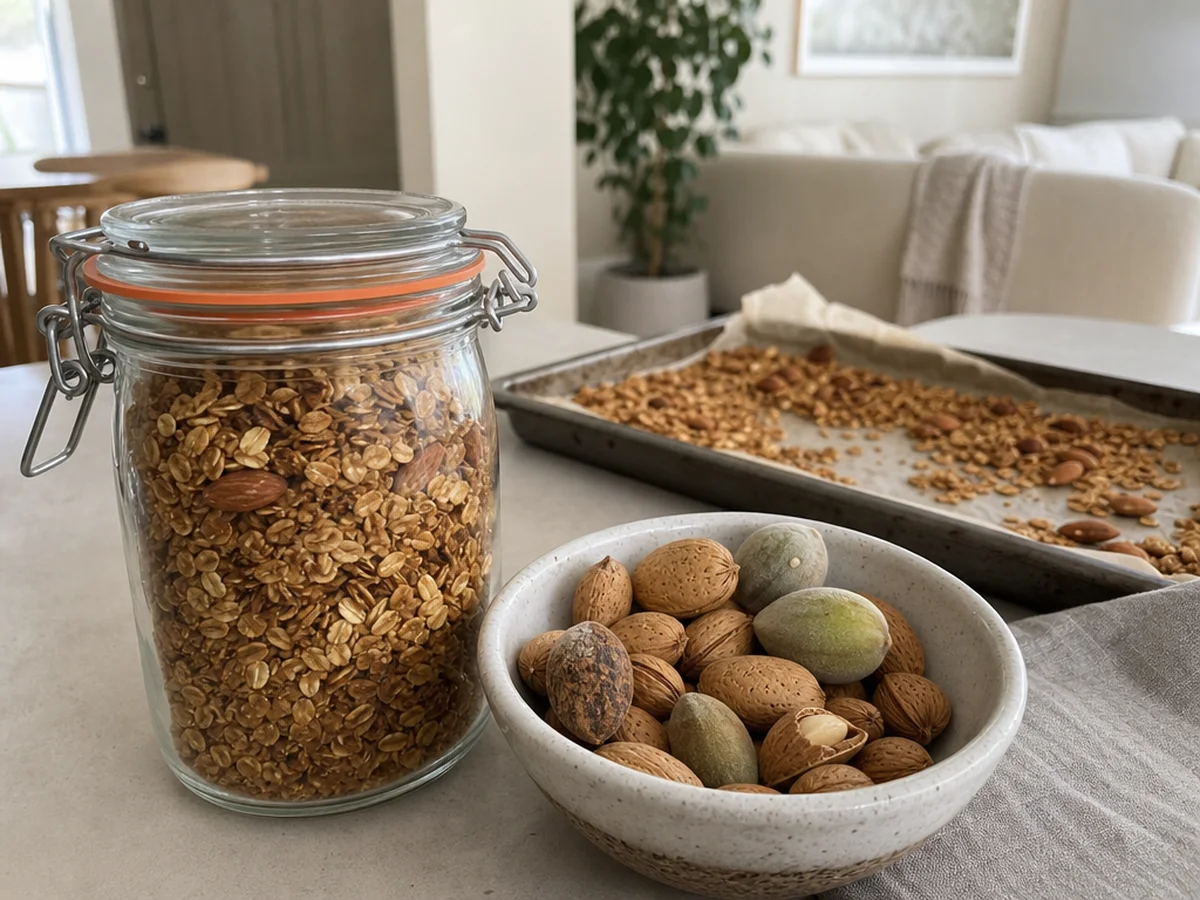
The one thing worth knowing about any nut oil is how it ages. In a study of cold-pressed almond, walnut and pistachio oils kept for up to 16 months, the oils lost resistance to oxidation over time under every storage condition, and peroxide values rose faster at room temperature than under refrigeration (Storage stability and composition changes of three cold-pressed nut oils under refrigeration and room temperature conditions). It did not test granola, but the sensible habits follow: start with a fresh bottle, make a batch you will finish, and smell the granola before serving it.
Make it your own
Once you have the base proportions, the fun starts. A spoonful of cinnamon or a few strips of orange zest in the wet mix changes the whole personality. Stir in pumpkin seeds, coconut flakes or chopped dried apricots after baking. Keep any change small at first, one addition at a time, so you know what you liked. Write the weights on a card and tape it inside a cupboard door, and you will have a recipe that feels like yours after only a few batches.
Storing it
Let the pan cool completely before closing a container, because trapped steam softens the clusters. An airtight container away from heat is all it needs. Our storage guide covers the oil itself.
A word on allergies
This granola contains almonds twice, once as nuts and once as oil, so it is a tree nut food and not one to serve a guest with a tree nut allergy. An allergist writing for the AAAAI explains that refined oils generally lack allergenic protein while unrefined, cold-pressed oils may retain it (Food allergy: nut oils in topical products), and our nut allergy article goes through it in more detail.
If you enjoy baking with almond oil, our baking article has more ideas for swapping it in, and the smoke point guide explains what those numbers really mean.
Weigh it, keep the oil share as the one thing you change, pull the pan at golden, and enjoy the smell of toasting almonds filling the kitchen.

Sweet Almond Oil
Sweet Almond Oil from our own shop, in sizes from 0.5 oz to bulk.
From $9.99
Shop Now →Sources & Further Reading
- FDA, Acrylamide and Diet, Food Storage, and Food Preparation
- Rabadan et al., Storage stability and composition changes of three cold-pressed nut oils under refrigeration and room temperature conditions, Food Chemistry, 2018
- Pongracic, AAAAI Ask the Expert, Food allergy: nut oils in topical products