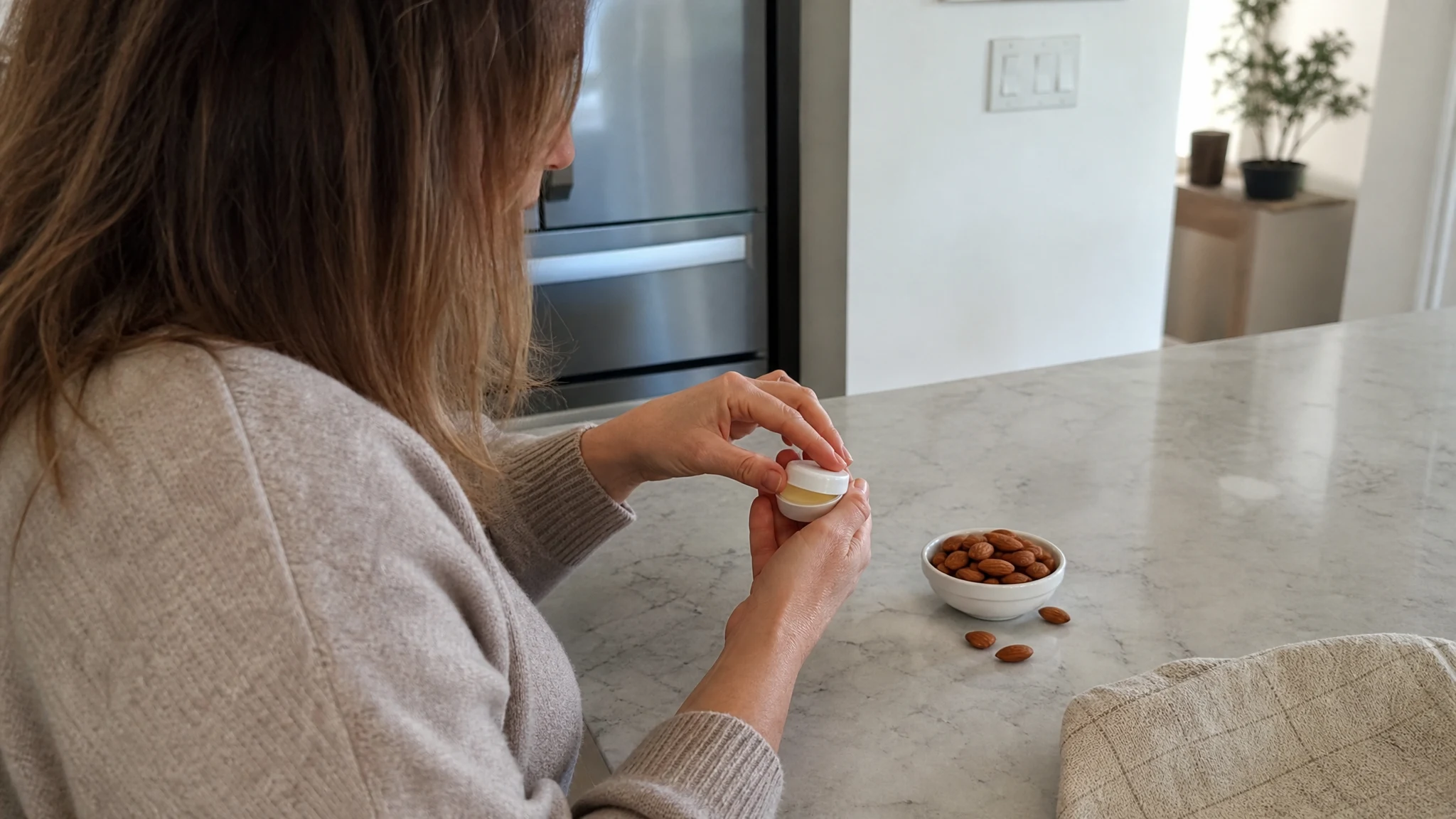
Almond Oil Lip Balm: 3 Easy Ratios by Weight
Almond oil and beeswax make a balm that glides on, leaves lips feeling soft and smells faintly of almonds. It is a nice thing to make and a nice thing to carry in a pocket. It is also worth knowing what it is and is not, so you can choose the right balm for the right day.
Where a wax-and-oil balm fits
The American Academy of Dermatology makes one comparison that shapes everything here: "Ointment seals in water longer than waxes or oils." For lips that are very dry or cracked, it suggests a thick ointment such as white petroleum jelly. An almond oil and beeswax balm belongs in the wax-and-oil family, so we think of it as an everyday, comfortable balm for the pleasure of knowing exactly what is in it, and a lovely handmade gift. For lips that crack or stay rough, the AAD says to expect improvement within two to three weeks of steady care and to see a board-certified dermatologist if you do not.
Our recipes are deliberately short. For chapped lips the AAD lists camphor, eucalyptus, menthol, fragrance, lanolin, salicylic acid and the flavorings cinnamon, citrus, mint and peppermint as things to avoid, and says that burning, stinging or tingling means a product is irritating your lips. That covers most of a typical recipe's "extras," so we leave them out and let the oil's soft, mild aroma do the work.
Three formulas by weight
Weigh everything. Wax is awkward to measure by spoon, and a scale that reads to 0.1 g keeps a small batch honest. These percentages are arithmetic starting points, not a standard; more wax gives a firmer, waxier balm, and more oil gives a softer, glossier one. The volume column converts our oil using the density of the batch on our Certificate of Analysis, 0.918 g per ml.
| Balm | Beeswax | Shea butter | Almond oil | Oil as volume (50 g batch) |
|---|---|---|---|---|
| Soft pot balm | 15% (7.5 g) | none | 85% (42.5 g) | about 46 ml |
| Firmer tube or stick | 25% (12.5 g) | none | 75% (37.5 g) | about 41 ml |
| Richer pot balm | 20% (10 g) | 20% (10 g) | 60% (30 g) | about 33 ml |
If a stick drags or a pot balm runs in a warm room, move 2 to 3 percentage points between wax and oil and try again. The WHO's beeswax monograph gives a melting point of 62 to 65 C, so a heatproof jar over a pan of just-simmering water is enough.
- Wash and dry your jar or tubes completely. Water left in a container is the easiest contaminant to avoid.
- Melt the beeswax (and shea butter, if you are using it) in the jar over the hot water, then stir in the almond oil. Keep it over the water until it is uniform again.
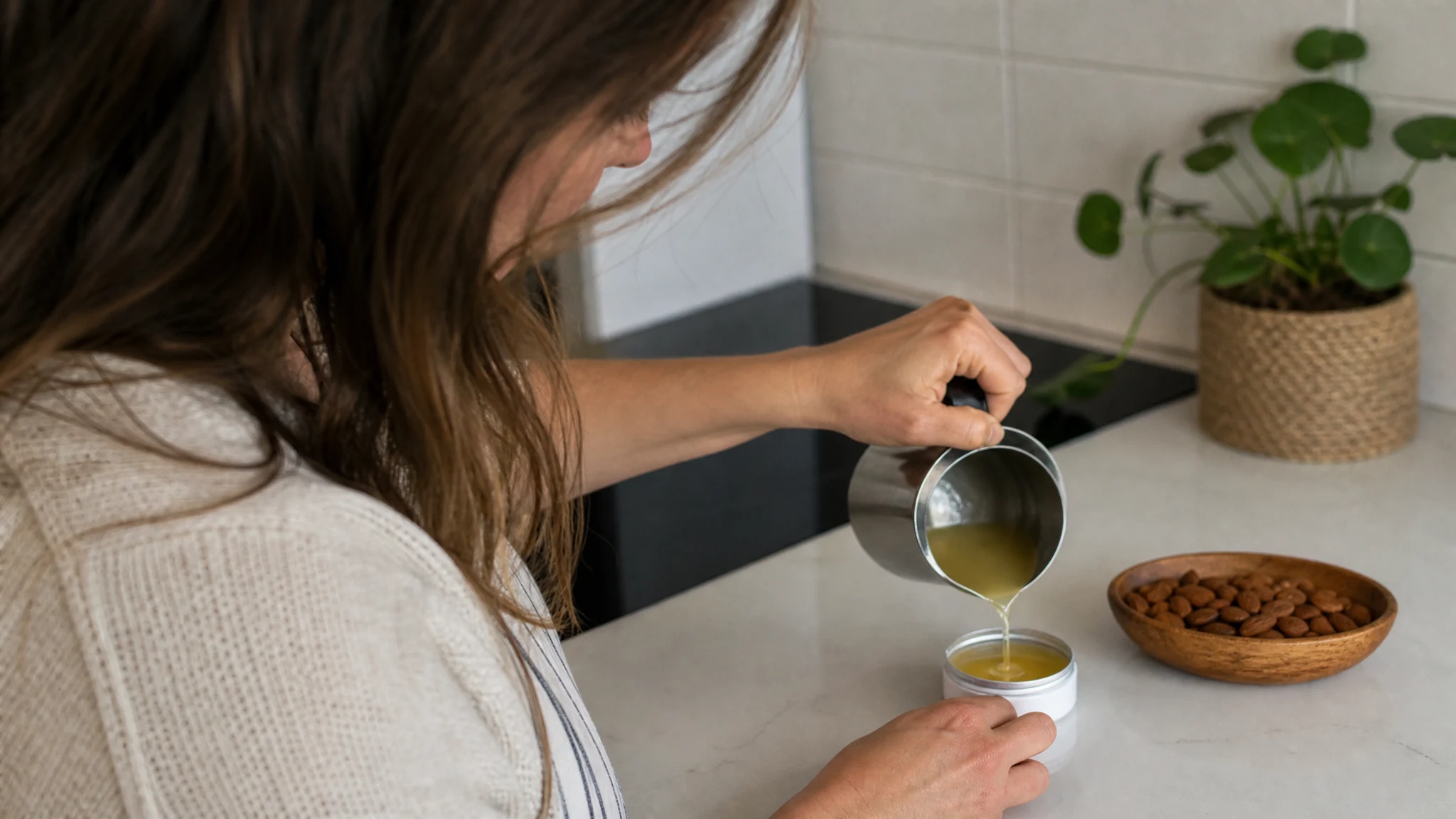
- Pour into your containers and let them set undisturbed before capping.
- Label with the date you made it and the date on your oil's bottle.
Keep it waterless. Aloe, honey or a hydrosol would make it a different product that needs a broad-spectrum preservative, and the FDA lists contaminated water, added water, damp storage and dipped fingers among the routes by which cosmetics become contaminated. A tube is kinder than a pot on that last point; with a pot, use a clean fingertip and do not share it.
Pouring and finishing
Pour slowly and steadily, and give the containers a moment to level before you walk away. You will notice the balm turn cloudy at the edges and then firm up as it cools. Resist the urge to tap or move the tubes while they set. A balm made mostly of beeswax smells faintly honeyed, with the soft almond note underneath, and that is lovely just as it is.
If you give a balm away, write "contains almond oil" on the label. It takes a second and it lets a friend with a nut allergy say no thank you.
On sunny days
The AAD advises a lip balm with SPF 30 or higher, reapplied every two hours, before going outdoors. Nothing in a balm made of oil and wax is a sunscreen, so we think of these as indoor, evening and everyday balms. We explain why in our post on almond oil and the sun.
Who should check first
Almond is a tree nut. Our oil is cold-pressed and unrefined, so trace almond protein is present, and if you have a tree nut allergy you should not use it. The AAAAI notes that refined oils usually lack allergenic protein while unrefined, cold-pressed ones retain it, and that topical exposure has not been well studied. Lips are the one place where a product is routinely swallowed in tiny amounts, so be careful about gifting this balm to someone whose allergy history you do not know. Our nut allergy article has the longer version.
Beeswax allergy is uncommon. A 2025 review of bee product allergy reports 0.45% in a patch test series of 2,828 patients, with reactions usually attributed to propolis left in unrefined wax. Anyone who reacts to propolis, or has had inflamed lips from a past balm, should ask a dermatologist or allergist before using beeswax. Patch test a small dab on the inner forearm first and wait a day, as we describe in our patch test guide.
Keeping the balm
A waterless balm has nothing for microbes to grow in, but its oils still age. Our oil keeps about a year from pressing when stored cool and dark, and a balm cannot outlast its shortest-lived ingredient, so date it and make small batches. If it smells sharp, paint-like or stale, let it go. For a closer look at how shea butter compares with almond oil, see almond oil vs shea butter. Make the balm because you like a tidy, scent-free lip product that you control, and it will earn its place in your pocket.
Sweet Almond Oil
Sweet Almond Oil from our own shop, in sizes from 0.5 oz to bulk.
From $9.99
Shop Now →Sources & Further Reading
- American Academy of Dermatology. 7 dermatologists' tips for healing dry, chapped lips. aad.org
- WHO Food Additives Series 30. 756. Beeswax. inchem.org
- FDA. Microbiological Safety and Cosmetics. fda.gov
- AAAAI. Food allergy: nut oils in topical products. aaaai.org
- Matuszewska-Mach E et al. Ensuring the Safe Use of Bee Products: A Review of Allergic Risks and Management. Int J Mol Sci, 2025. pmc.ncbi.nlm.nih.gov/PMC12732908