Chamomile and Almond Body Oil: An Easy Evening Blend
There is something lovely about an evening ritual that takes thirty seconds: a few drops of chamomile in a small bottle of almond oil, smoothed over your arms and shoulders after a bath. The aroma is soft and sweet, and the almond oil gives it a gentle, nutty base. Here is how to blend it sensibly, with the numbers worked out for you.
Roman or German? Check the label
Two different plants are sold as chamomile. Roman chamomile (Chamaemelum nobile) and German chamomile (Matricaria chamomilla) have different chemistry, and a recent review of the two concludes they should not be treated as interchangeable: Roman has an ester-rich oil, while German is rich in alpha-bisabolol and chamazulene-related compounds (German and Roman Chamomile: Species-Specific Phytochemical Profiles, Bioactive Potential, and Relevance for Functional Foods and Nutraceutical Development). For an evening blend, choose the one whose aroma you prefer and make sure the botanical name is on the bottle.
We make almond oil, not essential oil, so chamomile comes from an aromatherapy supplier. We would favor a supplier who prints the botanical name and a date.
The ratio: start at 1%
The Tisserand Institute gives 1 to 3% for body oils and lotions, 0.5 to 1.2% for facial cosmetics and 0.2 to 1% for sensitive or impaired skin (Dilution for essential oils). Because a nightly oil gets used again and again, we would sit at 1%, the bottom of the body-oil range, and not at the top.
The arithmetic, using our oil's relative density of 0.918 at 20 C (the figure on the Certificate of Analysis for one batch): 60 ml, about 2 fl oz, weighs roughly 55 g, so 1% chamomile is about 0.55 g. If you assume around 20 drops to the milliliter, which is only an approximation because droppers differ, that is about a dozen drops. A kitchen scale that reads to 0.01 g is better still. The Tisserand page itself calls drop conversions approximate.
A tempting shortcut is to add extra drops for a stronger scent. Doubling the drops doubles the dilution to roughly 2%, so if you want more fragrance, make a fresh batch with a stronger-smelling chamomile at the same percentage instead.
Making it
- Start with a clean, dry amber glass bottle. There is no water in this blend, which keeps it simple.
- Weigh the almond oil in, add the chamomile oil, cap it and roll the bottle gently between your palms.
- Label it with both ingredients, the percentage and the date. Our oil keeps for about a year from pressing when stored cool and dark. Make a small bottle and use it up.
- Patch test the finished blend. The American Academy of Dermatology describes a quarter-sized spot on the inner arm or elbow crease, the normal amount, twice daily for 7 to 10 days, stopping at redness, itching or swelling (How to test skin care products). For something you will use nightly, that longer schedule is a good habit.
Making the ritual part of the pleasure
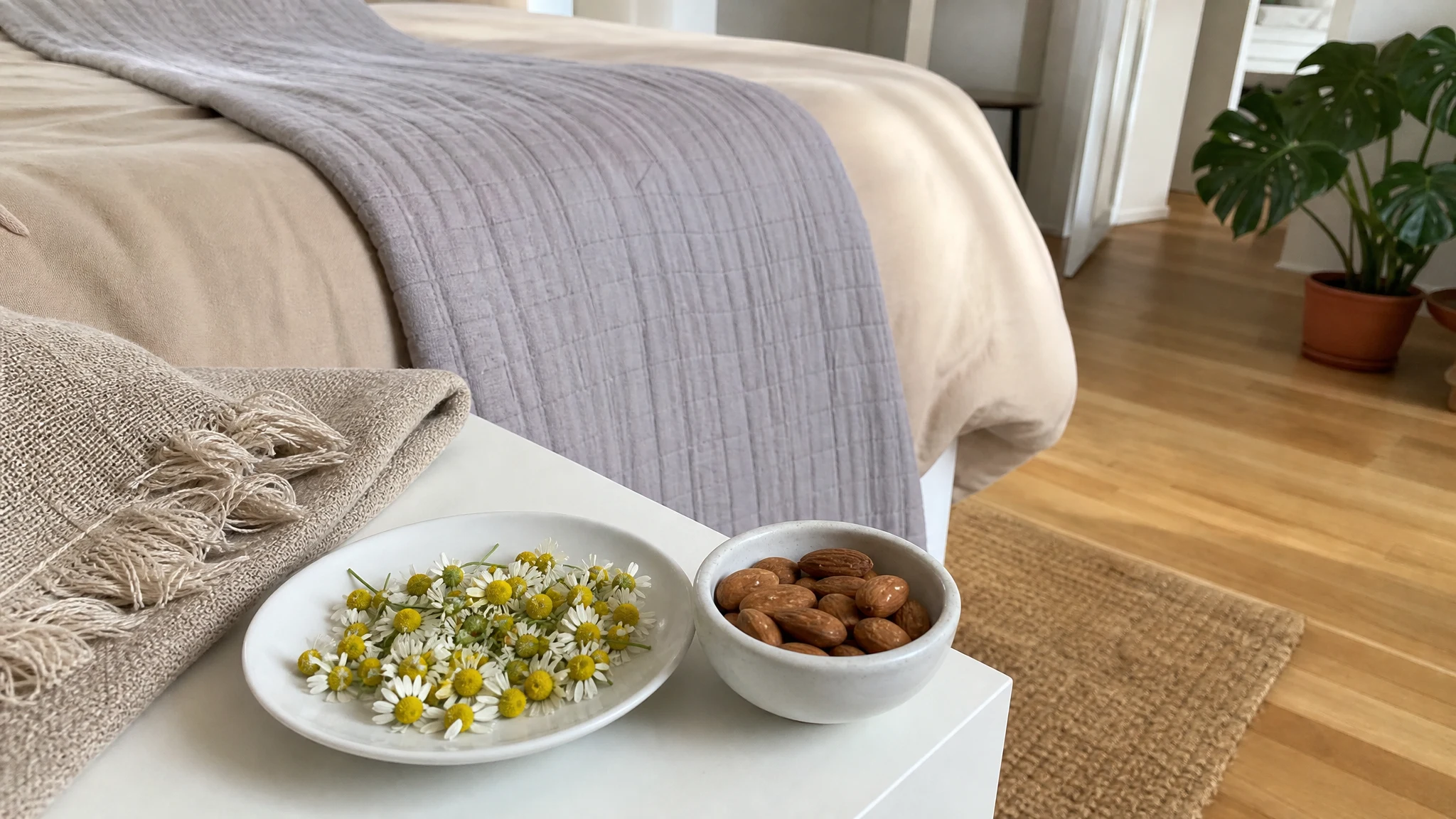
Part of the charm here is the ritual. Try making the oil the last step after a warm shower, with the lights low and your phone in another room. Warm a few drops between your palms first, then smooth them over forearms and shoulders with slow strokes. Because chamomile goes in at such a small percentage, the scent stays quiet, closer to a hint than a perfume.
Open the bottle and smell the finished blend before you use it. You will probably notice the soft, nutty sweetness of the almond first, with the chamomile arriving gently behind it.
Choosing a bottle
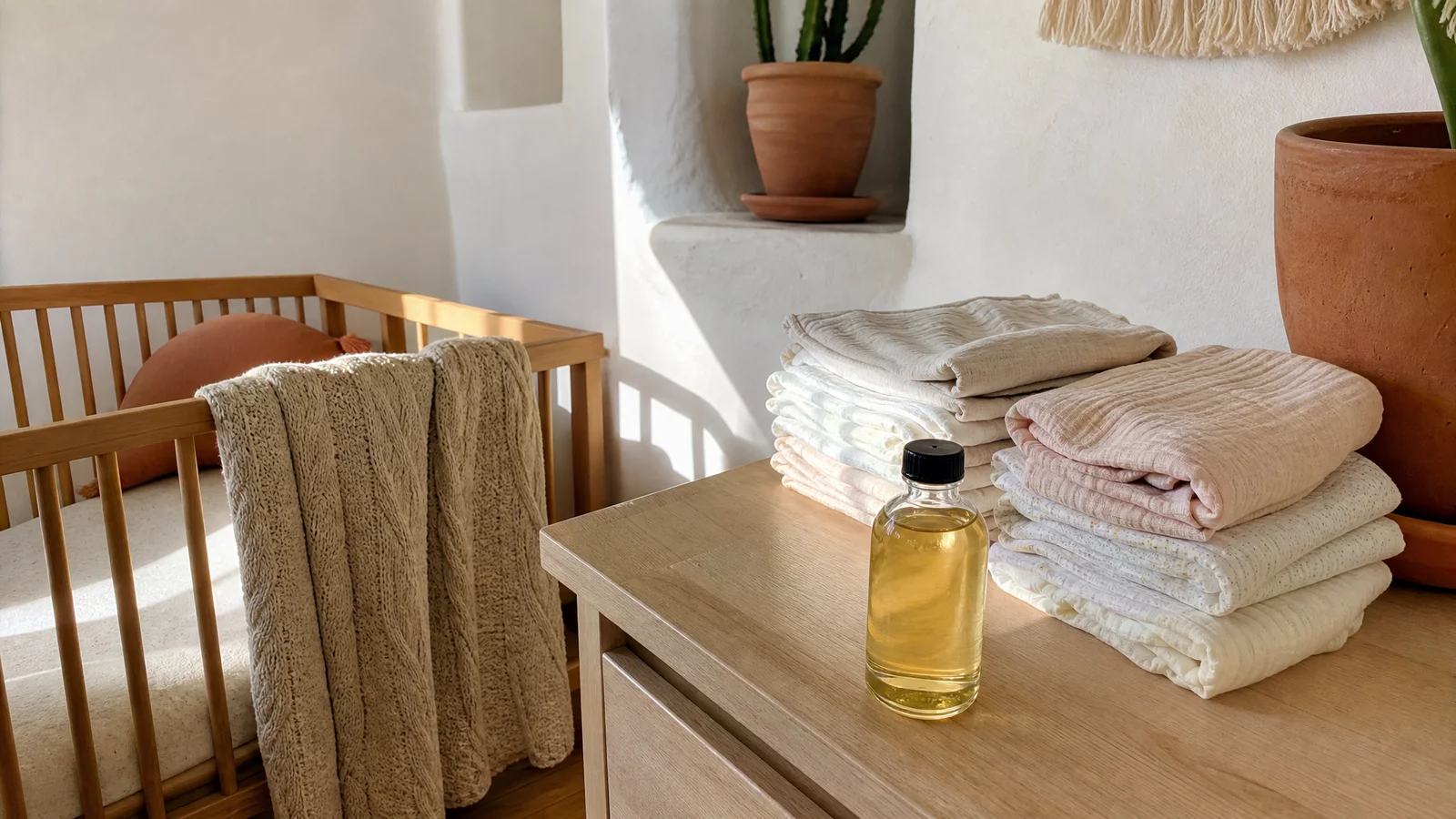
A small amber glass bottle is a comfortable size for a blend like this. It fits on a bathroom shelf and is easy to finish while the aroma is still fresh. If you want to give one as a gift, write the ingredients and the date on the label and mention the almond clearly, so whoever receives it can decide for themselves.
Who should sit this one out
Almond is a tree nut. Our oil is cold-pressed and unrefined, so we ask anyone with a tree nut allergy not to use it. Chamomile has its own allergy note: it belongs to the daisy family, and a 2025 review of medicinal plants in that family describes them as long-recognized sensitizers that can cause both immediate and delayed reactions (Allergic Potential of Medicinal Plants From the Asteraceae Family). If you react to ragweed, chrysanthemums or similar plants, ask an allergist before using chamomile oil. If you are pregnant or nursing, or the blend is for a child, ask your obstetrician, midwife or pediatrician about essential oils first.
This is a scented body oil, and we do not claim it improves sleep or treats anything. If sleep is a genuine concern, a physician is the right person to talk to.
A note about bedding
Oils soak into fabric. Cambridgeshire Fire and Rescue Service states that there is a fire risk with all emollients, paraffin or not, particularly when they soak into bedding or clothing, and advises regular washing of bedding and clothes (Emollients). A few drops on the arms is a very modest amount, but it is worth letting the oil absorb before you get into bed and washing your sheets as usual.
For the ratios of other essential oils, see our dilution ratios guide, and the carrier oil guide explains what the base does. If you prefer a livelier scent, our lavender massage oil uses the same arithmetic.
Keep the bottle small, the percentage low and the routine unhurried, and the blend will do exactly what a good evening oil should.

Sweet Almond Oil
Sweet Almond Oil from our own shop, in sizes from 0.5 oz to bulk.
From $9.99
Shop Now →Sources & Further Reading
- Such et al., German and Roman Chamomile: Species-Specific Phytochemical Profiles, Bioactive Potential, and Relevance for Functional Foods and Nutraceutical Development, Nutrients, 2026
- Tisserand Institute, Dilution for essential oils
- American Academy of Dermatology, How to test skin care products
- Ključevšek and Kreft, Allergic Potential of Medicinal Plants From the Asteraceae Family, Health Sci Rep, 2025
- Cambridgeshire Fire and Rescue Service, Emollients