Lavender Almond Oil Massage Blend: Ratios That Work
Lavender and almond oil is one of the classic pairings for a reason. Lavender brings the herbal, floral aroma people associate with unwinding, and almond oil brings glide: a soft, subtly nutty base that stays on the skin long enough for a proper massage. Getting the blend right comes down to a few numbers and a few good habits.
The ratio table
The Tisserand Institute gives 1 to 3% for body oils and lotions, 0.5 to 1.2% for facial cosmetics and 0.2 to 1% for sensitive or impaired skin, as a share of the finished product (Dilution for essential oils). For a body massage oil, 1% and 2% both sit inside the body range. The weights below follow from the relative density of 0.918 at 20 C on the Certificate of Analysis for one batch of our oil, and they are arithmetic rather than specifications.
| Almond oil | Weighs about | Lavender at 1% | Lavender at 2% |
|---|---|---|---|
| 30 ml (1 fl oz) | 27.5 g | 0.28 g | 0.56 g |
| 60 ml (2 fl oz) | 55.1 g | 0.56 g | 1.12 g |
| 120 ml (4 fl oz) | 110.2 g | 1.11 g | 2.25 g |
In drops, assuming roughly 20 drops per milliliter (an approximation, since droppers and oils differ), 1% in 60 ml is about 11 or 12 drops and 2% about 22 or 23. That makes the familiar "dozen drops per ounce" rule of thumb closer to 2% than 1%. For a bottle that will be used often, or shared, we suggest starting at 1%: lavender is fragrant enough that you will smell it long before you reach 2%, and if you find yourself adding drops for more scent, the percentage is the number to check. At 1% the same bottle also stays within the facial range, which is handy if it travels up to the neck. A 0.1 g kitchen scale cannot resolve 0.28 g, so for the smallest batch use a 0.01 g scale or make the larger one.
Keep your lavender fresh
Linalool, a fragrance compound found in lavender, changes as it oxidizes, and oxidized linalool is a stronger skin sensitizer. In a repeated open application test, volunteers who were already allergic to oxidized linalool reacted to creams containing it at 3.0%, 1.0% and 0.30% (Air-oxidized linalool elicits eczema in allergic patients - a repeated open application test study). Those were people already sensitized, so it is not a measure of risk for everyone, but it shows why freshness matters. Buy lavender oil with a date, keep it capped, cool and dark, and retire a bottle whose smell has changed. Mixing it into almond oil dilutes it but does not stop it aging.
Almond is a tree nut
An allergist writing for the AAAAI notes that unrefined, cold-pressed nut oils can retain protein that refined oils generally lack (Food allergy: nut oils in topical products). Our oil is cold-pressed and unrefined, so we ask anyone with a tree nut allergy not to use it, including as a massage oil for someone else. Check before you give a bottle as a gift.
A note on children
A 2007 report described three prepubertal boys who developed breast tissue enlargement while using products containing lavender and tea tree oils; it resolved when they stopped, and laboratory tests found both oils had estrogen-like and anti-androgen activity (Prepubertal gynecomastia linked to lavender and tea tree oils). Three cases cannot say how common this is, and those were not almond oil blends, but it is a reason to leave scented blends for adults and ask a pediatrician before using essential oils on a child. If you are pregnant or nursing, check with your obstetrician or midwife as well.
Making the massage itself nicer
A massage oil is as much about the setting as the blend. Warm the closed bottle in a bowl of warm tap water for a minute before you start, keeping water out of the oil, and warm a little between your palms before it touches skin. Use long, slow strokes: almond oil's soft glide means a small amount covers more than you might expect. Keep a towel under you and a second one for your hands.
Smell the finished blend before the first use. Lavender's herbal, floral scent should sit alongside the nutty sweetness of the almond, and if it feels too strong, that is your cue to lower the percentage next time.
Mixing, labeling and testing
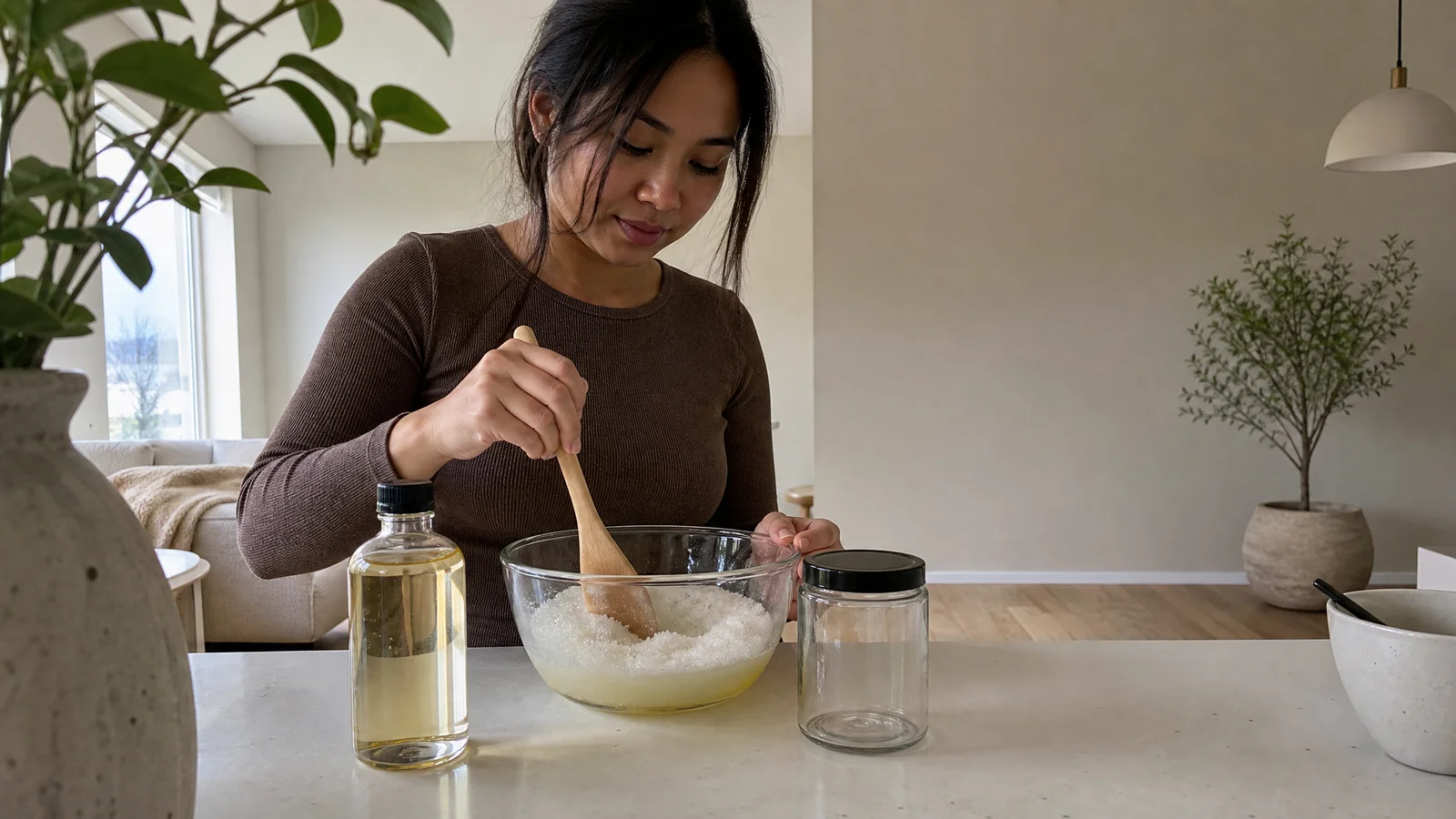
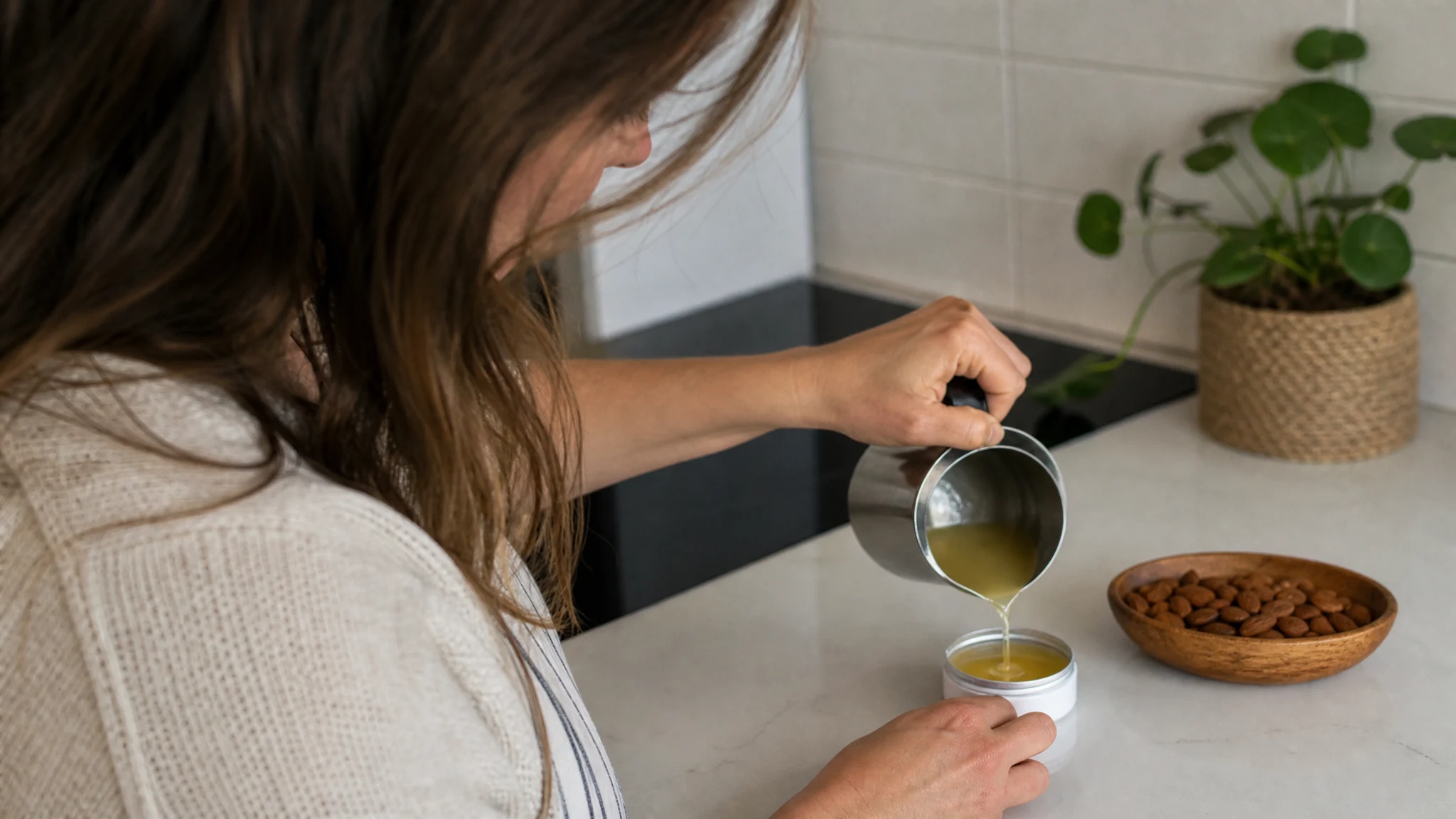
- Weigh the almond oil into a clean, dry amber bottle, add the lavender, cap and roll to mix.
- Label the ingredients, percentage and date. Our oil keeps about a year from pressing when stored cool and dark, so a small batch you finish within a few months is a sensible target.
- Patch test the finished oil. The American Academy of Dermatology describes a quarter-sized spot on the inner arm or elbow crease, twice daily for 7 to 10 days, stopping at redness, itching or swelling (How to test skin care products).
- Keep it away from the eyes, and launder massage towels hot. An insurer's loss-control article warns that oil-soaked linens can ignite in a dryer or in storage even after washing (Avoid Fires from Massage Oils). Our massage article has more.
This is a scented massage oil, and the lavender is there for its aroma. We make no medical claims, and if you have a skin condition or use medication that affects your skin, a dermatologist is the right person to ask before adding a scented oil.
For other essential oils, our dilution ratios guide uses the same arithmetic, and our chamomile evening oil is a gentler-smelling alternative.
Pick a fresh lavender, start at 1%, and enjoy a massage that smells like a summer field.

Sweet Almond Oil
Sweet Almond Oil from our own shop, in sizes from 0.5 oz to bulk.
From $9.99
Shop Now →Sources & Further Reading
- Tisserand Institute, Dilution for essential oils
- Andersch Björkman et al., Air-oxidized linalool elicits eczema in allergic patients - a repeated open application test study, Contact Dermatitis, 2014
- Pongracic, AAAAI Ask the Expert, Food allergy: nut oils in topical products
- Henley et al., Prepubertal gynecomastia linked to lavender and tea tree oils, N Engl J Med, 2007
- American Academy of Dermatology, How to test skin care products
- Great American Insurance Group, Avoid Fires from Massage Oils