Tea Tree Oil vs Almond Oil: Carrier or Essential Oil?
People search "almond oil vs tea tree oil" as if they were picking a team, but the two are different kinds of ingredient. Sweet almond oil is a carrier oil you use as it comes. Tea tree oil is a distilled essential oil that safety regulators discuss in fractions of a percent. The more useful question is how much tea tree would be in your bottle, and what the evidence says about that amount.
What tea tree has actually been studied at
The two trials people usually cite both used a 5 percent gel. In a 1990 single-blind trial of 124 people with mild to moderate acne, a 5 percent tea tree oil gel was compared with 5 percent benzoyl peroxide lotion; tea tree acted more slowly and the tea tree group reported fewer side effects (A comparative study of tea-tree oil versus benzoylperoxide in the treatment of acne). A 2007 double-blind, placebo-controlled trial of 60 people used the same strength over 45 days (The efficacy of 5% topical tea tree oil gel in mild to moderate acne vulgaris: a randomized, double-blind placebo-controlled study).
We report those studies rather than recommend anything from them. They tested a formulated gel, not tea tree stirred into a carrier oil, and we sell a cosmetic oil, not a blemish product. Our almond oil is not offered for any skin condition.
The number most articles skip
In late 2025 the EU's Scientific Committee on Consumer Safety published its final opinion on tea tree oil. It considers the oil safe in finished products at up to 2.0 percent in shampoo, 1.0 percent in shower gel, 1.0 percent in face wash and 0.1 percent in face cream, provided the oil meets the ISO 4730:2017 composition standard, for adults, and not in sprays or aerosols. The committee also described it as a moderate skin sensitiser (SCCS - Scientific Opinion on Tea Tree Oil (CAS/EC No. 68647-73-4 /285-377-1)).
Put that beside the trials. A 5 percent gel is fifty times the 0.1 percent face-cream figure. They are different documents, one reporting what happened to volunteers and the other setting a cap for products on shelves, but together they show that "dilute tea tree in a carrier" is not one number. A little arithmetic helps: a 1 oz bottle of our oil (29.57 ml) weighs about 27 g at the density on the batch certificate we publish (0.918), so 0.1 percent would be roughly 27 mg of tea tree oil, far less than you can count in drops. That is a good reason to leave facial formulas to products made with a scale and a stability test.
Fresh matters more than you would think
Most tea tree allergy stories are really oxidation stories. A laboratory study found that fresh tea tree oil was a very weak sensitizer in guinea pigs while oxidized oil was about three times stronger, and that the patients allergic to tea tree oil reacted to compounds that form as the oil degrades (Degradation products of monoterpenes are the sensitizing agents in tea tree oil). A clinic in Victoria, Australia reviewed patch-test records and found 41 of 2,320 people, 1.8 percent, reacted to oxidized tea tree oil, and many had used it neat (Allergy to tea tree oil: retrospective review of 41 cases with positive patch tests over 4.5 years). A clinic population overstates the general rate, but the pattern is clear enough: a bottle that has been open for a long time is not one to put on skin.
What each oil is for
Almond oil is the carrier. We press ours cold and sell it unrefined, neat, with a soft, lightly sweet aroma, and it suits massage, body oil and blending. One thing to know: because it is unrefined, trace almond protein is present, so anyone with a tree nut allergy should not use it. Our patch test guide explains a careful way to try any new oil.
Tea tree oil we do not sell. If you already own a bottle, check the date and the smell, keep it capped and cool, and read the label's own dilution advice. The American Academy of Dermatology suggests choosing moisturizers labeled oil-free or non-comedogenic if you are acne-prone and speaking with a dermatologist about concerns (Moisturizer: Why you may need it if you have acne). Our acne-prone skin FAQ goes through almond oil's side of that.
Smell tells a story
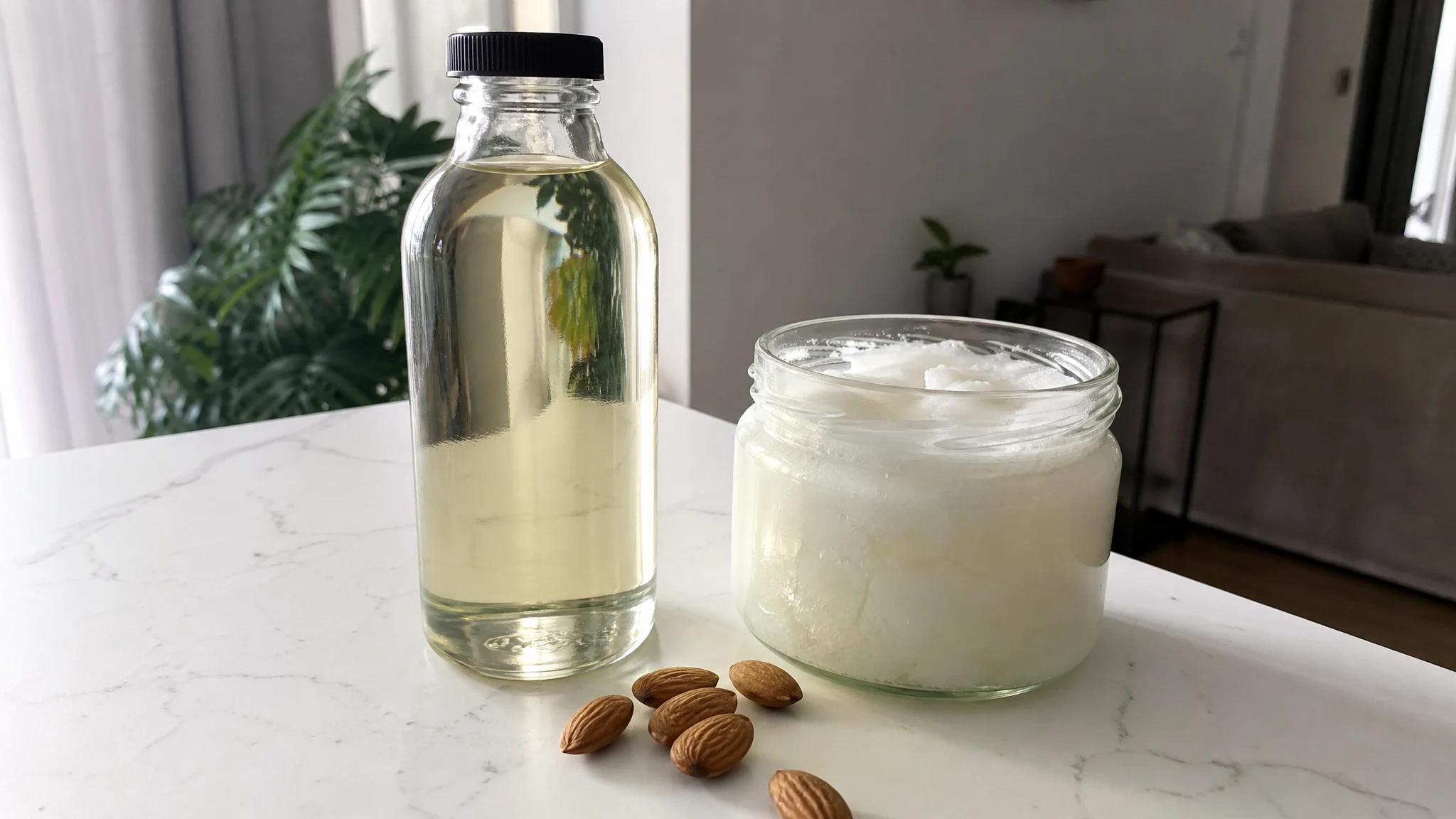
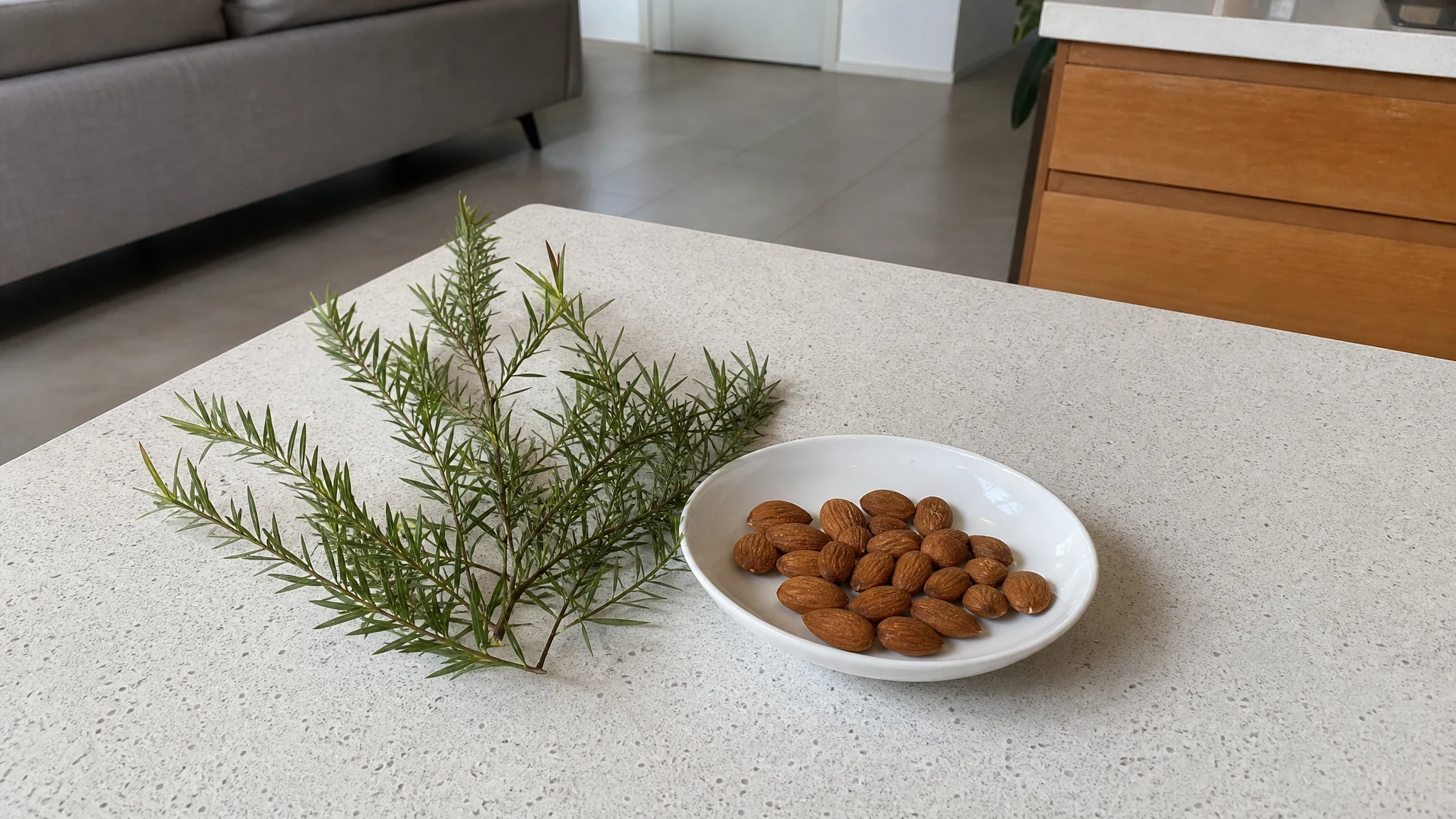
One way to feel the difference between the two is to open them one after the other. Almond oil is soft, round and a little sweet. Tea tree is sharp, medicinal-smelling and loud, and just a small amount fills a room. That contrast is the reason the two work as a pair and the reason they are so different to handle. Treat the tea tree bottle with respect, cap it right away and keep it away from your eyes.
If you blend them anyway
The carrier matters less than the dilution and the freshness of the essential oil. Our dilution ratios post lays out the published ranges. Patch test the finished blend using the AAD method, a quarter-sized spot on the inner arm applied twice daily for seven to ten days, stopping at redness, itching or swelling (How to test skin care products). Pregnant, nursing, or choosing for a child? Ask your doctor first; the SCCS opinion covers adult dermal products only.
So pick almond oil when you want a plain, gentle-smelling base, and treat tea tree as the potent, short-lived ingredient it is. They get along fine, but only one of them is a measure-in-milligrams ingredient.
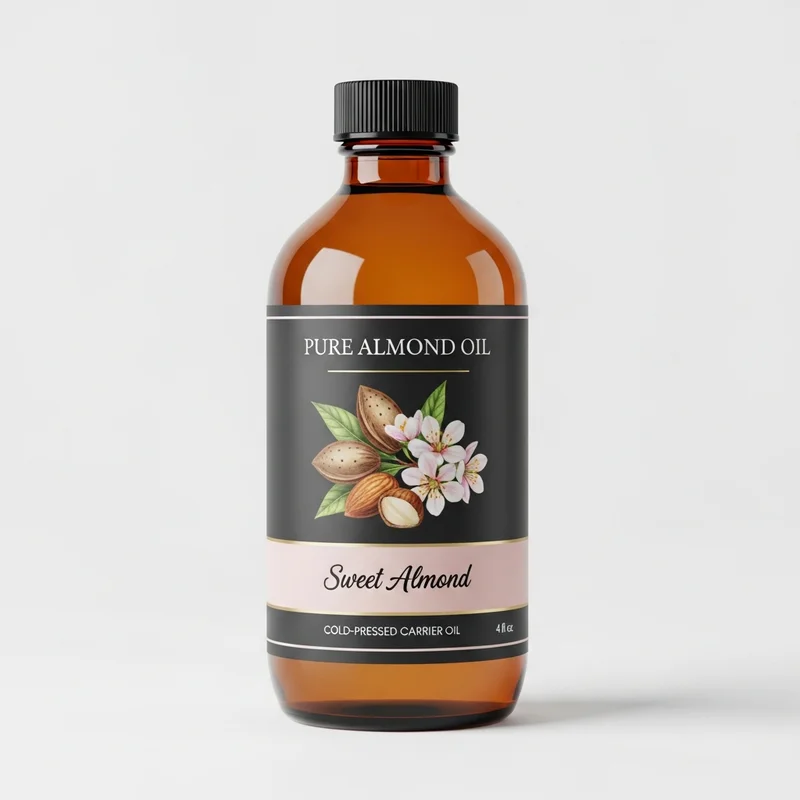
Sweet Almond Oil
Sweet Almond Oil from our own shop, in sizes from 0.5 oz to bulk.
From $9.99
Shop Now →Sources & Further Reading
- Bassett IB et al., 1990. A comparative study of tea-tree oil versus benzoylperoxide in the treatment of acne. Med J Aust.
- Enshaieh S et al., 2007. The efficacy of 5% topical tea tree oil gel in mild to moderate acne vulgaris: a randomized, double-blind placebo-controlled study. Indian J Dermatol Venereol Leprol.
- Scientific Committee on Consumer Safety, 2025. SCCS - Scientific Opinion on Tea Tree Oil (CAS/EC No. 68647-73-4 /285-377-1).
- Hausen BM et al., 1999. Degradation products of monoterpenes are the sensitizing agents in tea tree oil. Am J Contact Dermat.
- Allergy to tea tree oil: retrospective review of 41 cases with positive patch tests over 4.5 years. Australas J Dermatol, 2007.
- American Academy of Dermatology. Moisturizer: Why you may need it if you have acne.
- American Academy of Dermatology. How to test skin care products.