Almond Oil on a Guitar Fretboard: Should You?
Every guitarist with an unfinished rosewood or ebony fretboard has looked at a dry, pale patch of wood and wondered what is in the kitchen cupboard. Almond oil is a reasonable thing to wonder about. It is gentle, it smells pleasant, and it is easy to find. Before any oil goes near an instrument, though, two questions matter more than the oil: what is your fretboard's surface, and what do the makers say?
Step one: is the board finished at all?
This single check settles most of the debate. D'Addario's fretboard guide explains that unfinished boards, the bare wood without a protective lacquer layer, are the ones that benefit from conditioning, and that darker woods are commonly left unfinished. Maple boards are often finished and generally do not need it. Your instrument's spec sheet or maker will tell you which you have.
If your board is finished, there is no bare wood for an oil to reach, and a wipe with a damp cotton cloth is all it needs. Martin's own advice for cleaning is exactly that: a clean, damp cotton cloth, then a dry one.
Look and feel before you touch anything
Spend a few minutes with your guitar in good light before you do anything at all. Tilt the neck so the light slides across the fretboard and look for the sheen of a finish. A finished board looks smooth and slightly glossy, and a bare one looks matte, with the grain of the wood visible. Run a fingertip along it: bare wood feels like wood, a little dry and grainy, while a finish feels slick. That simple look will tell you more than any bottle.
What the instrument makers actually name
Read the major care guides and you will meet the same names again and again. D'Addario notes that PRS, Tom Anderson and Takamine recommend lemon oil, while Martin does not recommend it on the fingerboard because its acids can damage the finish and may speed fret corrosion and shorten string life. D'Addario recommends its own conditioner for unfinished boards, and StewMac sells a board oil built on Amazonian rosewood oil, made for unfinished fretboards and acoustic bridges. Linseed oil appears too, though D'Addario says it is harder to clean up.
Almond oil does not appear in any of these. We read that as meaningful: the people who build and service these instruments have settled on purpose-made products, and we would sooner point you to your maker than ask you to be the experiment.
Why a food-type oil is a different animal on wood
Our oil is a cold-pressed sweet almond oil sold for external cosmetic use. That is a skin and hair oil, not an instrument conditioner, and we do not sell it as one. There is also some chemistry worth knowing. Plant oils rich in unsaturated fatty acids react with oxygen over time, a process a 2025 review of vegetable oil oxidation describes in detail. Almond oil is mostly oleic acid, which sits at the gentler end of that scale, but any plant oil that is left on a surface will change with time, and what that looks like on a fretboard is something we have no way of promising. That is reasoning from the chemistry, not a result from a guitar.
The practical takeaway is not that almond oil is forbidden. It is that a kitchen oil on an instrument is a decision with consequences, so it should be yours and your maker's, not ours.
The player's side of the story
Guitarists get attached to their instruments, and it is easy to see why. The neck is where your hand lives. So it is worth thinking about your hands as part of the care routine. Wash and dry them before you play, because grime on the fingers ends up on the board. Wipe the strings with a dry cloth after you finish. You will notice the instrument stays brighter and the board stays cleaner, and the habits cost nothing.
What does the most good
If your fretboard looks dry, the likeliest culprit is the air. Martin recommends keeping a guitar at 45 to 55% relative humidity and 72 to 77 F (22 to 25 C), and says dry air is behind damage like cracking and warping. D'Addario makes the same point: conditioning supports the wood, but it does not replace humidification. A room or case humidifier in winter may do more for the instrument than any bottle.
- Clean first. Grime under the oil helps nobody.
- Check the finish, then check your maker's guide.
- Condition at string changes, as D'Addario suggests, not on a whim.
- Use the product your maker or a luthier recommends.
If you are tempted to try anyway
If you are still curious, the careful route is to ask first. Your maker or a local repair shop can tell you in a minute what they would use and why. They have seen many boards and know the local climate. If they say no to a kitchen oil, you have saved yourself a mistake. If you want to try it on the odd bit of spare wood, do that first, in a place nobody will see, and watch how the surface looks over a few weeks.
Where we are happy to help
If you want almond oil in your day, we are good for hands, cuticles and skin, which are all part of a guitarist's toolkit. Our posts on wood furniture, cutting boards and leather look at other surfaces, and squeaky hinges covers a household job. Questions are welcome through the contact page.
Take care of the guitar first, and the guitar will take care of you.
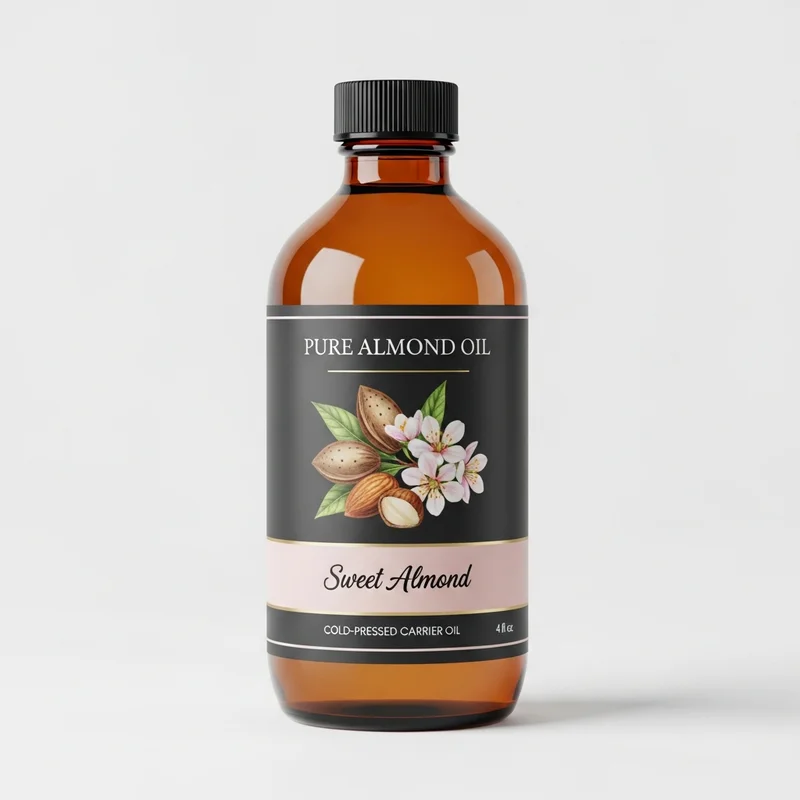
Sweet Almond Oil
Sweet Almond Oil from our own shop, in sizes from 0.5 oz to bulk.
From $9.99
Shop Now →