Almond Oil Cost: How to Compare Bottles Fairly
Two bottles of almond oil can both say 8 oz, cost about the same, and still hold different amounts of oil. That is not a trick, just how labels work, and once you know where the differences hide, comparing almond oils gets a lot easier. We do not quote prices in articles because they change, so this is a guide to doing the sums yourself.
Start with the unit on the label
US cosmetic labels may state quantity by weight (avoirdupois ounces) or by volume (fluid ounces), and the rule lets wording alone tell them apart, such as "net wt." versus "fl oz" (21 CFR 701.13). A weight ounce of oil is bigger than a fluid ounce of it, because almond oil is lighter than water.
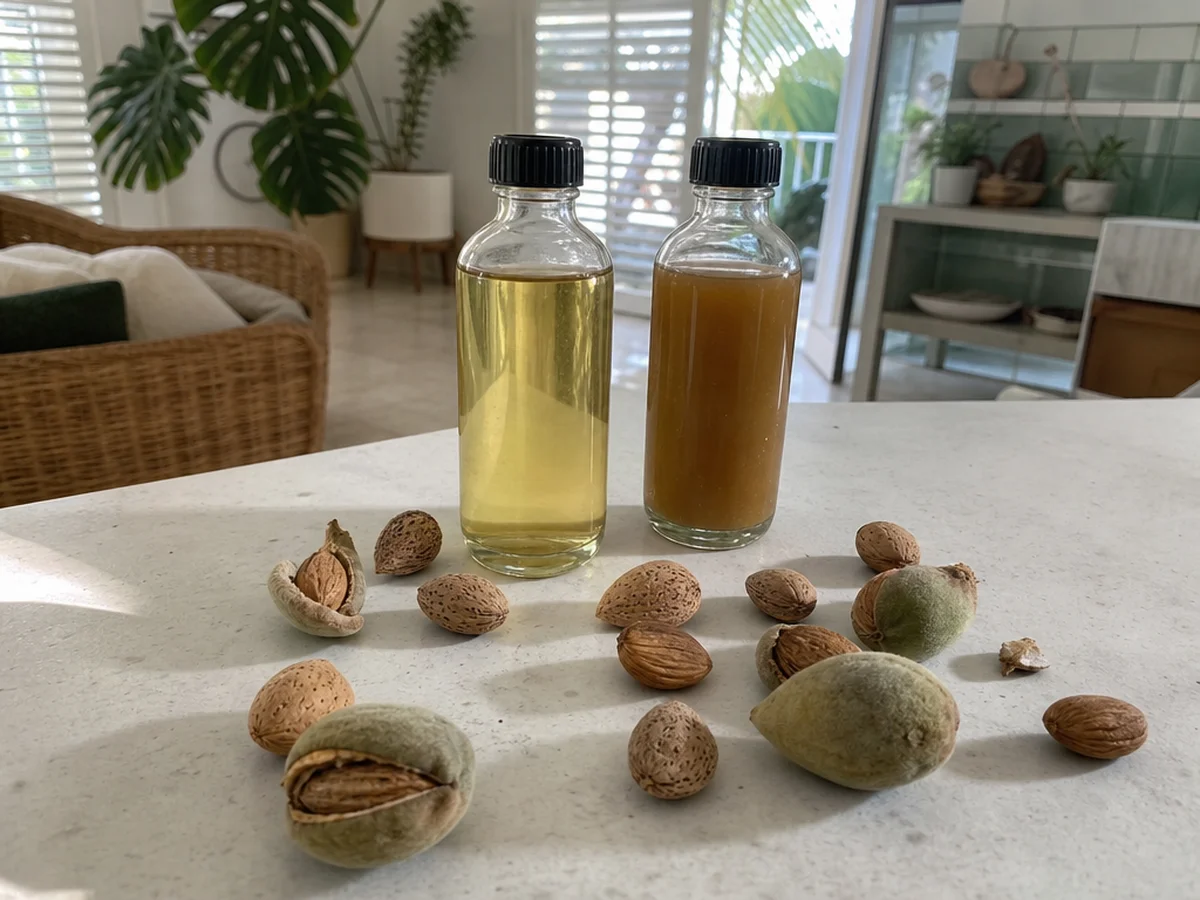
The Certificate of Analysis we publish for one batch of our oil gives a relative density of 0.918 at 20 C, so a millilitre of that batch weighs about 0.918 g. Working from that figure, 8 oz by weight is roughly 8.3 fluid ounces, about 4 percent more oil than a bottle labelled 8 fl oz. A few percent is small, but when two offers sit close together it can be the whole difference. Convert both to grams or millilitres, then divide. Treat 0.918 as the number for that one batch rather than a promise about every bottle.
The nut is most of the cost
Almond oil starts as kernels, and a press never gets every drop out of them. In a 2021 Spanish study, a screw press averaged 49 percent oil from the kernel and a hydraulic press about 38 percent. Reading those as shares of kernel weight, which is our own arithmetic, a kilogram of oil takes roughly 2 to 2.6 kilograms of almonds. So the oil's cost tracks the nut far more than the packaging, and a very low price for a large amount of oil deserves a question about what is in it.
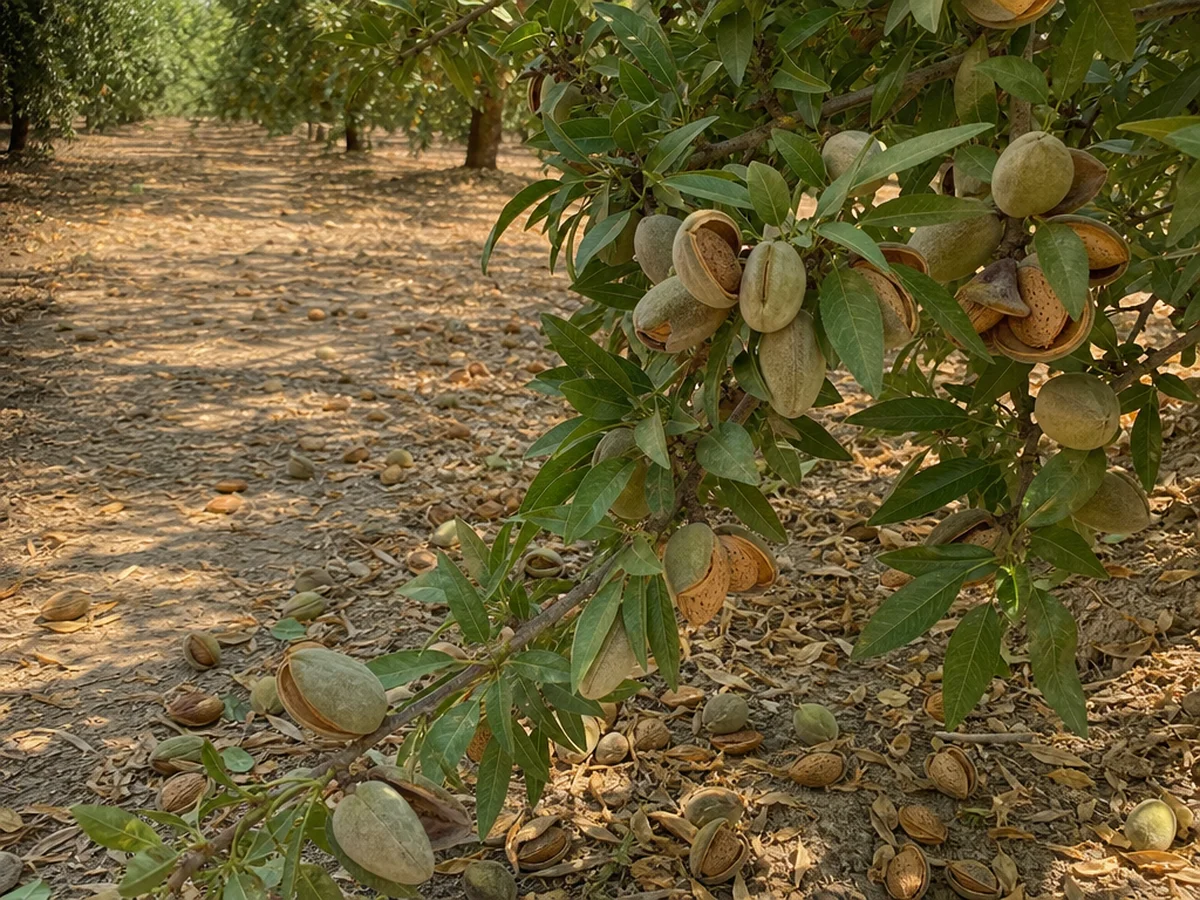
Pressing is also where a familiar phrase gets slippery. That same study ran its screw press anywhere from 50 to 200 C and noted that a screw press is generally counted as cold-pressing even when it is heated for a better yield. "Cold-pressed" on a label does not name a temperature. Ours is pressed by us with the press held below 40 C (104 F), and that is a fair thing to ask any seller to put a number on. If you are curious how the oil gets from orchard to bottle, our walk through the process covers it.
Price cannot stand in for quality
It is tempting to read a high price as a good oil and a low one as a poor oil. The one market survey we know of points the other way: a Turkish team bought 17 almond oils from pharmacies, herbal shops, online sellers and cosmetics stores and checked them against the European Pharmacopoeia almond oil monograph. Only two of the 17 complied. The study did not link results to price, so it cannot tell you a dearer oil passes. What it does show is that the label alone did not predict the contents.
So ask for paperwork. The certificate on our site covers one batch and lists density, refractive index and optical rotation. If peroxide value, free fatty acids or a fatty-acid profile matter to you, write to us through the contact page before you buy and ask for the lot paperwork. It is a fair question for any seller, and our guide to refined and unrefined almond oil explains why the wording on the bottle matters too.
A notebook habit helps. When you compare two bottles, write down the net amount, the unit, the pressing or best-by date and what the seller will put in writing. Five minutes of this beats an afternoon of second-guessing, and it lets the cheaper-looking bottle win or lose on facts.
Size the bottle to your year
Bigger containers usually cost less per millilitre, and that is where a comparison can mislead. Our oil keeps about a year from pressing when stored cool and dark. Oils drift with time: when researchers stored cold-pressed almond, walnut and pistachio oils for up to 16 months, peroxide values rose in every condition and rose faster at room temperature than in the fridge.
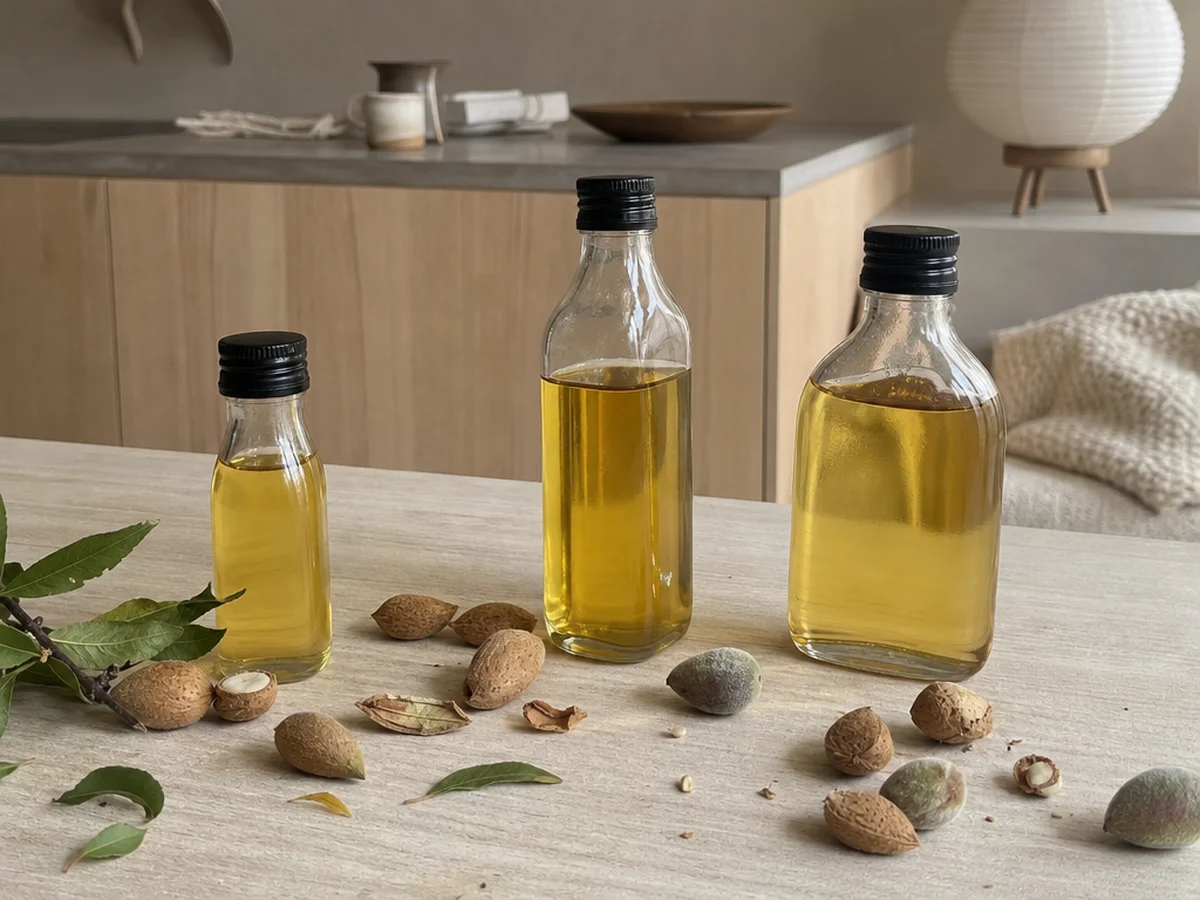
Here is the arithmetic. A teaspoon a day is about 1,800 ml over a year, around 61 fluid ounces. A 25 lb container holds roughly 12 litres at that density, which is nearly seven years of teaspoons. A saving on a container you cannot finish while the oil is fresh is not a saving. For soap making, formulating or a studio that really does go through litres, our bulk page and wholesale page are the place to start, and a small sample bottle is a cheap way to confirm the oil suits your use before ordering a drum. Our storage guide covers keeping what you buy.
One note that outranks any price: almond is a tree nut. Our oil is unrefined, so trace almond protein is present, and anyone with a tree nut allergy should not use it. An allergist writing for the American Academy of Allergy, Asthma and Immunology explains that unrefined cold-pressed nut oils keep their protein. Our oil is also for external cosmetic use only, so it never belongs in a price comparison with food-grade almond oil.
The cheapest almond oil is the one you finish while it is still fresh, in the unit you actually measured.
Sweet Almond Oil
Sweet Almond Oil from our own shop, in sizes from 0.5 oz to bulk.
From $9.99
Shop Now →Sources & Further Reading
- Cornell Legal Information Institute. 21 CFR § 701.13 - Declaration of net quantity of contents. law.cornell.edu
- Roncero JM et al., 2021. Influence of Pressure Extraction Systems on the Performance, Quality and Composition of Virgin Almond Oil and Defatted Flours. Foods 10(5):1049. PMC8151718
- Berkkan A et al., 2022. Evaluation of Marketed Almond Oils [Prunus dulcis (Mill.) D.A. Webb] in Terms of European Pharmacopoeia Criteria. Turk J Pharm Sci 19:322-329. PMC9254091
- Rabadan A et al., 2018. Storage stability and composition changes of three cold-pressed nut oils under refrigeration and room temperature conditions. Food Chem 259:31-35. PubMed 29680059
- Pongracic J, American Academy of Allergy, Asthma and Immunology. Food allergy: nut oils in topical products. aaaai.org