Rosemary Almond Scalp Oil: How to Mix It Safely
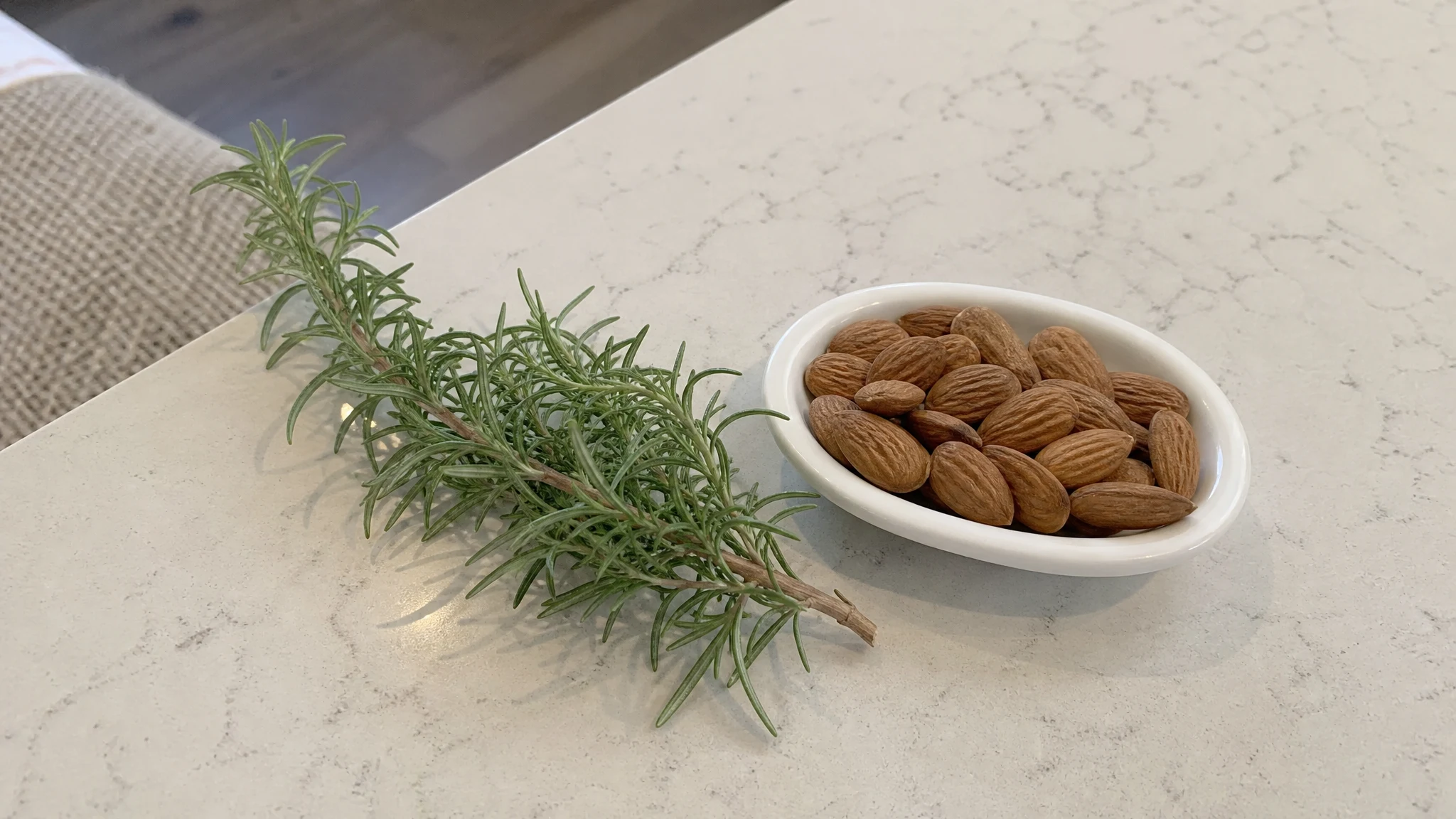
Rosemary and almond oil is a natural kitchen-counter pairing: the clear, herbal, camphor-bright aroma of rosemary on top of a soft, faintly nutty base. Used on the scalp and hair ends, it makes a fragrant conditioning oil for a pre-shampoo ritual. Here is how to mix one sensibly, with the numbers done for you.
What each ingredient does in the bottle
Almond oil is the carrier: it dilutes the essential oil so it can go on skin, spreads evenly, and gives hair a soft, smooth feel. Rosemary essential oil is the aroma, and it is concentrated, which is why the amount matters far more than the number of drops you happen to like. We sell the almond oil, which is cold-pressed and sold unrefined, with nothing added. Rosemary essential oil comes from an aromatherapy supplier, ideally one who prints the botanical name (Salvia rosmarinus) on the bottle.
Because you may have read bold claims about rosemary oil and thinning hair, a quick word on that: a scented conditioning oil is a pleasant ritual, and we do not claim that this one changes how much hair you have. If thinning is on your mind, the American Academy of Dermatology says a board-certified dermatologist can work out the cause, sometimes with a blood test or a scalp biopsy, because the answer differs from person to person (Hair loss: Diagnosis and treatment). That is a good conversation to have before experimenting.
Setting up your mixing space
Before you open any bottle, clear a small, clean table and lay out everything you need: a scale, a dry amber bottle, a funnel if you have one, a label and a pen. Wash and dry your hands. A tidy setup means you can weigh the rosemary calmly rather than racing against dripping fingers, and you will not knock over a tiny, strongly scented bottle.
Choosing a percentage
The Tisserand Institute lists 0.2 to 1% for sensitive or impaired skin, 0.5 to 1.2% for facial cosmetics and 1 to 3% for body oils and lotions (Dilution for essential oils). It gives no scalp-specific figure. Our reasoning is that a leave-on scalp oil is closer in spirit to a facial product than to a body oil, so we would begin in the lower rows and let the aroma tell you whether it is enough. Rosemary is strongly scented, and a little goes a long way.
| Rosemary share (by weight) | With 30 g almond oil | With 50 g almond oil |
|---|---|---|
| 0.5% | 0.15 g | 0.25 g |
| 1% | 0.30 g | 0.50 g |
| 1.2% (top of the facial range) | 0.36 g | 0.60 g |
These amounts are tiny, so a scale that reads to 0.01 g helps. The Tisserand page calls drop conversions approximate, because no two drops are quite the same, so we prefer weighing to counting. For volume, at the relative density of 0.918 at 20 C on the Certificate of Analysis for one batch of our oil, 30 g is about 32.7 ml and 50 g about 54.5 ml. These tables are our arithmetic from published ranges, and for any specific rosemary oil your supplier's safety data sheet is worth reading too.
Know your rosemary
Rosemary oil is potent stuff. In a 2025 opinion on rosemary oil as an animal feed additive, EFSA's panel said that for people handling it, the oil should be considered an irritant to skin and eyes and a dermal and respiratory sensitizer (Safety and efficacy of a feed additive consisting of an essential oil derived from the flowering aerial parts of Salvia rosmarinus Spenn. (rosemary oil) for use in all animal species (FEFANA asbl)). That opinion concerns feed handling and is not a cosmetic limit, but it is a good reason to keep the concentration low and to patch test.
Mixing and testing
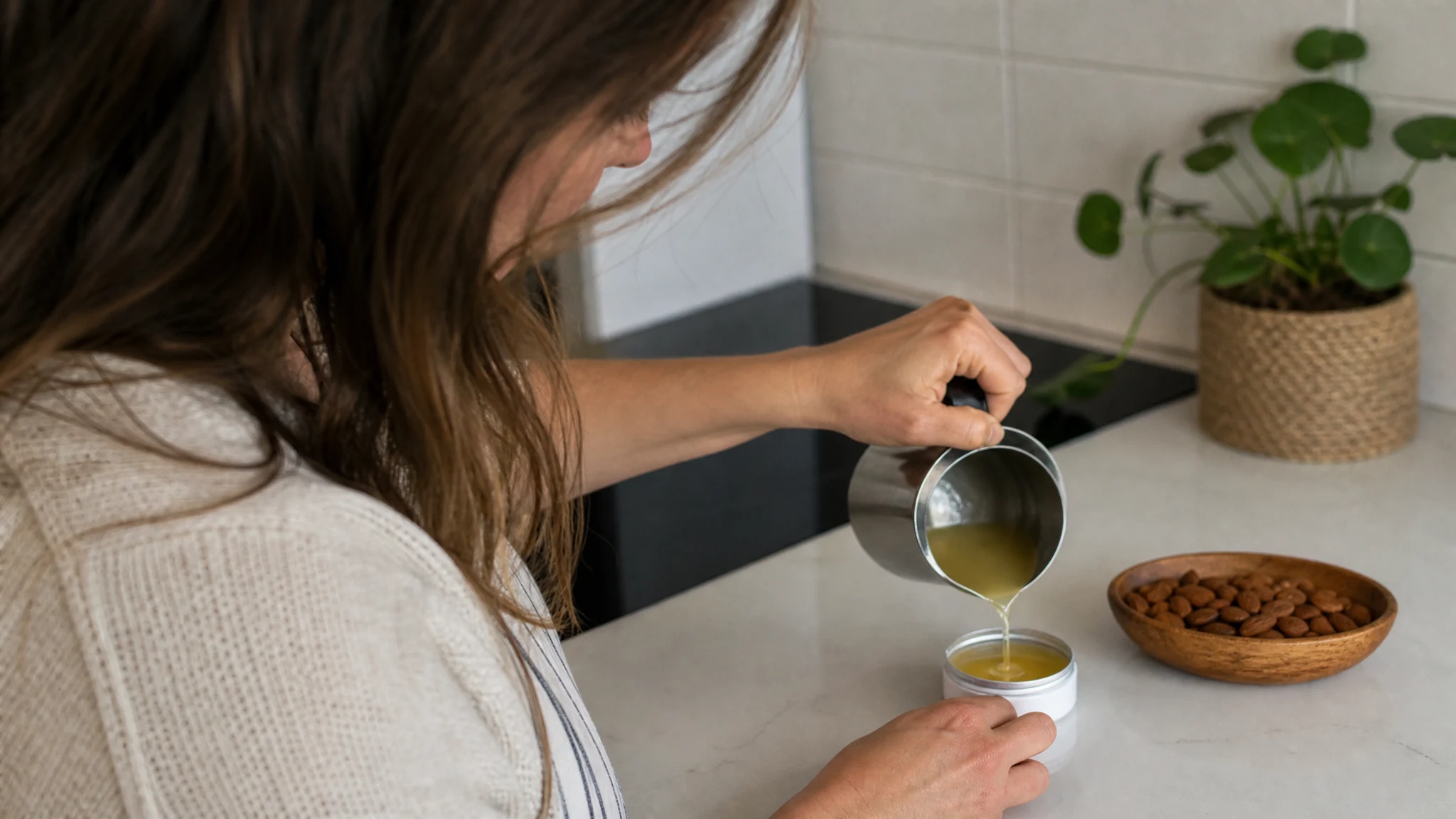
- Weigh the almond oil into a clean, dry amber bottle and add the rosemary oil. There is no water in this blend, which keeps it simple.
- Cap and roll the bottle gently. Label it with the ingredients, the percentage and the date.
- Patch test. The American Academy of Dermatology describes a quarter-sized spot where the product will not rub off, the normal amount, twice daily for seven to ten days, stopping if the skin turns red, itchy or swollen (How to test skin care products). Our patch test guide applies it to almond oil.
- Keep it clean. Pour rather than dipping fingers in, and store it cool and dark. Our oil keeps about a year from pressing, and a small blend is best used within a few months.
Using it, and what you will notice
When the blend is ready, open the bottle and smell it before you use it. You should get the green, herbal brightness of rosemary sitting on top of almond oil's soft, nutty sweetness, and if the rosemary shouts, you have probably used too much, so make the next batch lighter. Warm a few drops between your palms, work them through your hair ends or onto the scalp with your fingertips, and then give the oil time to be a pleasant ritual. Wash it out with your usual shampoo, and be aware that oil on a pillowcase or towel will leave a mark, so put an old towel over your shoulders as you work.
Who should skip it
Almond is a tree nut, and our oil is unrefined, so we ask anyone with a tree nut allergy not to use it (see our nut allergy article). If you are pregnant or breastfeeding, or the oil is for a child, ask your obstetrician, midwife or pediatrician before using any essential oil.
If you simply want to enjoy almond oil on the scalp without any essential oil, our scalp massage routine is a gentle place to begin, and our dilution ratios guide covers other blends.
Start low, weigh carefully, and let the clean, herbal scent of rosemary do what a good aroma does.

Sweet Almond Oil
Sweet Almond Oil from our own shop, in sizes from 0.5 oz to bulk.
From $9.99
Shop Now →Sources & Further Reading
- American Academy of Dermatology, Hair loss: Diagnosis and treatment
- Tisserand Institute, Dilution for essential oils
- EFSA FEEDAP Panel, Safety and efficacy of a feed additive consisting of an essential oil derived from the flowering aerial parts of Salvia rosmarinus Spenn. (rosemary oil) for use in all animal species (FEFANA asbl), EFSA J, 2025
- American Academy of Dermatology, How to test skin care products