Does Almond Oil Go Bad? How to Tell and What to Do
Almond oil does go bad, though never on a set day, and the first stage has no smell at all. By the time a bottle smells wrong it has usually been changing for a while. So the useful question is how to read the signs early, and what a clearly turned bottle should do next.
What "bad" means for a plant oil
Almond oil is mostly unsaturated fat, and unsaturated fats react with oxygen. A 2025 review of vegetable oil oxidation gives the pecking order: the fatty acids with more double bonds oxidize far faster, with linoleic acid reacting roughly ten times as fast as oleic acid in the review's rate table. Almond oil is mostly oleic, with a smaller share of linoleic, and that is one reason it keeps better than some oils and worse than others. Heat, light and air speed the process up, and a cold-pressed oil that has not been refined or stripped of its natural compounds keeps what it came with, including the vitamin E that slows things down.
Chemists track the early stage with the peroxide value, the first products of oxidation, and the later stage with the acid value, a measure of free fatty acids that rises as the oil breaks down. A Turkish pharmacy-oil study describes a rising acid value as a sign of falling oxidative stability and an oil becoming rancid. The European Pharmacopoeia sets almond oil limits of 15.0 for peroxide value and 2.0 for acid value.
How a fresh oil measures up
Fresh, cold-pressed almond oil sits well under those limits. In a study of cold-pressed oils from three Turkish almond cultivars, peroxide values were between 3.27 and 4.11 meq O2/kg. That is the baseline of a good oil on a good day.
Retail shelves tell a different story. When researchers in Ankara bought 17 almond oils from pharmacies, herbal shops, online sellers and cosmetics stores, only two met the pharmacopoeia criteria. Four had acid values above 2.0, between 3.30 and 9.18, and two had peroxide values above 15.0 (17.30 and 19.59). A few were off in color too, pale green or dark yellow. The study did not set out to say why. Age, storage and processing are all candidates, which is a good reason to care about the date on the bottle.
What the clock looks like
A 16-month study of cold-pressed almond, walnut and pistachio oils stored at several temperatures found that peroxide values rose faster at room temperature than in cooler conditions, and that the resistance of all three oils to oxidation fell as storage went on, wherever they were kept. Almond oil came out second to pistachio. So cooler is slower, and nothing stops the clock.
That is why we count about a year from pressing, kept cool and dark. Each of our bottles carries a pressing date, a bottling date and a lot number, and we would rather you go by those dates than by your nose. If you want peroxide value or free fatty acid figures for a particular lot, write to us through the contact page and ask for that lot's paperwork before you rely on it.
Judging a bottle at home
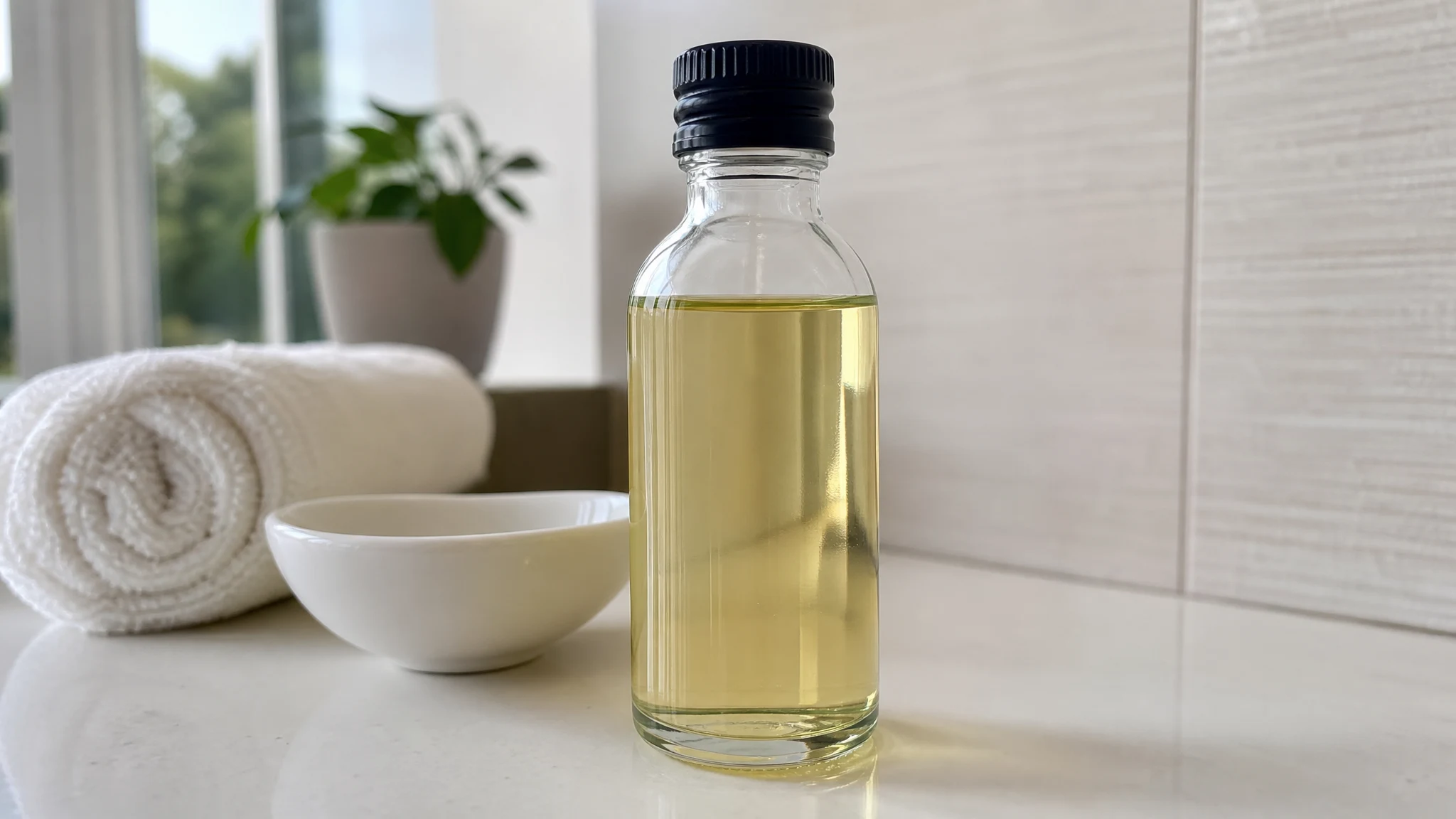
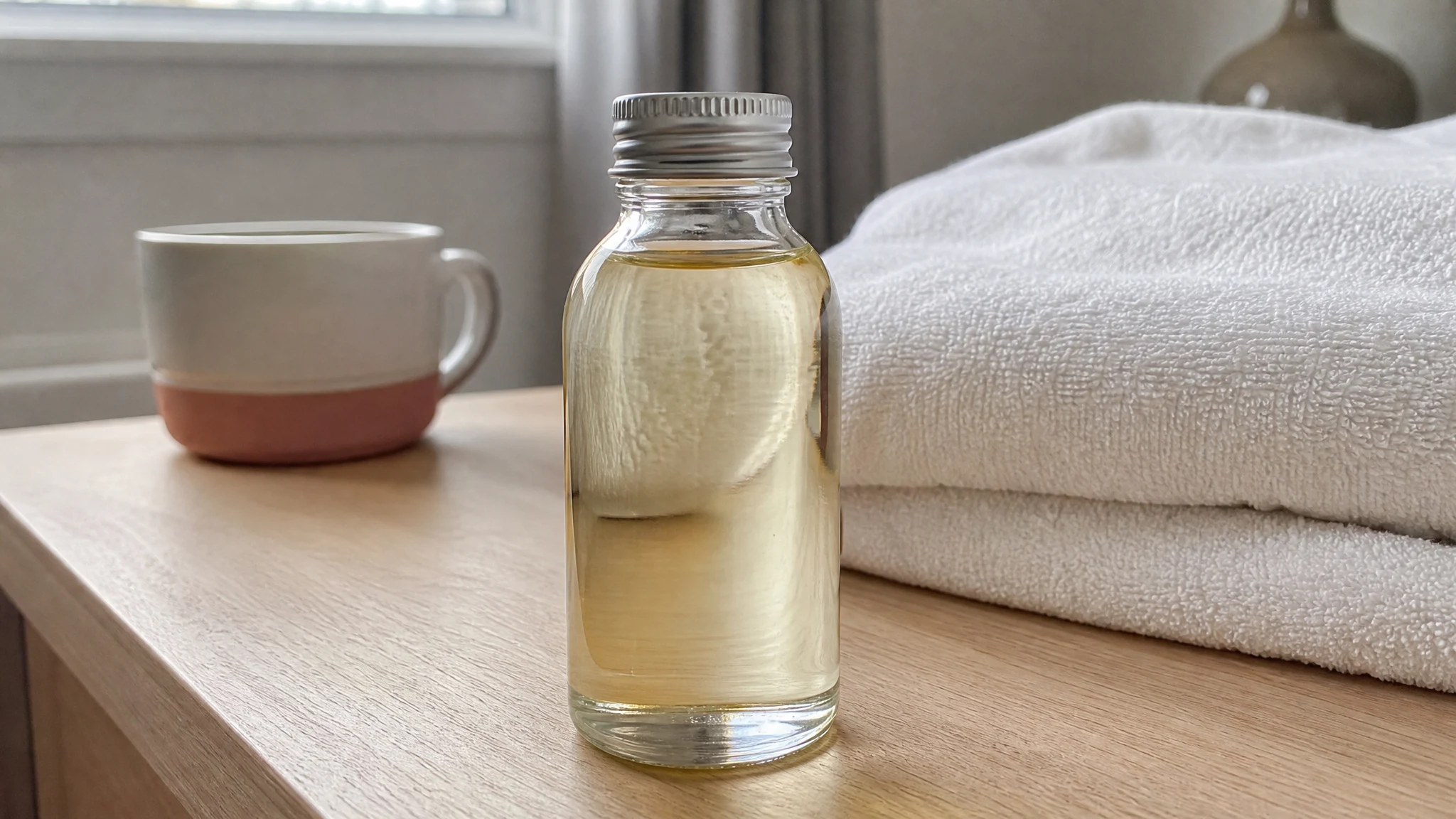
You cannot measure a peroxide value in a bathroom, but you can trust a few signals. Fresh almond oil smells soft and faintly nutty, runs smoothly, and is clear and pale gold. A bottle that has turned may smell sharp, stale or like old paint, feel heavier or stickier on your fingers, look cloudy, or leave a tacky film after the rest has absorbed. Any one of those is enough to retire it. A clean smell is no proof of freshness, so the date matters most when a bottle has had a warm shelf or a sunny window. Our guide to storing almond oil covers the habits that slow the clock, and our comparison of grapeseed and almond oil shows how each ages.
What to do with a bottle that has turned
Do not use it on skin, and do not cook with it. We do not sell our oil for eating anyway, and an oil that has turned is no candidate for the kitchen. Soak it up with a paper towel, seal it in a bag and put it in the household trash. Rinse the glass with hot soapy water before recycling it if your area takes it.
If a bottle is only a little past its date and still smells right, the choice is yours, but when in doubt, a fresh bottle costs little next to the irritation from a bad one. If you have a tree nut allergy, our almond oil and nut allergy post explains why almond oil is not for you at any age.
The easy habit is to write the opening date on the bottle and use the oil within its year. That way a bottle gets finished while it still smells like almonds.

Sweet Almond Oil
Sweet Almond Oil from our own shop, in sizes from 0.5 oz to bulk.
From $9.99
Shop Now →Sources & Further Reading
- Gharby S et al. Vegetable oil oxidation: Mechanisms, impacts on quality, and approaches to enhance shelf life. Food Chem X, 2025
- Berkkan A et al. Evaluation of Marketed Almond Oils [Prunus dulcis (Mill.) D.A. Webb] in Terms of European Pharmacopoeia Criteria. Turk J Pharm Sci, 2022
- Rabadan A et al. Storage stability and composition changes of three cold-pressed nut oils under refrigeration and room temperature conditions. Food Chem, 2018
- Ozcan MM et al. Characterization of physico-chemical and bioactive properties of oils of some important almond cultivars by cold press and soxhlet extraction. J Food Sci Technol, 2020